A low melting point doesn’t automatically mean good bonding.
That’s the part most spec sheets leave out.
Low melt fiber is one of the most useful materials in nonwoven and thermal-bonding production. But “it melts at a lower temperature” only tells you part of the story. Whether it actually bonds well in your product depends on your equipment, your blend, your web thickness, and how you validate it before running a full order.
If you’re sourcing filling, wadding, mattress layers, automotive interiors, or technical nonwovens, you’ve run into this material already. Here’s what it actually is, how thermal bonding really works, and — the part most guides skip — how to validate it before you commit to bulk production.
What Is Low Melt Fiber?
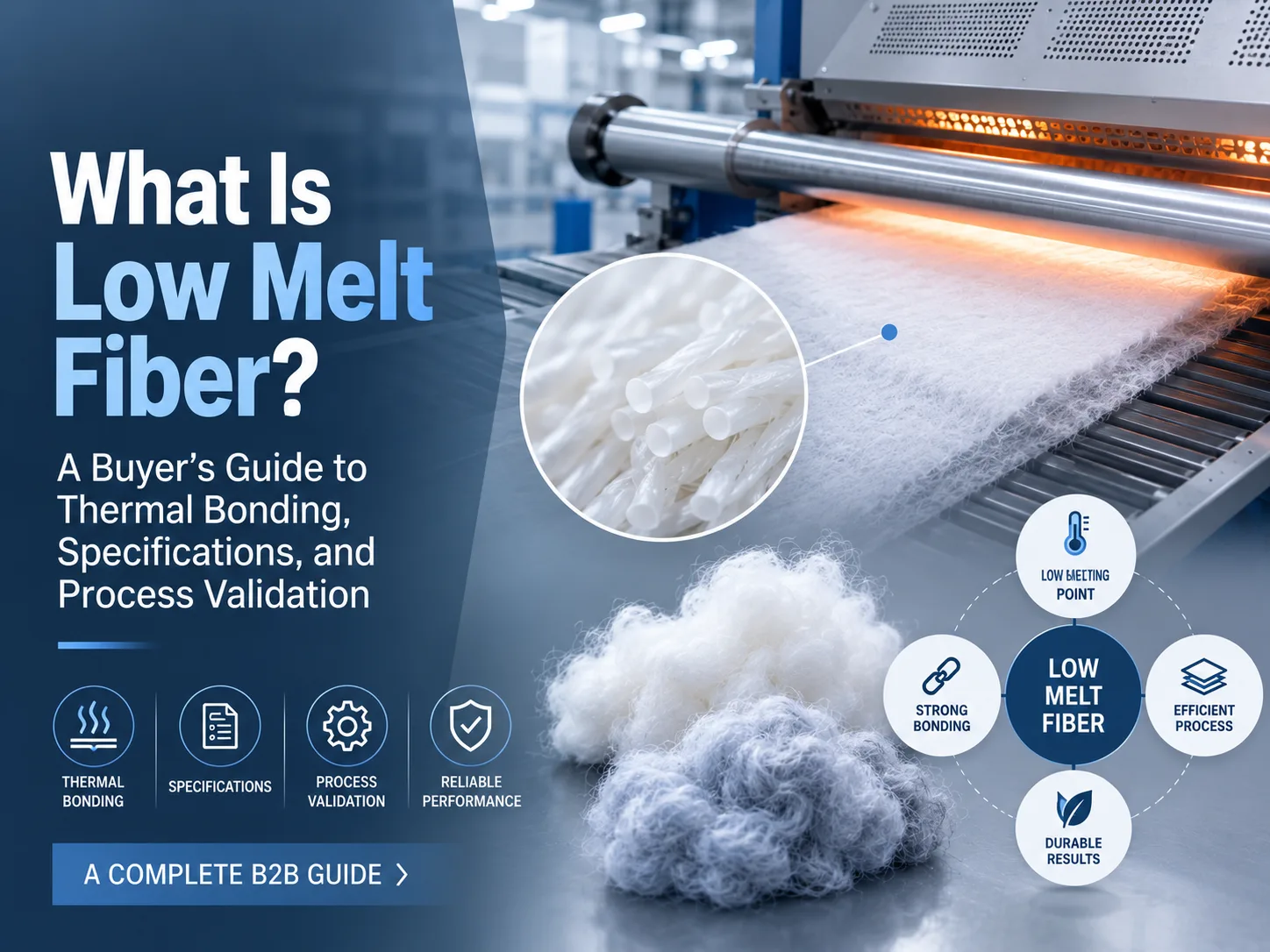
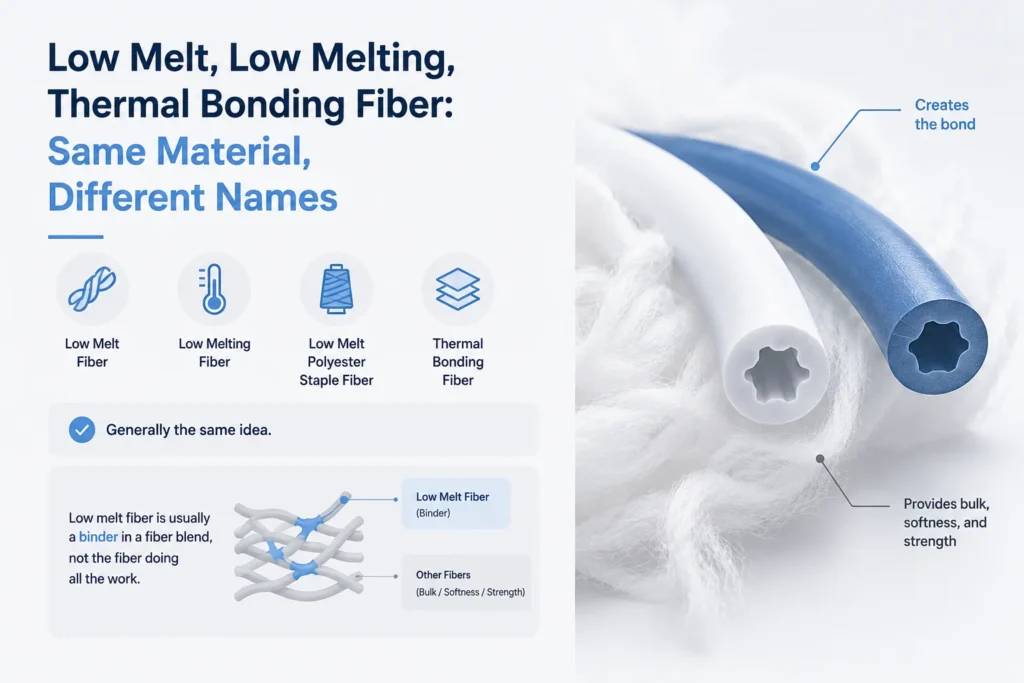
Low melt fiber is a thermally activated bonding fiber, usually made with a lower-melting sheath and a higher-melting core. Under controlled heat, the sheath softens and bonds nearby fibers at their contact points. The core holds the structure together after cooling.
Low Melt, Low Melting, Thermal Bonding Fiber: Same Material, Different Names
You’ll see this called a few things. Low melt fiber. Low melting fiber. Low melt polyester staple fiber. Thermal bonding fiber. Generally the same idea.
Here’s the part worth understanding early: low melt fiber is usually a binder inside a fiber blend, not the fiber doing all the work. It creates the bond. Something else in the structure is usually responsible for the bulk, softness, or strength.
How Sheath-Core Low Melt Polyester Fiber Actually Works
Most low melt polyester fiber uses a sheath-core structure. The outer layer, the sheath, has a lower melting point than the inner core. Apply heat, and the sheath softens and flows slightly at fiber-to-fiber contact points. As the material cools, those points solidify into bonds. The core keeps its shape and keeps providing structural support the whole time.
Low Melt Fiber vs. Standard Polyester Staple Fiber
| Factor | Low Melt Fiber | Standard Polyester Staple Fiber |
|---|---|---|
| Main role | Thermal bonding and layer stabilization | Bulk, loft, strength, filling, spinning, or web structure |
| Heat response | Designed to activate within a specified bonding range | Usually remains stable under low melt bonding conditions |
| Buyer focus | Bonding grade, processing window, blend compatibility | Denier, cut length, crimp, mechanical and end-use performance |
For a broader look at how polyester staple fiber types are structured and specified, see our guide to polyester staple fiber types and specifications.
How Thermal Bonding Works
The Four-Step Process
- Form or blend the fiber web.
- Apply controlled heat.
- The sheath softens and bonds at fiber contact points.
- The material cools and the structure stabilizes.
Simple in concept. The details are where it gets interesting.
Through-Air vs. Calender Bonding
| Process | Typical Result | More Relevant When |
|---|---|---|
| Through-air bonding | Softer, loftier, more open structure | Wadding, insulation, comfort layers |
| Calender bonding | Flatter, denser, more structured material | Interlining, stiff components, structured nonwovens |
Which one you use depends heavily on what the finished product needs to feel like. Which brings us to something that gets glossed over constantly.
Why the Nominal Melt Point Isn't Your Oven Setting
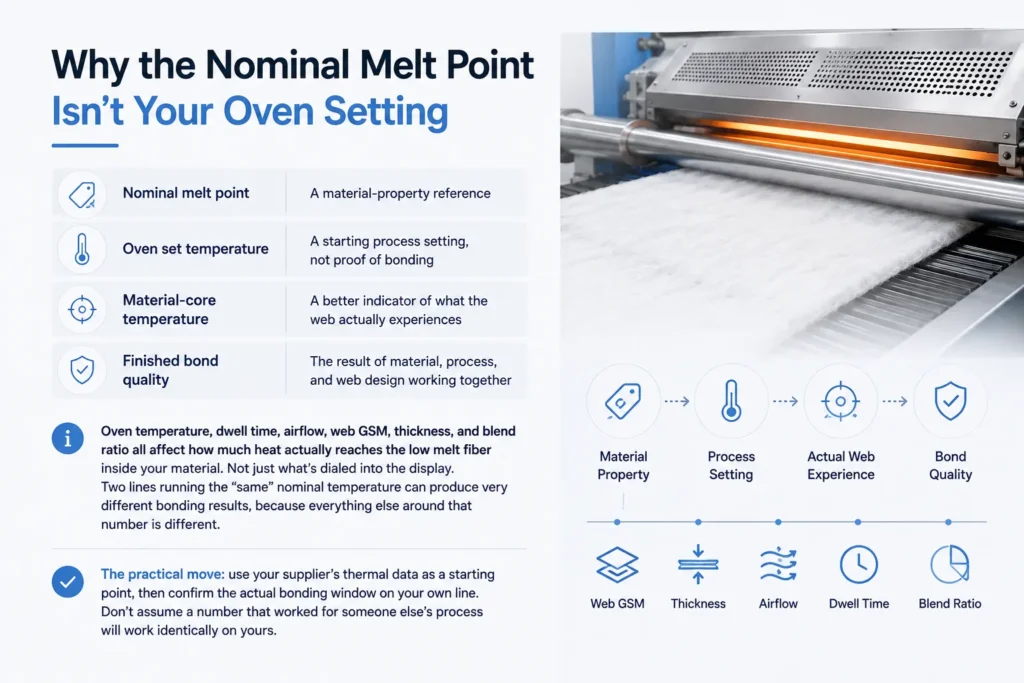
A low melt fiber’s nominal sheath melting point is a material property.
Your oven setting is a process parameter.
Related. Not the same thing. Treating them as interchangeable is where a lot of bonding problems start.
| What You See | What It Actually Tells You |
|---|---|
| Nominal melt point | A material-property reference |
| Oven set temperature | A starting process setting, not proof of bonding |
| Material-core temperature | A better indicator of what the web actually experiences |
| Finished bond quality | The result of material, process, and web design working together |
Here’s why this matters: oven temperature, dwell time, airflow, web GSM, thickness, and blend ratio all affect how much heat actually reaches the low melt fiber inside your material. Not just what’s dialed into the display. Two lines running the “same” nominal temperature can produce very different bonding results, because everything else around that number is different.
The practical move: use your supplier’s thermal data as a starting point, then confirm the actual bonding window on your own line. Don’t assume a number that worked for someone else’s process will work identically on yours.
Common Applications of Low Melt Fiber
Wadding and Thermal Insulation
Insulation layers and thermal wadding, where low melt fiber holds the structure together while a structural fiber provides most of the loft and warmth.
Mattresses, Quilts, and Home Textile Padding
Comfort layers and quilted padding often rely on low melt fiber to stabilize the layer after bonding. Compression behavior and recovery mostly come from the structural fiber.
Automotive Interiors and Acoustic Materials
Interior trim and acoustic pads use low melt fiber for bond stability. Still needs validation against project-specific performance and compliance requirements.
Nonwovens, Filtration, and Technical Products
In technical nonwovens and filtration media, low melt fiber contributes bond integrity without compromising the functional performance the structural fiber is there to deliver.
Start With the Finished Product, Not the Low Melt Grade
Here’s a mistake we see constantly: buyers pick a low melt fiber grade first, then try to figure out what to blend it with.
Works better in reverse.
Low melt fiber often creates the bond. The structural fiber largely defines the loft, bulk, softness, or technical function of the finished material.
| Finished-Product Goal | Structural Fiber Priority | Low Melt Fiber Priority | What to Validate |
|---|---|---|---|
| Soft thermal wadding | Loft and insulation | Bonding without excess stiffness | Thickness, loft recovery, hand feel |
| Mattress comfort layer | Compression behavior | Layer stability | Compression set, density, durability |
| Structured nonwoven | Web integrity and dimensional stability | Reliable bonding response | Bond distribution and stiffness |
| Automotive acoustic pad | Acoustic structure and compliance | Bond stability | Project-specific performance |
| Filter or technical web | Functional web structure | Bond integrity | Performance after bonding |
Need both loft and thermal stability? That combination usually points toward pairing low melt fiber with hollow conjugated fiber for filling and loft rather than expecting one fiber to do both jobs. If recycled content is part of your sourcing brief, our recycled polyester staple fiber buyer’s guide covers what to confirm before working recycled material into the blend.
How to Choose Low Melt Fiber
Confirm the Polymer System and Bonding Grade
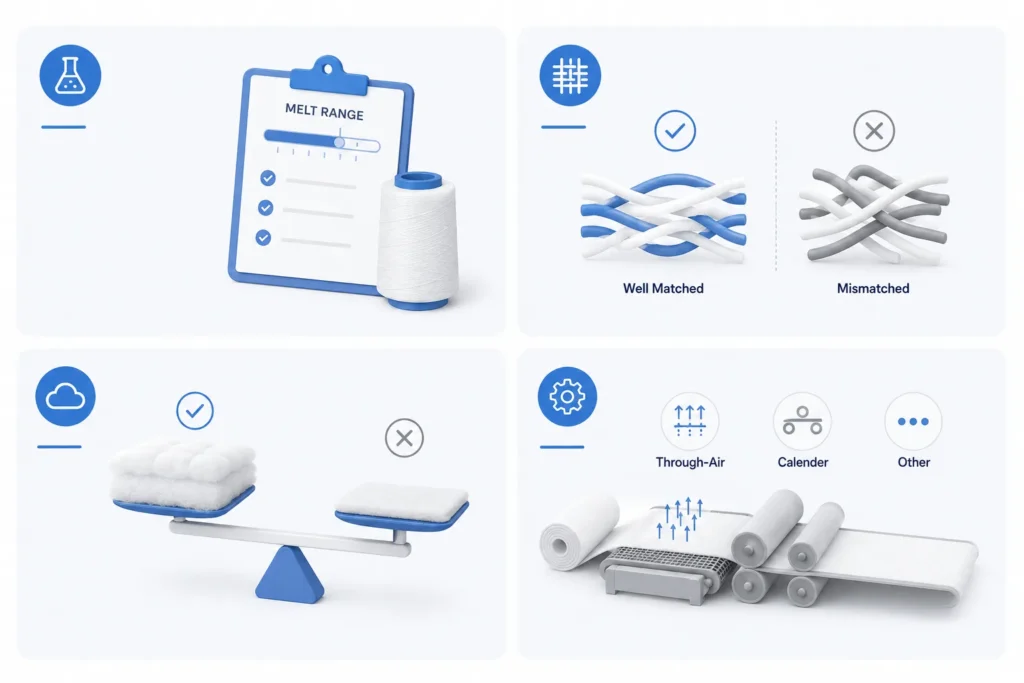
Different grades are built for different bonding ranges and applications. Start with your supplier’s technical data. Not a generic spec you found somewhere else.
Match Denier and Cut Length to the Structural Fiber
Low melt fiber needs to blend well with whatever structural fiber it’s paired with. Mismatched denier or cut length creates uneven blending and inconsistent bonding.
Define the Required Hand Feel, Loft, and Stiffness
More bonding isn’t automatically better. Over-bond a soft wadding product and you’ll lose loft, and end up with something stiffer than you wanted.
Confirm Equipment and Sample-Trial Conditions Before Ordering
Know your bonding process, through-air, calender, or something else. Plan a trial on that actual equipment before committing to volume.
A Pre-Production Validation Plan for Low Melt Fiber
Skipping this is where most bonding surprises come from.
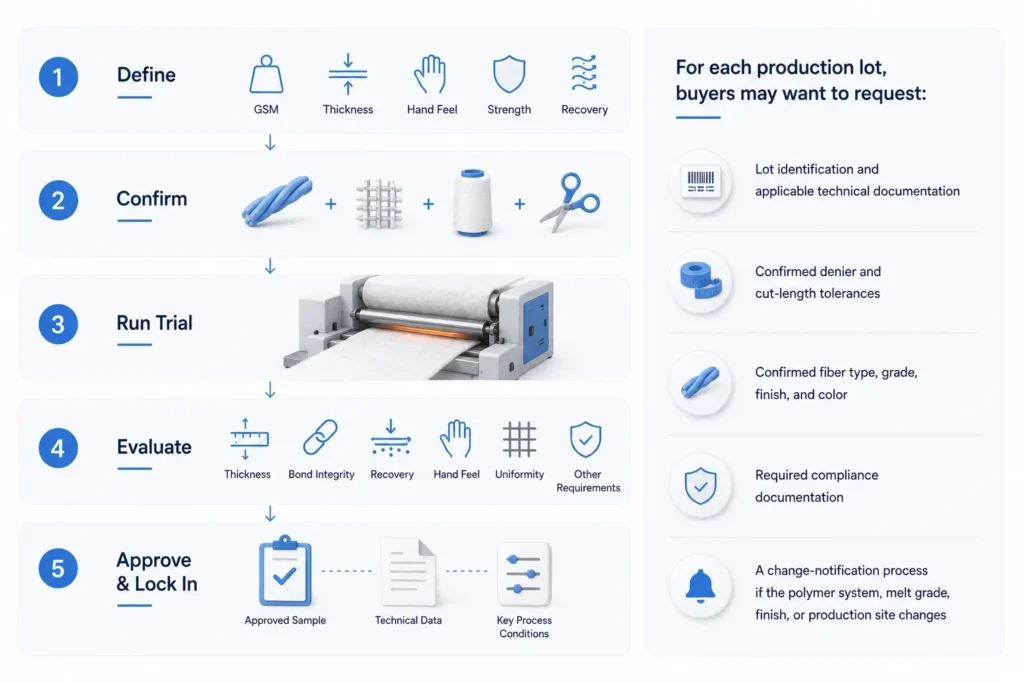
Step 1: Define the Finished-Product Target
Document target GSM, thickness, hand feel, strength, recovery, and acceptable stiffness range before requesting anything.
Step 2: Confirm the Fiber System and Initial Blend
Lock in low melt fiber grade, structural fiber, target blend ratio, denier, cut length, finish, and color.
Step 3: Run a Representative Thermal-Bonding Trial
Test on equipment as close to your actual production line as possible. Not a lab-scale approximation.
Step 4: Evaluate the Finished Material
Check thickness, bond integrity, compression recovery, hand feel, uniformity, and any project-specific requirements like odor or flame performance.
Step 5: Approve a Reference Standard for Repeat Orders
Once it passes, lock in the approved sample, technical data, and key process conditions as your benchmark. Every order after this gets checked against it.
For each production lot, buyers may want to request:
- Lot identification and applicable technical documentation
- Confirmed denier and cut-length tolerances
- Confirmed fiber type, grade, finish, and color
- Required compliance documentation
- A change-notification process if the polymer system, melt grade, finish, or production site changes
Common Bonding Problems and What to Check
| Symptom | Possible Causes to Investigate |
|---|---|
| Weak bonding | Insufficient heat exposure, unsuitable blend, uneven temperature distribution |
| Material too stiff | Excess bonding, high low melt fiber proportion, excessive heat exposure |
| Loss of loft | Over-bonding, excessive compression, structural fiber mismatch |
| Uneven structure | Uneven blending, web density variation, inconsistent airflow or pressure |
| Discoloration or distortion | Excess heat or an incompatible material/finish combination |
Starting points for investigation. Not a substitute for validating your specific fiber blend, equipment, and finished-product requirements.
What Buyers Should Confirm Before Ordering
- Low melt fiber grade and polymer structure
- Nominal bonding information and available technical data
- Denier, cut length, crimp, color, and finish
- Structural-fiber compatibility and intended blend ratio
- Equipment and process route, plus a planned trial
- Final-product acceptance criteria (thickness, strength, hand feel, recovery)
- Batch consistency, MOQ, packaging, and documentation
- Required recycled-content or certification records, if applicable
FAQ
What is low melt fiber?
A thermally activated bonding fiber, typically with a lower-melting sheath and a higher-melting core, used to bond fibers together under controlled heat in nonwoven and thermal-bonding applications.
Is low melt fiber the same as bicomponent fiber?
Many low melt polyester fibers are bicomponent (sheath-core) fibers, but confirm the exact structure and polymer combination with your supplier.
What temperature does low melt fiber bond at?
Depends on the fiber grade, polymer system, equipment, and how heat actually reaches the material, not just the nominal melt point on a datasheet. Confirm the real bonding window through a trial on your own line.
Can low melt fiber replace glue?
In suitable thermal-bonding structures, yes, it can reduce or eliminate liquid adhesives. Whether it’s a full replacement depends on the substrate, required strength, and process.
Can low melt fiber be blended with hollow conjugated fiber?
Yes. Common combination when a product needs both loft and thermal bonding stability. Confirm the final blend ratio and process through sample testing.
How much low melt fiber should be used in a blend?
No fixed ratio. Depends on your target bond strength, hand feel, thickness, structural fiber, and equipment, validated through a production trial.
Why is my thermally bonded material too stiff?
Often linked to too much low melt fiber in the blend, excessive heat exposure, or dwell time that’s too long for the target hand feel. Check the blend ratio and process conditions first.
Work With MAKEIT for Low Melt Fiber Solutions
Choosing low melt fiber isn’t about picking a lower bonding temperature.
It’s about matching the fiber grade, structural fiber, blend design, and processing conditions to what your finished material actually needs to do.
MAKEIT manufactures low melt polyester staple fiber alongside hollow conjugated, recycled, and functional fiber options, supporting nonwoven producers, home-textile and mattress manufacturers, and automotive-material converters with specification guidance, technical data, and samples for process validation.