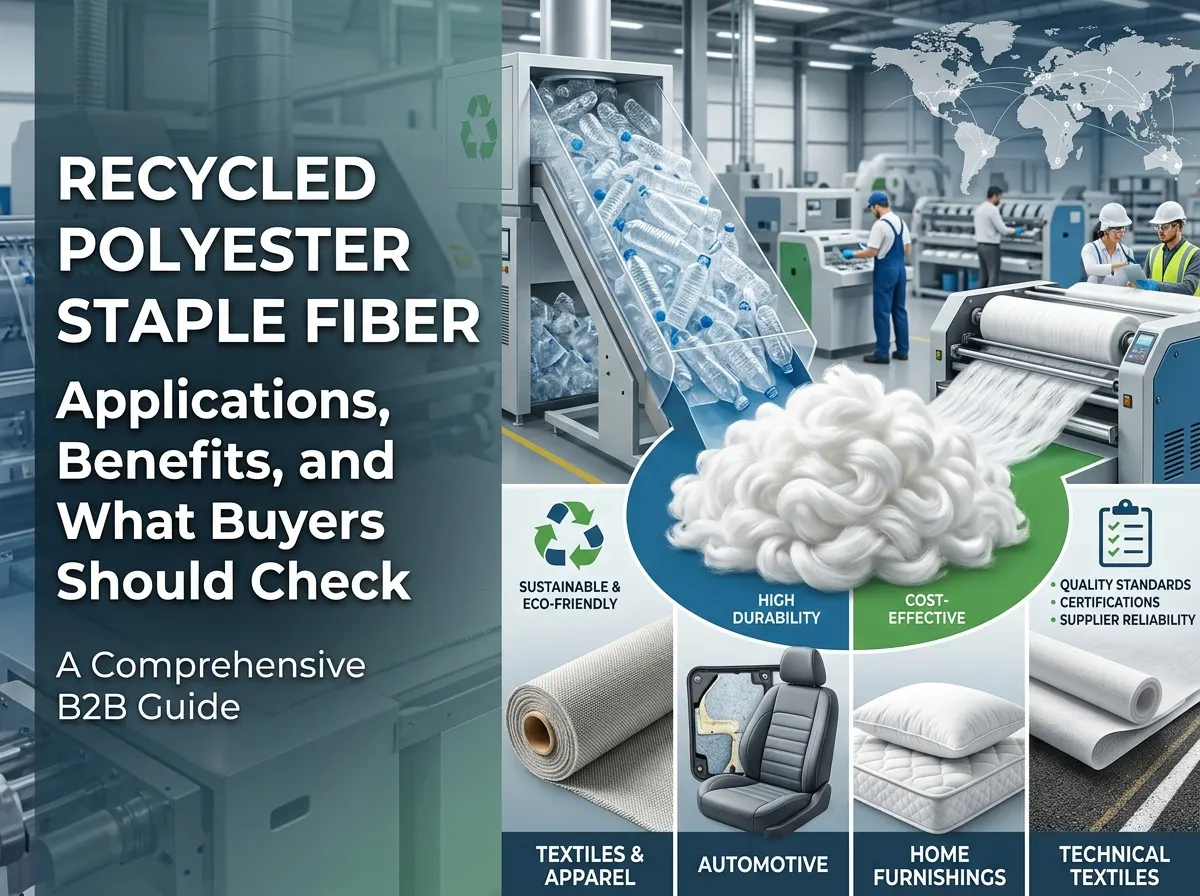
Recycled polyester staple fiber shows up in a lot of sourcing conversations these days.
And for good reason.
Whether you’re responding to a customer’s sustainability requirement, trying to hit a cost target, or just updating a product line, recycled PSF is usually one of the first materials that comes up.
But here’s the thing: “recycled polyester staple fiber” isn’t one standardized product. Specs vary a lot between suppliers. And not every recycled fiber works for every application.
In this guide, I’ll break down what recycled PSF actually is, where it performs well, how it stacks up against virgin fiber, and exactly what to check before you place an order.
Let’s dive in.
What Is Recycled Polyester Staple Fiber?
Recycled polyester staple fiber is a short-cut polyester fiber made from recycled polyester feedstock instead of newly produced polyester.
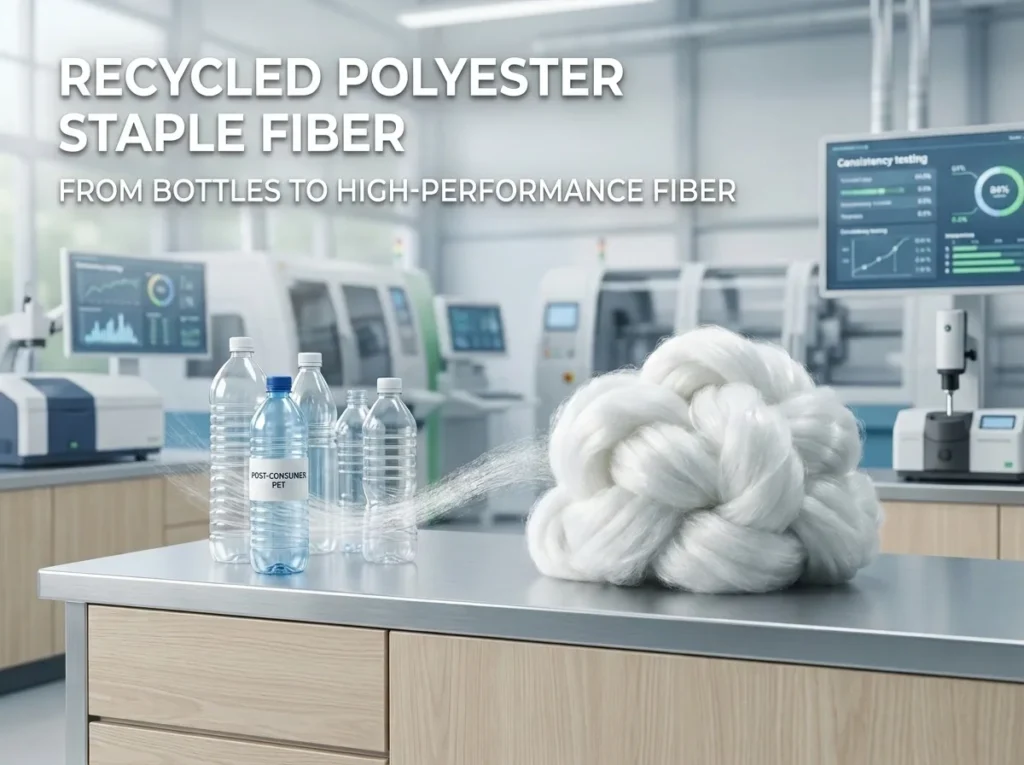
Most of it starts as recycled PET — often from post-consumer bottles. Some comes from recycled industrial polyester waste.
The manufacturing process itself doesn’t change much. The recycled material still gets melted, extruded, drawn, crimped, and cut into short lengths, just like virgin fiber.
So what actually changes? The input material. Not the process.
Here’s why that matters: “recycled” tells you where the raw material came from. It tells you nothing about denier, cut length, fiber structure, color, or how it will perform in your process.
Two recycled PSF products can look identical on a spec sheet and behave completely differently once they hit your production line.
Where Recycled PSF Gets Used
Recycled PSF shows up in more places than most buyers realize. But the right spec changes depending on the application.
1. Home Textiles and Filling
This is the biggest use case, by far.
Pillows, quilts, cushions, mattress toppers, furniture filling — all of these need fiber that holds its loft and bounces back after compression.
For these products, hollow recycled fiber usually beats solid fiber. It holds volume better over time.
2. Spinning and Textiles
Recycled PSF also gets spun into yarn for woven and knitted fabrics.
Here, the priorities flip. Loft doesn’t matter as much. Consistency does — stable denier, stable cut length, predictable carding and spinning behavior. Color consistency matters too, since variation is harder to hide in finished fabric.
3. Nonwoven Products
In nonwoven manufacturing, recycled PSF ends up in padding, insulation, and technical nonwoven materials.
The fiber needs to form a stable web and respond predictably during thermal bonding, especially when blended with a binder like low melt fiber.
4. Automotive and Technical Applications
Recycled PSF also gets used in automotive interiors and acoustic insulation.
These applications come with stricter requirements — performance consistency, odor control, sometimes flame retardancy. Testing matters more here than it does in general filling.
Here’s a quick-reference table:
| Application | Main Focus | What to Check |
|---|---|---|
| Pillows and quilts | Loft, softness, resilience | Hollow structure, denier, siliconized finish |
| Spinning and textiles | Processability, consistency | Cut length, denier, color, batch stability |
| Nonwovens | Web formation, bonding | Fiber structure, thermal process, blend compatibility |
| Automotive interiors | Stability, compliance | Performance requirements, testing, project specs |
Why Buyers Choose Recycled PSF
It Supports Recycled Content Goals
Let’s be honest — for most buyers, this is the real driver. A customer or internal policy requires a certain percentage of recycled material, and recycled PSF is one of the easiest ways to hit that number without redesigning the product.
It Works Across Multiple Product Categories
Recycled PSF isn’t a one-trick material. Depending on spec, it works for filling, spun yarn, nonwovens, and technical applications. That flexibility is a big reason it’s become a standard material across so many industries.
It Can Be Matched to Cost and Performance Targets
Here’s something worth being upfront about: recycled fiber isn’t automatically cheaper, and it isn’t automatically “more sustainable” in every scenario. It depends on the source material, the processing, and how well it fits your product.
What it does give you is another lever — a way to balance sustainability goals against performance and cost, as long as the spec is matched correctly.
Recycled vs Virgin Polyester Staple Fiber
This is probably the question I get most often: can recycled PSF just replace virgin PSF?
Sometimes, yes. Sometimes it needs spec or process adjustments. Here’s the practical breakdown:
| Factor | Recycled PSF | Virgin PSF |
|---|---|---|
| Raw material | Recycled feedstock (often PET) | Newly produced polyester |
| Sustainability angle | Supports recycled-content goals | Better for max raw-material consistency |
| Spec control | Depends on feedstock quality | Generally more predictable batch-to-batch |
| Typical uses | Filling, textiles, nonwovens, industrial | Similar range |
| What to focus on | Recycled content, traceability, certification | Spec accuracy, performance testing |
Bottom line: neither one is universally “better.” The right choice depends on your end product, your process, your performance needs, and whether recycled content is actually a requirement — not just a nice-to-have.
How Recycled PSF Performs in Your Actual Process
Here’s something a lot of guides skip: a datasheet can tell you a lot, but it can’t tell you everything.
Even when the numbers look right on paper, recycled fiber can behave differently once it’s running through your equipment.
The Datasheet Is a Starting Point — Not a Decision
Denier, cut length, structure — these numbers narrow down your options. But how a fiber opens, cards, spins, or bonds depends on more than what’s printed on a spec sheet. This is especially true with recycled fiber, where feedstock consistency tends to vary more than with virgin material.
Run a Trial That Matches Your Application
Before you commit to a bulk order, test it the way you’ll actually use it:
| Application | What to Test |
|---|---|
| Filling | Loft, hand feel, resilience, fiber opening |
| Spinning | Carding behavior, evenness, yarn appearance |
| Nonwoven | Web formation, bonding response, blend compatibility |
| Automotive/technical | Project-specific performance and compliance |
Lock In a Reference Sample
Once a sample checks out, approve it as your reference point — either internally or with your supplier. For repeat orders, use that reference to set incoming inspection criteria. This catches batch drift early, instead of after you’ve already run production.
What to Check Before You Order
1.Recycled Content and Source
Ask exactly where the recycled material comes from and what percentage is actually recycled. If your project needs a specific type — post-consumer PET, for example — say so. Don’t accept a vague “recycled” label.
2. Certification and Documentation
If your project requires GRS or a similar standard, confirm the certification is current and actually covers the product and production line you’re buying from. If your market needs OEKO-TEX or ISO-based documentation, ask which papers apply to your specific order.
3. Core Specifications
At minimum: denier, cut length, structure (solid or hollow), color, crimp, and whether it’s siliconized. For technical applications, ask about tenacity, elongation, and thermal behavior.
4. Sample Testing
Test before you buy in bulk. Run the sample under conditions close to your real process. This one step catches most compatibility issues before they get expensive.
5. Supply Consistency
Ask about MOQ, lead times, packaging, and whether the supplier can hold the same spec across repeat orders. For ongoing programs, this matters more than the price on a single PO.
How to Actually Verify Recycled Content Claims
This part gets skipped a lot, and it shouldn’t.
Ask What the Claim Actually Means
“Recycled material available” is not the same as a specific, verifiable percentage. Ask what type of recycled input is used, what percentage it represents, and whether that number holds steady across batches.
Check the Certification Scope
A supplier holding GRS certification doesn’t mean every product they sell is automatically covered. Ask if the certification applies to your specific product and order — and ask for the transaction documentation to prove it.
Match Your Claims to Your Paperwork
If you’re planning to market your finished product with recycled-content language, make sure your supplier’s documentation actually backs that up. Skip broad claims like “100% recycled” unless the paperwork for that specific order supports it.
Quick Checklist Before You Source
- Confirm the end use and processing method
- Confirm denier, cut length, and fiber structure
- Confirm recycled-content target and certification needs
- Confirm color, finish, and performance requirements
- Set up a sample-testing plan before bulk production
- Set up a process for checking batch consistency
FAQ
What is recycled polyester staple fiber?
A short polyester fiber made from recycled polyester material, usually recycled PET. Used in filling, textiles, nonwovens, and industrial applications.
What is recycled polyester staple fiber made from?
Mostly recycled PET, often from post-consumer bottles. Some comes from recycled industrial polyester waste, depending on the supplier.
Is recycled PSF good for pillows and quilts?
Yes, in most cases. Hollow recycled fiber is usually the better choice here because it holds loft and resilience better than solid fiber.
What’s the real difference between recycled and virgin PSF?
Mainly the raw material source. Performance can be similar, but batch consistency and documentation requirements are often different.
What should I ask a recycled PSF supplier for?
A spec datasheet and a sample, at minimum. If recycled content matters to your project, also ask for certification documents and transaction records tied to your specific order.
Work With MAKEIT
Choosing the right recycled PSF really comes down to three things: matching the fiber to your application, confirming the spec, and verifying the paperwork behind any recycled-content claim.
Most sourcing problems trace back to skipping one of those three steps.
MAKEIT manufactures recycled, hollow conjugated, low melt, and functional polyester staple fiber, backed by GRS, OEKO-TEX Standard 100, ISO 9001, ISO 14001, and ISO 45001 certifications. We can help match a spec to your application and provide the documentation your project actually needs.