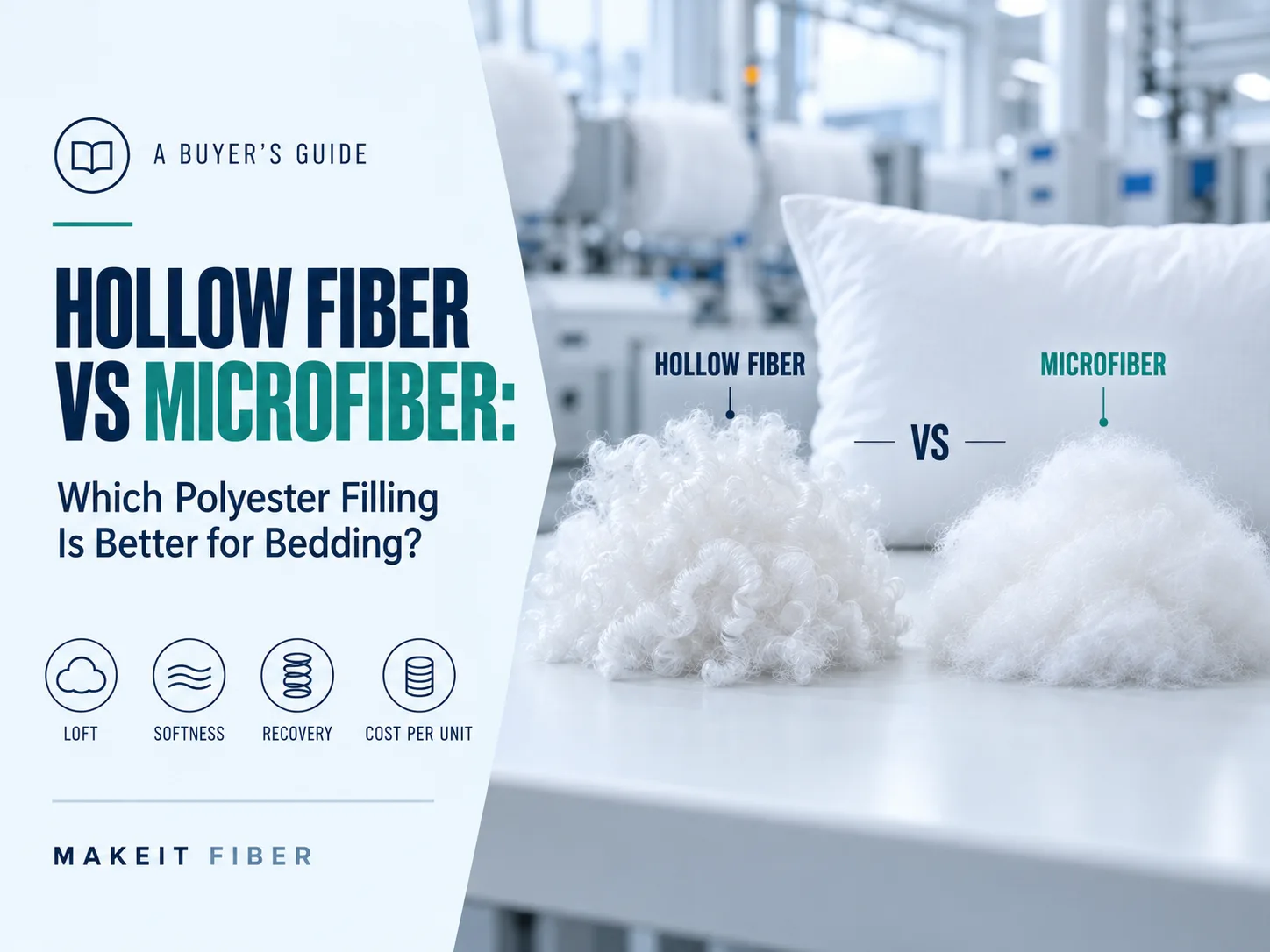
Here’s the short answer: neither one wins by default.
Hollow conjugated siliconized fiber is usually the stronger starting point when you need bulk, resilience and support at a controlled cost. Microfiber tends to win when the priority is a fine, smooth, down-like hand feel. That’s it — that’s the core trade-off.
But here’s what most comparison pages won’t tell you: the label on a spec sheet barely matters. Two suppliers can both ship “hollow fiber vs microfiber” and land on completely different products. What actually decides the outcome is denier, fill weight, crimp and construction — not the name.
This is the trap a lot of sourcing teams fall into. They compare fiber types in the abstract, then get surprised when two bags of “the same” fiber process and feel nothing alike on the line.
So instead of picking a winner, we’re going to compare both fibers against six criteria that actually predict performance: hand feel, loft, recovery, processing behavior, wash performance and cost per finished unit. Let’s get into it.
Hollow Fiber vs Microfiber at a Glance
Want the quick version? Here’s a side-by-side comparison you can scan before diving into the technical detail.
| Criterion | Hollow conjugated fiber | Microfiber |
|---|---|---|
| Structure | Hollow cross section, often conjugated and crimped | Very fine fibers; cross section and construction must be confirmed per supplier |
| Typical feel | Airy, springy, resilient | Fine, smooth, down-like |
| Loft and support | Usually the stronger starting point for bulk and support | Usually the stronger starting point for soft drape and close packing |
| Recovery | Often strong when crimp and finish are well controlled | Depends heavily on fineness, finish, blend and construction |
| Processing | Common choice for blow filling and high-bulk products | May need tighter control of opening, static and dosing |
| Common uses | Hotel and economy pillows, cushions, resilient filling | Premium down-alternative pillows and duvets, soft-touch products |
| Cost view | Often lower raw material cost, but confirm required fill weight | Often higher raw material cost, but may support a premium feel or lower target weight |
One thing to flag before you go further: don’t compare price per kilogram in isolation. A cheaper fiber that needs a heavier fill to hit the same loft can cost more per finished pillow than a pricier fiber that runs lighter. We’ll do the actual math on that later in this article.
What Is Hollow Fiber Filling?
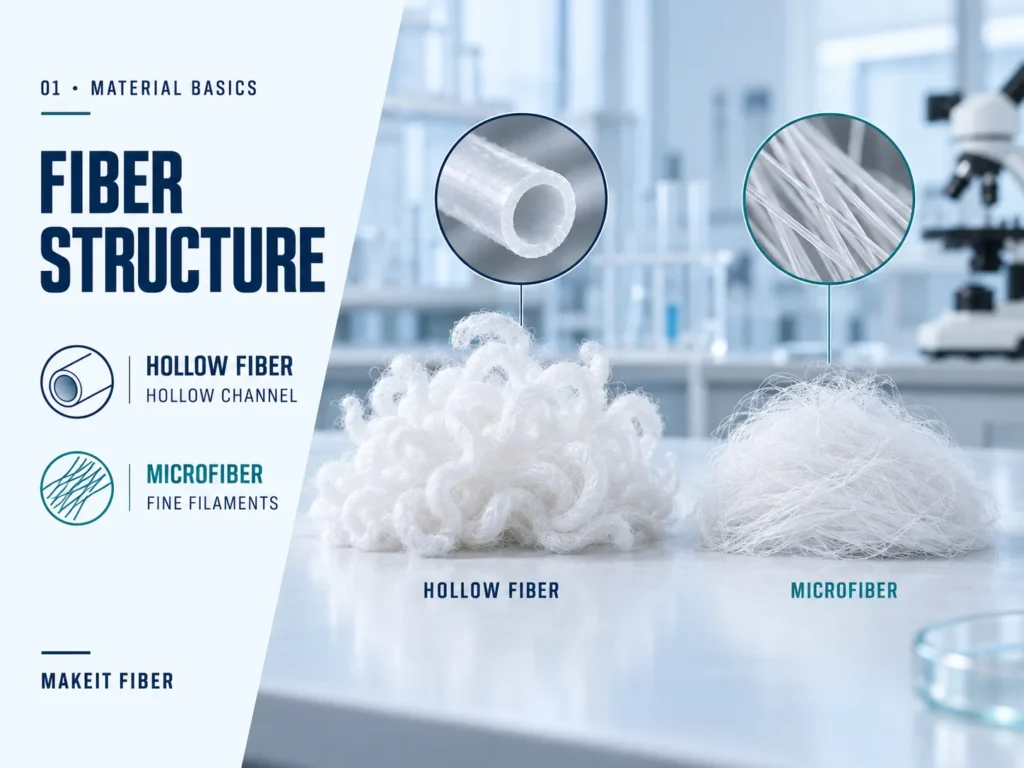
Hollow polyester staple fiber is a fiber engineered with one or more internal voids running through its cross section.
That hollow channel does one job: it lowers apparent density. Less density means more trapped air and more volume, without adding much weight. That’s the entire reason hollow fiber became the default filling for bulk-driven products.
Now, three terms get thrown around like they’re interchangeable. They’re not.
- Hollow describes the cross section itself.
- Conjugated describes a fiber structure — usually side-by-side or eccentric — that encourages a helical crimp, which builds bulk and improves recovery.
- Siliconized describes a surface finish that affects slickness, how easily fibers slide during opening, and final hand feel.
A fiber can be hollow without being conjugated. It can be conjugated without being siliconized. So when a supplier quotes you “hollow fiber,” ask which of these three features you’re actually getting.
And here’s the catch: not every hollow fiber behaves the same way. Void ratio, crimp consistency and finish quality vary by supplier and by batch. Those variables matter more than the word “hollow” on the spec sheet. For a deeper technical breakdown of how conjugated structure is built, see our hollow conjugated fiber guide.
What Is Microfiber Filling?
Quick clarification before anything else: microfiber filling and microfiber fabric are not the same product.
Search “microfiber” and most results point to cleaning cloths, towels or upholstery — woven or knitted fabrics made from ultra-fine yarns. That’s a different supply chain entirely from the loose polyester staple fiber used to fill a pillow or duvet. If your supplier is quoting filling fiber, keep the conversation there.
Microfiber filling is defined by one thing: fineness. The individual filaments are much thinner than standard fiber. But “microfiber” is a marketing-friendly umbrella term — it doesn’t tell you the actual spec. Ask for the denier or dtex directly. Two grades both labeled “microfiber” can sit at meaningfully different fineness levels, with different hand feel and different processing behavior.
That fine structure is what gives microfiber its signature feel: smooth, dense and closer to natural down. A tightly packed network of fine fibers compresses and rebounds differently than a bulkier hollow fiber — which is exactly why microfiber dominates premium down-alternative products.
Microfiber filling is typically polyester. Don’t assume it by default. Confirm the polymer, the finish, the cut length and whether the feedstock is virgin or recycled for the specific grade you’re being offered. Check our polyester microfiber filling page for current specification ranges.
How Fiber Structure Changes Bedding Performance
This is the section most consumer-facing comparison articles skip. It’s also the section that actually matters for production.
Softness and hand feel. Well-opened hollow conjugated fiber has a springy, slightly airy hand. You can feel the resilience when you press into it. Microfiber feels smoother and more enveloping, closer to natural down, because the individual fibers are so much finer. But neither description holds up if the fiber is poorly opened, under-conditioned or carelessly blended. Processing quality matters as much as fiber choice.
Loft, support and drape. More bulk doesn’t automatically mean more comfort. A pillow that’s too lofty for its use case can feel unsupportive instead of luxurious. A duvet with excessive loft can drape poorly. Switching from a hollow fiber baseline to a softer microfiber fill usually means adjusting weight or construction — you can’t swap fibers gram-for-gram and expect the same result.
Compression recovery. How well a filling bounces back depends on crimp, finish, packing density and construction working together — not on fiber type alone. A hollow fiber with weak crimp can underperform a well-finished microfiber. And vice versa. Be skeptical of any claim that promises permanent loft based purely on fiber category. Recovery is a system property, not a guaranteed trait of one material.
Washability and clumping. Post-wash performance comes down to finish quality, how well the fiber was opened before filling, migration control inside the casing, the casing fabric, and the quilting pattern. Both fibers can clump if any of those upstream factors are weak. Fiber type is one variable among several — not the deciding one.
Warmth and breathability. This is where online sources contradict each other constantly, and there’s a clear reason why.

Why online comparisons disagree about warmth
Warmth in a finished duvet comes from trapped air, fill weight, loft, casing permeability and quilting structure working together — not from the fiber alone.
A lightly filled microfiber duvet can feel cooler than a heavily filled hollow fiber duvet. The reverse is just as achievable with different construction choices.
Most comparison articles test finished consumer products, then credit the result to fiber type. That’s backwards. If warmth or breathability is a spec you’re designing against, the only reliable answer comes from testing your own finished construction — not from a generalized claim on a blog.
Which Filling Fits Each Bedding Product?
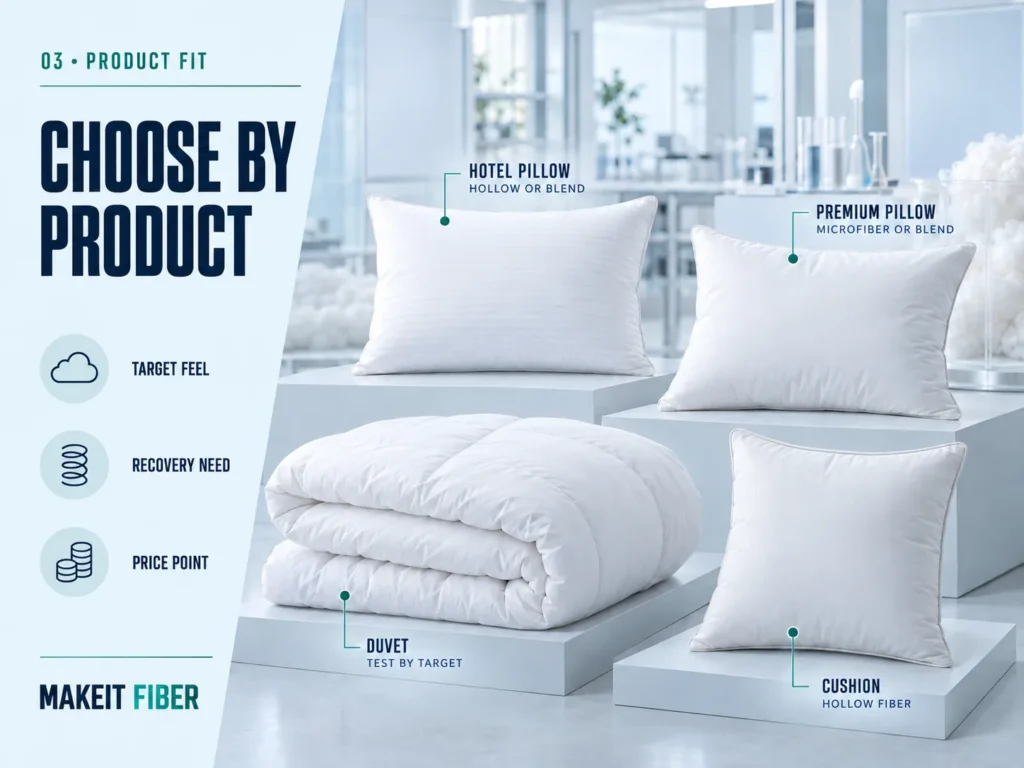
Instead of repeating the fiber definitions, let’s work backward from the finished product. Think of these as preferred starting points for a first trial, not fixed rules. Your target price point and construction can shift the answer.
| Product | Starting point | Primary reason | Validate first |
|---|---|---|---|
| Economy pillow | Hollow conjugated siliconized fiber | Bulk, resilience and cost control | Fill weight consistency and recovery |
| Hotel pillow | Hollow conjugated fiber or a validated blend | Repeatable loft and support across frequent use | Cycle compression and wash test |
| Premium down-alternative pillow | Microfiber or a validated blend | Fine hand feel and soft drape | Panel hand feel plus recovery |
| Duvet or comforter | Microfiber, hollow fiber or blend based on target | Warmth-to-weight ratio, drape and migration control | Thermal target, quilting and wash performance |
| Decorative cushion | Hollow conjugated fiber | Shape retention and visual fullness | Seam profile and long-cycle recovery |
| Topper or wadding | Application-specific grade or blend | Loft uniformity and layer stability | Carding behavior and thickness variation |
Notice duvets sit in the “it depends” zone more than anything else on this list. That’s intentional. Warmth-to-weight targets vary too much by market and season for one universal fiber recommendation to be responsible advice.
Specifications That Matter More Than the Product Name
If you take one habit away from this article, make it this: stop asking “hollow fiber or microfiber,” and start asking for the numbers behind the name.
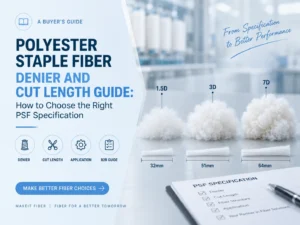
Denier or dtex, and cut length. These two numbers drive hand feel, opening behavior and equipment compatibility. Finer deniers generally feel softer but can be harder to open cleanly. See our denier and cut length guide for how these interact with processing.
Crimp level and crimp consistency. Crimp isn’t just a certificate number. It directly affects bulk, opening and post-compression recovery. Ask how crimp is measured, and whether it’s held within a stated tolerance batch to batch.
Siliconized or non-siliconized finish. This surface treatment changes slickness, fiber movement during processing, and final hand feel. A siliconized and non-siliconized version of the same base spec can feel noticeably different in the finished pillow.
Cross section and hollow ratio. Don’t assume every “hollow fiber” has the same void geometry. Ask for the supplied cross section and any test evidence. Hollow ratio varies — and it changes bulk and cost.
Virgin or recycled feedstock. This is a sourcing and consistency question, not a comfort predictor. Recycled feedstock can perform very well. The real question is whether it’s consistent lot to lot.
Tolerance and batch consistency. Define acceptable ranges upfront. Keep a golden sample from your approved trial so future shipments get checked against something physical — not just a data sheet.
Here’s a checklist you can copy straight into an RFQ:
- Fiber type, denier/dtex and cut length
- Cross section and hollow ratio (if applicable)
- Crimp level and tolerance
- Finish (siliconized or non-siliconized)
- Feedstock (virgin or recycled) and consistency history
- Batch tolerance range and golden sample reference
Processing Differences on a Bedding Line
Fiber choice doesn’t just change how a product feels — it changes how your line runs.
Bale opening, fiber separation, static behavior, carding or air-laying, and blow-filling consistency can all shift depending on which fiber you’re running. Fine microfiber often needs tighter control of opening, feed rate and static buildup, since fine fibers cling and feed unevenly more easily than coarser ones. High-bulk hollow fiber can shift your volumetric dosing behavior, because a given weight occupies more volume than a denser fill.
None of this reduces to a single universal machine setting you can copy from an article. Equipment model, ambient humidity, throughput and product construction all affect what actually works on your line. The better move: run a short line trial and record both the finished product results and what your operators observe about feed stability, dust and static. That gives you your own reference point instead of borrowing someone else’s.
Cost Per Finished Product
Here’s a comparison most competitor content skips entirely — and it’s often the one that decides the sourcing call.
Price per kilogram alone can mislead you. Two fibers rarely need the same fill weight to hit the same loft or hand feel. A cheaper fiber that needs 15% more weight to reach your target can cost more per pillow than a pricier fiber that runs lighter. The basic formula:
Fiber cost per unit = fill weight (kg) × fiber price per kg
That’s just the starting point. For an honest picture, extend it to total variable cost per finished unit — including processing time, material loss during opening and filling, rework, and reject rate. A fiber that’s cheap per kilogram but generates more waste or more rejects on your line can quietly erase its price advantage.
We won’t hand you invented market prices here. They go stale fast and vary by region and order volume. Run this comparison with your own supplier quotations and your own line data, in two stages: first, an equal-weight trial to see raw performance differences; second, an equal-target-performance trial, where you adjust weight until both fibers hit the same loft, support or hand feel — then compare cost per unit on that level playing field.
A simple worksheet structure to build yourself:
| Input | Hollow fiber | Microfiber |
|---|---|---|
| Price per kg | ||
| Fill weight per unit (kg) | ||
| Line rate (units/hour) | ||
| Material loss rate | ||
| Reject rate | ||
| Cost per finished unit |

How to Run a Fair Hollow Fiber vs Microfiber Trial
A controlled trial beats another round of subjective “it feels nicer” opinions. And it doesn’t need to be complicated to be useful.
Start by conditioning both fibers after compressed bale shipping. Record how long you conditioned them, and under what environment — fiber straight out of a tightly compressed bale won’t behave like fully relaxed fiber. Keep everything else fixed for the first comparison: same casing, same quilting, same product dimensions, same equipment, same operators, same test method. Change more than one variable at a time, and you won’t know what caused the difference.
Run it in two stages:
- Equal fill weight. Compare both fibers at the same weight to see raw behavior differences.
- Equal target performance. Adjust fill weight in each fiber until both reach the same target loft, support or hand feel — then compare on a level playing field.
While you run the trial, record: opening behavior, feed stability, fill weight variation, cycle time, dust or static observations, finished loft, compression recovery, post-wash clumping, and material used per unit. Score hand feel blind where practical — don’t tell the panel which sample is which. Keep the winner as your approval reference going forward.
Once you have a winner, convert it into an actual purchase specification with defined test methods, tolerances and batch approval requirements. That way, your next shipment gets checked against something concrete, not a general description.
A simple trial scorecard:
| Test | Hollow fiber sample | Microfiber sample | Test method | Acceptance limit |
|---|---|---|---|---|
| Fill weight variation | ||||
| Compression recovery | ||||
| Post-wash clumping | ||||
| Hand feel (blind score) | ||||
| Cycle time |

Can Hollow Fiber and Microfiber Be Blended?
Yes. Blending is a common way to balance resilience with a finer hand feel.
But there’s no single “correct” ratio that works across every product. The right blend depends on your target loft, hand feel and cost point — and it should come from testing, not a generic recommendation. Pilot two or three ratios and score them against the performance targets you actually care about.
One thing worth checking directly, not assuming: blend uniformity. Fibers with different fineness and density can segregate during feeding if your blending and opening equipment isn’t set up to handle the mix evenly. The result shows up as inconsistent hand feel or loft across the batch.
Buyer Decision Checklist
Before placing a bulk order, work through this list:
- Define the finished product, target price tier and target hand feel
- Specify required loft, support, recovery, wash performance and migration behavior
- Confirm denier/dtex, cut length, crimp, finish, cross section, feedstock and tolerances
- Verify the fiber is compatible with your existing process and equipment
- Compare cost per finished unit, not just price per kilogram
- Approve a controlled trial and keep a golden sample before scaling to bulk
Frequently Asked Questions
What is the main difference between hollow fiber and microfiber filling?
Hollow fiber has an internal void that reduces density and builds bulk, giving a springy, resilient feel. Microfiber is defined by extreme fineness, giving a smoother, more down-like hand feel. Both are typically polyester but behave differently under load and during processing.
Which is better for pillows, hollow fiber or microfiber?
Neither is universally better. Hollow fiber usually suits pillows that need firm support and resilience, like hotel or economy pillows. Microfiber tends to suit premium, softer, down-alternative pillows. The right choice depends on your target hand feel and construction.
Which filling is warmer for a duvet?
Warmth depends on fill weight, loft, casing permeability and quilting — not fiber type alone. A well-constructed duvet from either fiber can outperform a poorly constructed one from the other. Test warmth in the finished product.
Is microfiber filling always made from polyester?
Usually, but not by default. Confirm the polymer, finish, cut length and feedstock (virgin or recycled) for the specific grade you’re being quoted.
Does hollow fiber flatten over time?
It can, if crimp, finish or fill weight are inadequate — just like any filling. Recovery depends on crimp consistency, finish quality and construction working together, not on the hollow structure alone.
Can hollow fiber and microfiber be blended?
Yes. Blends balance resilience with a finer hand feel, but the ideal ratio depends on your target product and should come from pilot testing, not a fixed recipe.
Is recycled polyester suitable for bedding filling?
It can be, in both hollow fiber and microfiber grades. The key is verifying consistency across batches, since recycled feedstock sourcing can introduce more variation than virgin material if not well controlled.
Which fiber is a better starting point for hotel pillows?
Hollow conjugated fiber or a validated blend, usually. Hotel pillows need to hold up to frequent compression cycles and repeated washing while keeping a consistent, repeatable loft.
What should a buyer test before placing a bulk order?
Run a controlled trial covering fill weight consistency, compression recovery, post-wash clumping and hand feel, using the same casing, quilting and equipment for both candidate fibers. Approve a golden sample before scaling up.
The Bottom Line
If you’re choosing by target instead of by label: hollow conjugated fiber is the stronger starting point for bulk, resilience and cost control. Microfiber is the stronger starting point for a fine, down-like hand feel. A controlled blend makes sense when you need both.
What actually decides the outcome is the specification behind the name — denier, crimp, finish, fill weight and construction. Not whether the bag says “hollow fiber” or “microfiber.”
Send us your product type, dimensions, target fill weight, required hand feel, equipment and current specification. MAKEIT can recommend trial grades and samples so you can run your own side-by-side comparison before committing to a bulk order.