Not all polyester filling performs the same way.
Even when the spec sheets look nearly identical.
Some fibers hold their loft for years. Others go flat after a few months of daily compression. Some feel smooth and slippery when you fill a pillow. Others grip together and resist even distribution.
A lot of that difference comes down to one material: hollow conjugated fiber.
If you’re sourcing filling for pillows, duvets, cushions, toys, or insulation, you’ve run into this term already. But picking the right one isn’t as simple as grabbing a denier off a price list.
Here’s what it actually is, where it works well, how to choose between siliconized and non-siliconized versions, and how to test a sample before you commit to a full container.
What Is Hollow Conjugated Fiber?
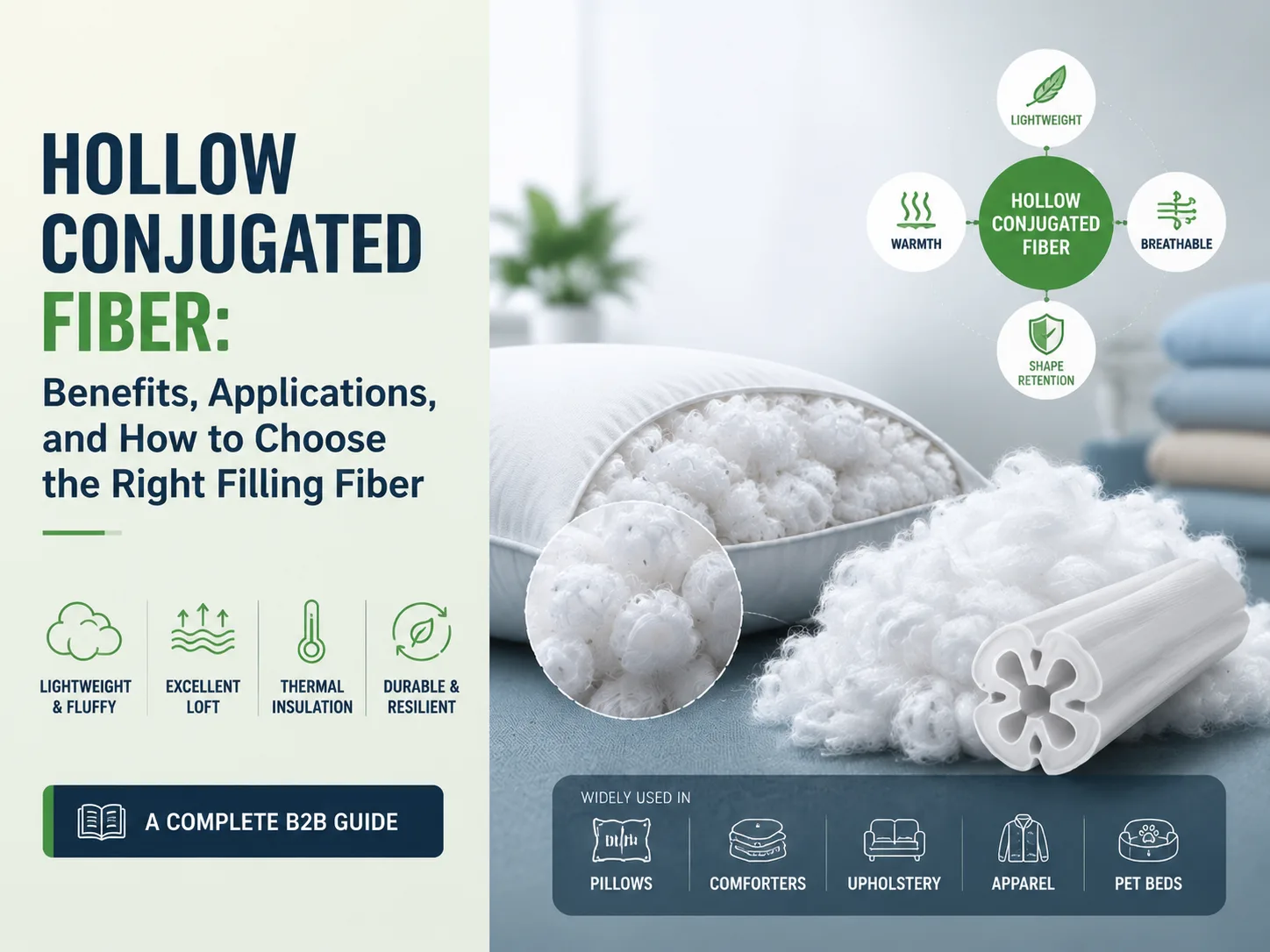
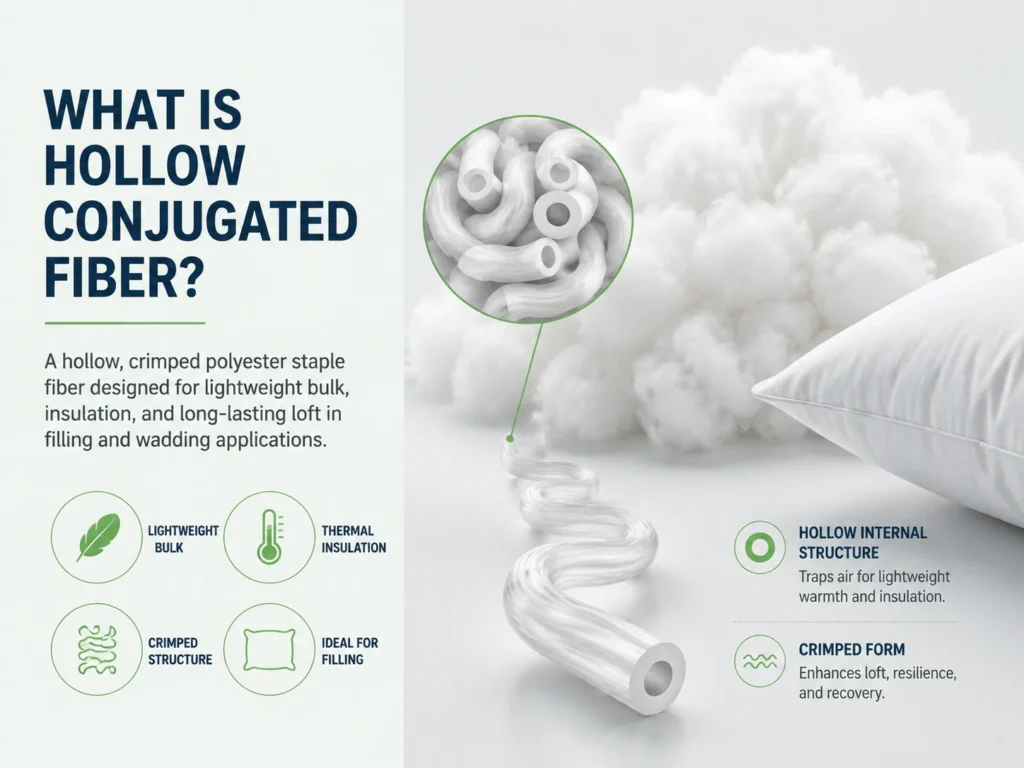
Hollow conjugated fiber is a polyester staple fiber with a hollow internal structure and a crimped form. The hollow space supports lightweight bulk and insulation. The crimp drives loft and recovery in pillows, duvets, cushions, wadding, and select nonwoven products.
It’s one engineered form within the broader polyester staple fiber family, built specifically for filling and bulk applications rather than spinning or general nonwoven use. For a wider look at fiber structures, grades, and end uses, see our guide to polyester staple fiber types and specifications
What "Hollow" Actually Means
Instead of a solid, fully packed cross-section, the fiber has an internal air channel running through it.
That air space is the whole point. More volume, without a proportional jump in weight. The trapped air also adds insulation.
One caveat: the exact insulating or weight-saving effect isn’t a fixed number you can slap on every product. It depends on the specification, how much fiber you use, and how the final product is built. Fiber structure is only one part of that equation, our textile fiber guide breaks down how fiber properties actually translate into finished-product performance.
What "Conjugated" Actually Means
Most hollow conjugated fiber on the market has a three-dimensional or spiral crimp built in. That crimp is what lets individual fibers interlock, creating bulk and helping the filling bounce back after compression.
Different manufacturers get there differently, so the structure varies between suppliers. Look at the actual crimp, denier, and cut length on the datasheet. Better yet, test a sample. Don’t assume every “conjugated” fiber behaves the same.
Is HCS Always Siliconized?
You’ll see hollow conjugated fiber called “HCS” a lot. That usually stands for Hollow Conjugated Siliconized fiber.
But it’s not automatic. Siliconized is a surface finish, not a property of the hollow structure itself. Not every hollow conjugated fiber on the market carries it.
That distinction matters more than it sounds like it should. Here’s why.
Key Benefits of Hollow Conjugated Fiber
Lightweight Bulk and Loft
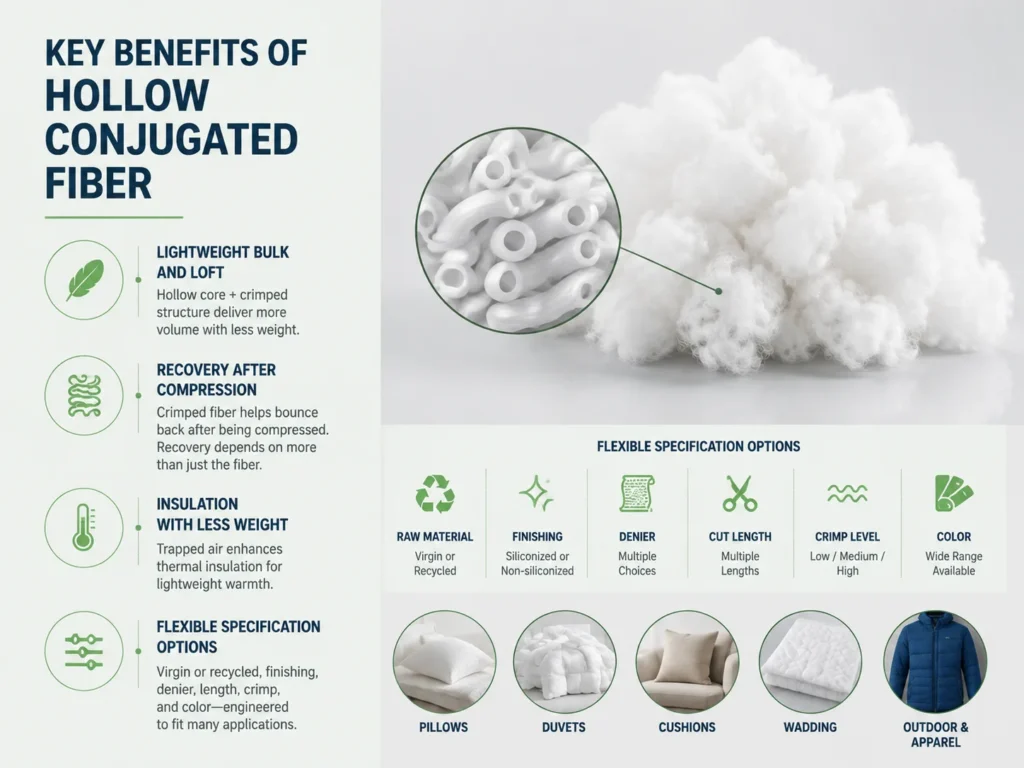
The hollow core and crimped structure team up to give fiber more visual and tactile volume without much added weight. Useful anytime you want a “full” or plush feel without over-filling.
Recovery After Compression
A well-crimped fiber springs back into shape after getting squashed. Someone sits on a cushion. A pillow gets crushed under a head all night. It bounces back.
But recovery isn’t only about the fiber. Fill weight, product design, outer fabric, and how the thing actually gets used all play a role too.
Insulation With Less Weight
Air trapped inside and between fibers supports thermal insulation. That’s exactly why hollow fiber shows up so often in lightweight warm filling and outdoor products.
Flexible Specification Options
This isn’t one fixed product. You get virgin or recycled raw material, siliconized or non-siliconized finishes, and a range of deniers, cut lengths, crimp levels, and colors.
That flexibility is why hollow conjugated fiber works across so many filling applications. It also means there’s no single “correct” spec that fits everything.
Siliconized vs. Non-Siliconized HCS
This is where a lot of buyers get tripped up. Worth slowing down here.
| Factor | Siliconized HCS | Non-Siliconized HCS |
|---|---|---|
| Surface feel | Typically smoother and softer | Typically higher fiber-to-fiber friction |
| Fiber movement | Often opens and distributes more easily | Often provides more grip within a web or filling structure |
| Common direction | Pillows, duvets, cushions, plush toys, soft filling | Wadding, needle-punched materials, selected nonwovens, structural filling |
| What to validate | Hand feel, opening, fill distribution, clumping, recovery | Web formation, blending, bonding or needling compatibility |
Selection takeaway: go siliconized when softness, smooth fiber movement, and even filling distribution matter most, think pillows and plush toys. Go non-siliconized when your process actually benefits from more fiber cohesion, like wadding or needle-punched materials.
Not a hard rule, though. Your equipment, your blend ratio, and your actual production trial get the final say.
Common Applications of Hollow Conjugated Fiber
Pillows, Duvets, and Bedding
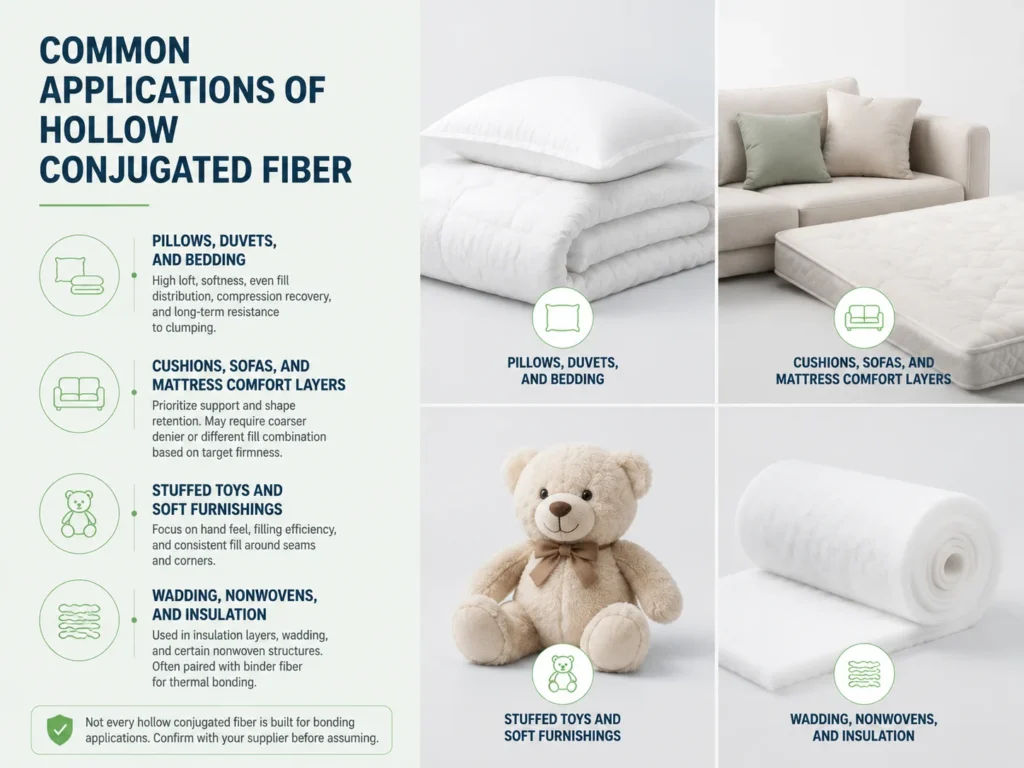
The classic use case. Priorities: loft, softness, even fill distribution, compression recovery, resistance to clumping over time. Siliconized HCS is the usual starting point.
Cushions, Sofas, and Mattress Comfort Layers
Support and shape retention matter more here than pure softness. Depending on target firmness, you might need a coarser denier or a different fill combination than what works in a pillow.
Stuffed Toys and Soft Furnishings
Hand feel and filling efficiency lead here, along with keeping the filling consistent around seams and corners, exactly where a toy gets handled the most.
Wadding, Nonwovens, and Insulation
Hollow conjugated fiber also shows up in insulation layers, wadding, and certain nonwoven structures. When thermal bonding is involved, it’s often paired with a binder fiber. Not every hollow conjugated fiber is built for bonding applications, so confirm this directly with your supplier before assuming.
How to Choose HCS Fiber by Application
Don’t start with a denier number. Start with what your product actually needs to do.
| Application | Start With These Fiber Considerations | Validate Before Bulk Ordering |
|---|---|---|
| Pillows and duvets | Siliconized HCS, soft hand feel, suitable crimp and denier | Loft, recovery, fill distribution, clumping |
| Cushions and sofa filling | Medium or coarser denier, resilient hollow structure | Support, shape retention, compression recovery |
| Stuffed toys | Soft fiber with stable opening behavior | Hand feel, fill efficiency, seam-area consistency |
| Mattress comfort layers | HCS compatible with layer design and binder fiber if needed | Compression set, layer stability, durability |
| Thermal wadding | Hollow structure, blend-ready finish, suitable cut length | Web formation, insulation, bonding response |
Why 7D × 64 mm Is Common — But Not Universal
If you’ve sourced hollow conjugated fiber before, you’ve seen 7D × 64 mm everywhere. It’s the go-to reference spec for filling applications, and for good reason. It strikes a decent balance between bulk, softness, and processability.
But “common” isn’t the same as “correct for your product.”
A lighter, plusher pillow might need a finer denier. A firmer cushion or structural wadding application might need something coarser, or a different cut length entirely. Don’t default to 7D × 64 mm just because everyone else lists it. Match it to what your product needs.
How to Test HCS Fiber Before a Bulk Order
Datasheets tell you what a fiber should do. They don’t tell you how it’ll behave once it’s actually inside your product.
Here’s the process to run before you commit to a full container.
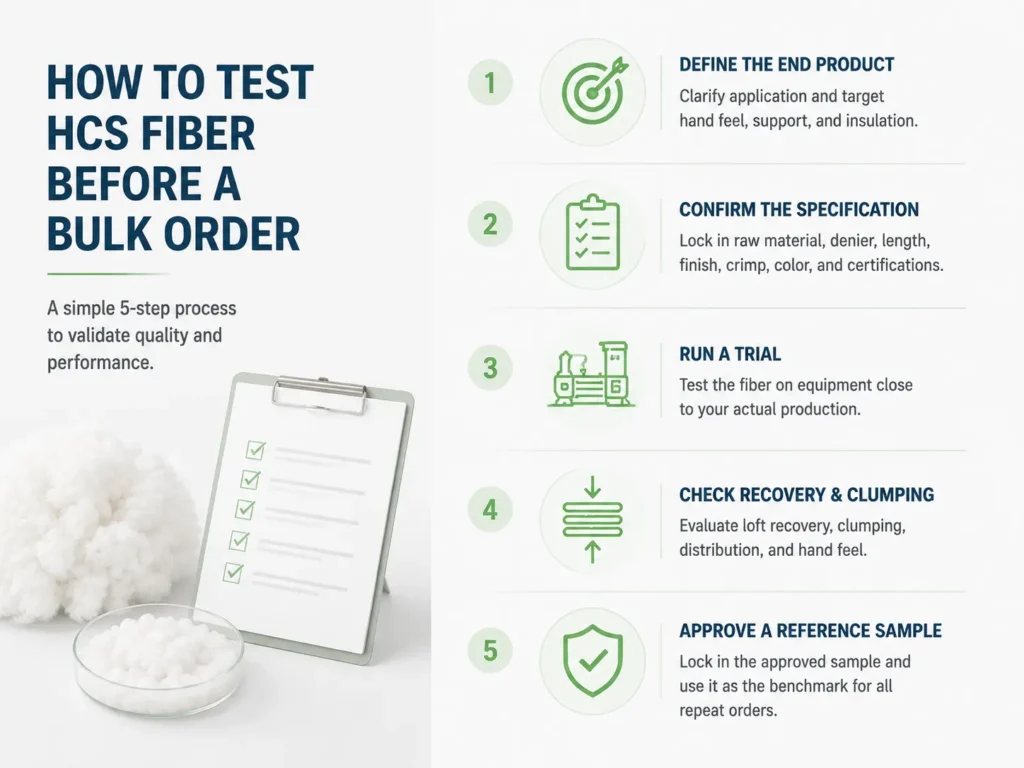
Step 1: Define the End Product
Pillow, duvet, cushion, toy, mattress comfort layer, or wadding? What hand feel, support level, and insulation performance are you targeting?
Step 2: Confirm the Baseline Specification
Lock down raw material source (virgin or recycled), denier, cut length, siliconized or non-siliconized finish, crimp, color, and any certification requirements. Do this before requesting a sample, not after.
Step 3: Run a Representative Trial
Test the fiber on equipment close to your actual production. Real opening, blending, filling, or web-formation gear. Not just a lab bench evaluation.
Step 4: Check Compression Recovery and Clumping
Compress the filled or formed sample. Check how well it recovers loft, whether it clumps, how evenly it distributes, and whether the hand feel holds up.
Step 5: Approve a Reference Sample
Once it checks out, lock in the approved sample, spec sheet, and acceptance criteria as your benchmark. Use that reference for every repeat order. It’s the easiest way to catch batch drift before it turns into a customer complaint.
Virgin vs. Recycled Hollow Conjugated Fiber
The Practical Difference
Virgin HCS comes from newly produced polyester raw material. Recycled HCS uses recycled polyester feedstock, which matters if your project has a recycled-content target or sustainability requirement attached.
Neither one wins by default. The right call depends on your performance target, any recycled-content or certification requirements, and how the actual sample performs once tested.
What Buyers Should Verify
- The recycled-content target, and whether it’s documented
- Certification scope and order-specific paperwork, if required (GRS, for example)
- Odor, color consistency, recovery, and batch-to-batch consistency
- An approved sample and production reference before scaling up
If recycled content is part of the brief, confirm the required recycled-content level, applicable certification scope, and order-specific documentation before approving bulk supply. Our recycled polyester staple fiber buyer’s guide covers a practical sourcing and verification checklist for exactly this.
What Buyers Should Confirm Before Ordering
- Virgin or recycled raw material option
- Denier, cut length, and crimp
- Siliconized or non-siliconized finish
- Target fill weight and expected end-product feel
- A plan for testing loft, recovery, and clumping
- Color, packaging, MOQ, and delivery requirements
- Sample approval and a repeat-order reference process
- Required certifications and traceability documentation
If your filling program needs a stable custom color across repeat orders, that color should be approved at the fiber stage, not after the fact. Our dope dyed polyester fiber guide explains how that approval process works.
FAQ
What is hollow conjugated fiber?
A polyester staple fiber with a hollow core and crimped structure, commonly used in pillows, duvets, cushions, toys, and insulation for its lightweight bulk and recovery properties.
What does HCS fiber mean?
Usually Hollow Conjugated Siliconized fiber. Worth confirming with your supplier whether the specific product you’re sourcing actually carries a silicone finish.
What is the difference between siliconized and non-siliconized HCS?
Siliconized feels smoother and distributes more easily, making it common for pillows and soft filling. Non-siliconized offers more fiber-to-fiber grip, which suits wadding or structural nonwoven applications better.
Is 7D × 64 mm hollow conjugated fiber suitable for pillows?
It’s a common starting spec, but suitability still depends on your target fill weight, hand feel, and pillow design. Test a sample before assuming it’s the right fit.
Is hollow conjugated fiber good for duvets and cushions?
Generally yes, but confirm the specific denier, cut length, and finish through sample testing based on your target firmness and softness.
Can hollow conjugated fiber be made with recycled polyester?
Yes. Confirm the supplier’s actual recycled-content capability, certification documentation, and how the recycled version performs against your target spec.
How should I test HCS before placing a bulk order?
Run it through your actual production process, check compression recovery and clumping, then approve a reference sample and specification before scaling to a full order.
Related Guides
Work With MAKEIT for Hollow Conjugated Fiber Solutions
Choosing the right hollow conjugated fiber isn’t about picking a denier off a spec sheet.
It’s about matching the fiber structure, finish, and raw material source to what your product actually needs to do, and confirming that with a real sample before you commit to volume.
MAKEIT manufactures hollow conjugated polyester staple fiber in both virgin and recycled options, with siliconized and non-siliconized finishes available depending on your application. Our team can walk through your target end product, recommend a starting specification, and support you with datasheets and samples, so what gets approved is what actually shows up in your production run.