A supplier sends you a GRS certificate for recycled polyester staple fiber. Does it cover the fiber you plan to buy? Does it cover the company that will invoice you? And how will it connect to the shipment that arrives at your warehouse?
Quick answer: Verify the certificate holder and its status. Confirm the certificate’s scope covers your product. Agree on the transaction documents before ordering. Match those documents to your order lines and the goods you receive. Check fiber quality separately.
The Global Recycled Standard (GRS) is a full product standard. It verifies and tracks recycled raw materials through the supply chain, and it adds processing criteria that limit potentially hazardous chemicals. Two documents matter most to buyers: the Scope Certificate (SC) and the Transaction Certificate (TC).
In this guide:
- SC vs TC
- Verifying supplier and scope
- Documents to request
- Multi-grade orders
- Changes after sample approval
- Quality checks
- Common mismatches
- A copy-and-paste request template
- FAQ
Scope Certificate vs Transaction Certificate: What Does Each Prove?
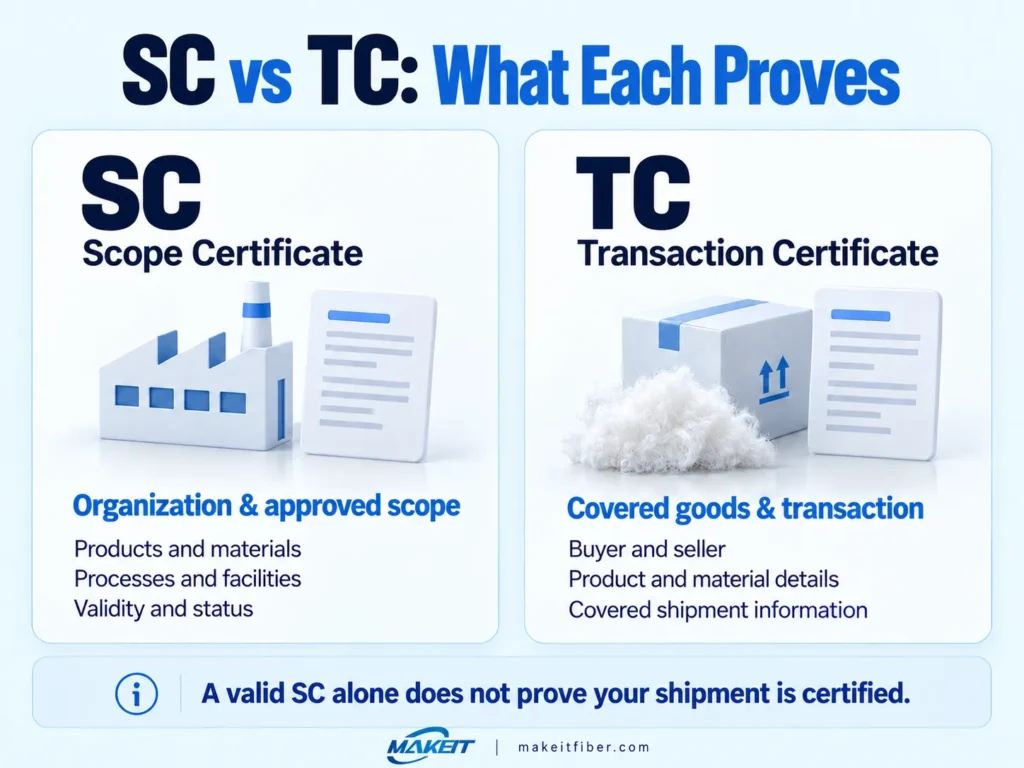
A Scope Certificate relates to an organization and what it is approved to do. A Transaction Certificate relates to certified products in a specific transaction or shipment. They answer different questions, and one does not replace the other.
What a Scope Certificate tells you
An SC shows that a company has been certified for a defined scope. Do not stop at the GRS logo. Read the products, materials, processes and sites listed, plus the certificate’s validity and status.
What a Transaction Certificate tells you
A TC links certified product to a particular transaction and its shipment details. Don’t assume every container automatically has its own TC. Also, a TC issued for another buyer’s order says nothing about yours.
| Scope Certificate (SC) | Transaction Certificate (TC) | |
|---|---|---|
| Main subject | The certified organization and its approved scope | Certified product in a specific transaction |
| Buyer’s use | Screening a supplier before ordering | Linking an order or shipment to certified material |
| What to check | Legal entity, certificate number, issuing body, validity, products, processes, sites | Product description, quantity, parties, shipment details |
| Cannot prove alone | That a particular shipment is certified | That the supplier’s wider scope or fiber performance is suitable |
Neither document tells you whether the fiber will perform in your process. That needs a specification and quality evidence (see below).
How to Verify the Supplier and Certification Scope
Start with who holds the certificate, then check what it covers.
Check the legal entity, certificate details and current status
- Identify the certificate holder’s legal name and confirm its relationship to the company you are contracting with.
- Record the certificate number, issuing certification body (CB), validity dates and status.
- Brand name, selling company and factory can be different entities. If they are, ask who plays which role and how the documents connect.
Textile Exchange says the best way to verify a certificate is to contact the CB that issued it (source). Its public Find a Certified Company list is also available, but data entry on that list can lag by a few weeks. So if a company does not appear yet, don’t conclude the certificate is fake. Ask the CB.
Confirm the relevant product and activities are covered
- Check that the product category and materials listed fit what you want to buy.
- Check that the processes and sites on the certificate match the supply route.
- Don’t accept a yarn or fabric scope as proof for staple fiber purchasing.
- If certificate descriptions differ from internal grade codes, ask how the certified product maps to what you are ordering. Confirm unclear mappings with the certification body.
Which Documents Should You Request Before and After Ordering?
Ask for documents in stages. The right request at enquiry is different from the right request after shipment. The table below is a suggested procurement practice, not an official GRS rule.
| Stage | Documents to review | Decision to make |
|---|---|---|
| Enquiry / supplier evaluation | Current SC, verification route, product specification, your recycled-content requirement | Does the supplier’s scope plausibly fit the product? |
| Order confirmation | PO, agreed specification, written arrangement for TC (who applies, conditions, expected timing) | Are the document responsibilities clear before you commit? |
| Shipment and transaction documents | TC, commercial invoice, packing list, shipping records | Do quantities, product descriptions and parties line up? |
| Receipt and filing | Delivered goods records, batch identification, final document set | Is the file complete enough to support your own claims? |
At enquiry stage, no TC exists yet for an order that has not happened. That does not mean the supplier can’t provide one. Ask how the TC will be arranged, what conditions apply, and when you can expect it. Don’t assume a standard issue time; it depends on the actual transaction and the applicable rules.
How to Match GRS Documents When One Order Contains Multiple Fiber Grades
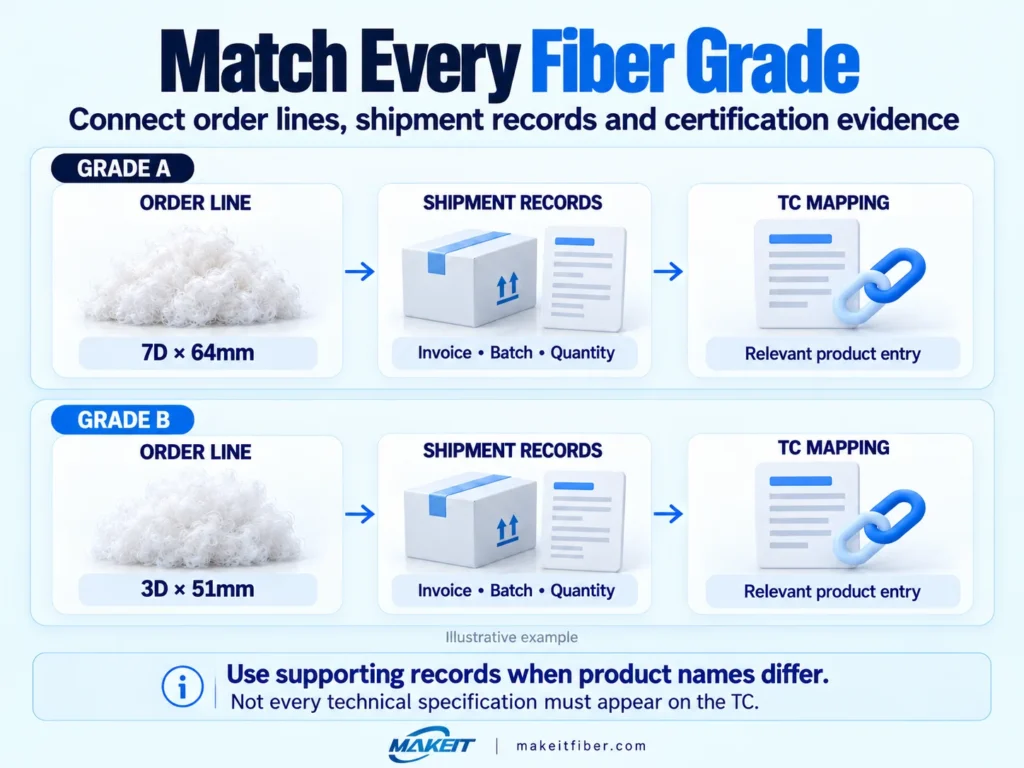
Checking only the total weight can hide problems when one order mixes grades. Build a line-by-line map instead.
Build an order-line mapping
| Order line | Agreed fiber specification | Commercial and receiving records | Certification evidence mapping |
|---|---|---|---|
| Grade A | Denier, cut length, finish, agreed composition | PO line, invoice reference, batch ID, quantity | Relevant TC product entry and supporting correspondence where needed |
| Grade B | Denier, cut length, finish, agreed composition | PO line, invoice reference, batch ID, quantity | Relevant TC product entry and supporting correspondence where needed |
Fill in one row per order line. Then check each row against the documents. For help interpreting the specifications that distinguish grades, see our polyester staple fiber denier and cut length guide.
Worked example: two grades in one purchase order
Illustrative example – not a MAKEIT customer order. The specifications are hypothetical and do not imply MAKEIT supplies them or that any certificate covers them.
Suppose a buyer orders Grade A (7D x 64 mm) and Grade B (3D x 51 mm) on one PO.
- Link each line to its spec and commercial records. Grade A’s PO line, invoice line and batch ID go in one row. Grade B’s go in another.
- Reconcile product names. The TC might describe both grades under a broader product name such as “recycled polyester staple fiber.” Ask the supplier to explain in writing how that name maps to each internal grade.
- Check split shipments. If Grade A ships in two lots, add up the lots and compare against the quantity covered. Log any unexplained difference.
Do not assume every internal grade code or technical specification will appear on the TC. Confirm the applicable requirements and how supporting records identify the goods. Supporting commercial records help you trace the goods, but they cannot expand certification scope or repair an invalid certificate.
What Changes Require a New GRS Document Review After Sample Approval?
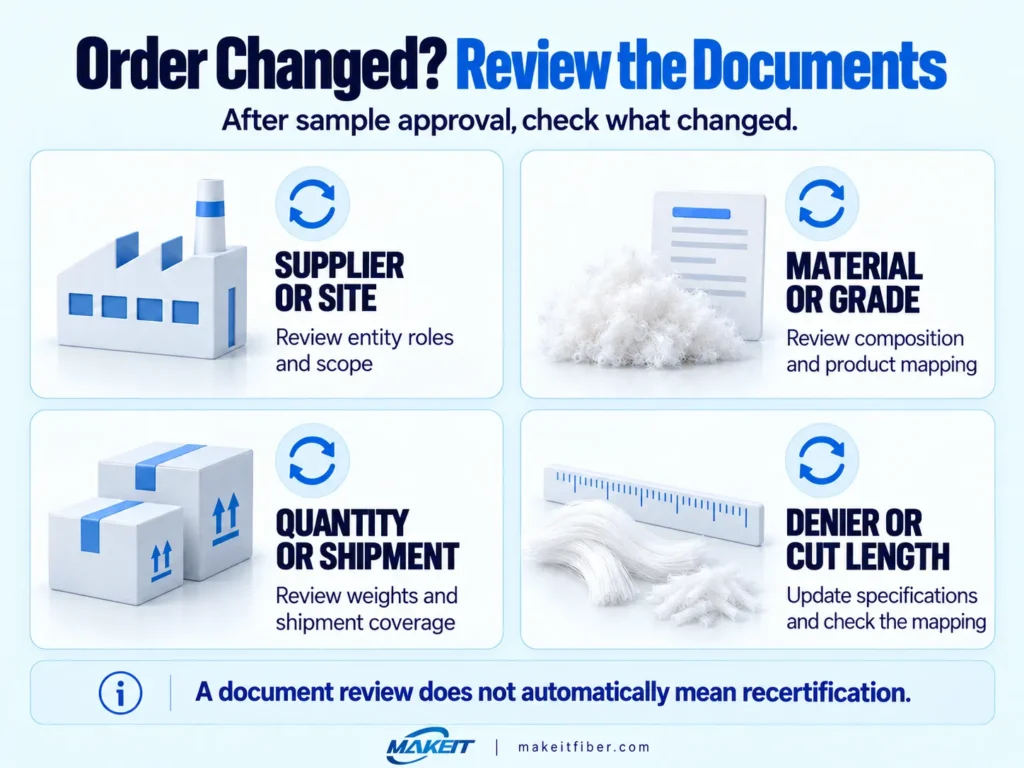
When the supply route, composition, product or shipment arrangement changes after you approve a sample, check that the original document arrangement still applies. This is a review step, not an automatic need for new certification. If you are considering a change in raw-material source, our virgin vs recycled polyester staple fiber comparison covers the broader selection questions to assess alongside documentation.
| Change | What to review |
|---|---|
| Different seller or production facility | Entity roles, relevant scope, transaction route |
| Different recycled-content declaration | Agreed composition and supporting certification or transaction information |
| Different product grade or finish | Approved specification, product identity, relevant scope |
| Split shipment or revised quantity | Actual shipment coverage and reconciliation with commercial documents |
| Denier or cut-length adjustment | Updated technical specification, and whether product-to-document mapping changes |
Decide internally who updates the procurement record. Ask the supplier, or the certification body, to clarify when something is unclear. Don’t decide on your own that a change definitely requires a new SC or TC.
Why Fiber Quality Needs a Separate Check
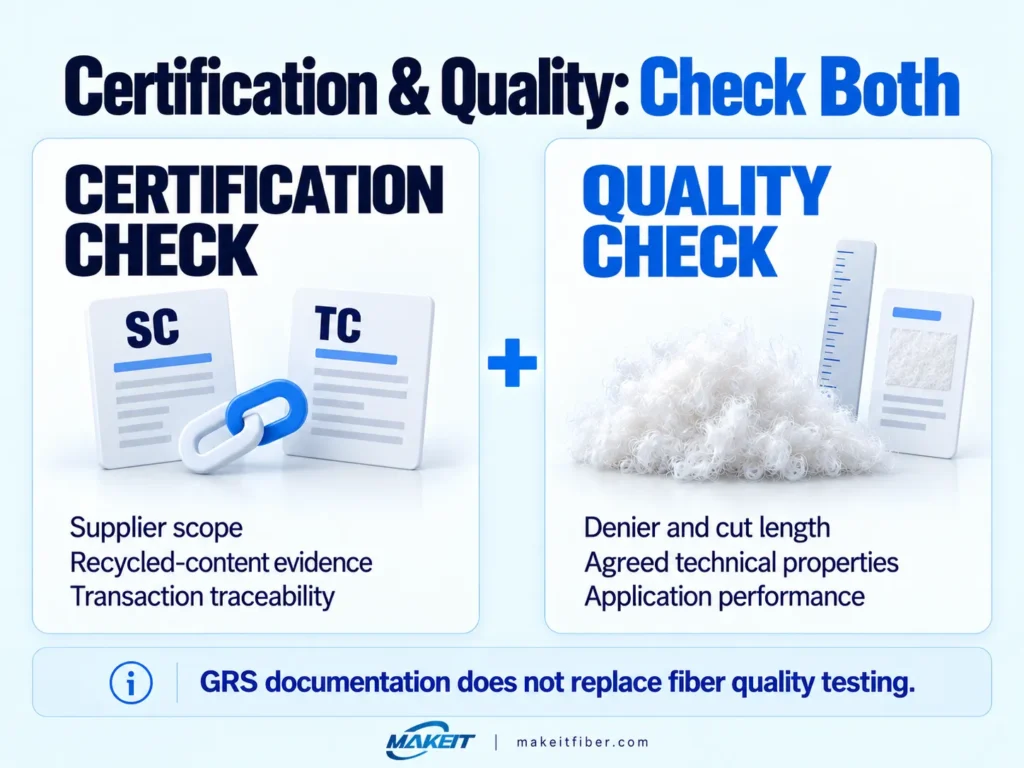
GRS certification and fiber quality evidence answer different questions. Certification concerns recycled material tracking and processing criteria. It does not guarantee that a fiber suits your machines or delivers a particular fill performance.
Select checks for your application
- Specification: denier, cut length, cross-section or structure, finish, and agreed tolerances.
- Filling use: opening behavior, hand feel, loft and recovery, as agreed for your project. Our guide to polyester fiber specifications for bedding and pillows explains application-specific selection questions.
- Textile and nonwoven use: tenacity, elongation, crimp and processing behavior, as agreed. For process trials and finished-product requirements, see our polyester staple fiber selection guide for nonwovens.
Use the approved sample, the specification sheet and batch test reports as your quality evidence. Acceptable values depend on the application, so we don’t give universal pass/fail numbers.
Common Document Mismatches and How to Resolve Them
A mismatch is a prompt to ask questions, not proof of fraud.
| What you observe | Question to ask | Suggested next step |
|---|---|---|
| Invoice seller differs from certificate holder | What is each company’s role, and how is the certified transaction arranged? | Request written clarification and confirm with the CB if needed |
| TC product description differs from the internal grade name | How does the grade map to the TC product entry? | Ask for written correspondence; verify with the CB if unclear |
| Weights differ between documents | Are these gross, net, certified or shipment-covered weights? | Reconcile by weight basis; don’t expect different bases to be equal |
| Supplier only shows a TC from another customer’s order | Is this just a format sample? | Use it to understand the format only; request documents for your order |
Leave any unexplained key discrepancy open. Don’t make a certified-content claim downstream until it is resolved.
A Copy-and-Paste GRS Documentation Request for Polyester Staple Fiber Buyers
Use this email template and replace the bracketed items.
Subject: GRS documentation for [Fiber grade/specification] – [Quantity]
Hello [Name],
We are considering [Quantity] of [Fiber grade/specification] for [Intended application], with [Required recycled-content declaration].
Please help us with the following: (1) confirm the selling entity and the certificate holder(s) involved; (2) send your current GRS Scope Certificate and tell us how we can verify it; (3) confirm how a Transaction Certificate would be arranged for this proposed order, including conditions and expected timing; (4) explain how you will map documents to each grade if the order has several grades or split shipments; (5) notify us if the product, composition or supply route changes.
Thank you,
[Your name / company]
Discuss your fiber and documentation requirements with MAKEIT
Explore MAKEIT’s GRS recycled polyester staple fiber product page, then send us your fiber and documentation requirements. Include your application, target specification, quantity and required recycled-content declaration so we can discuss product options and the documentation arrangements applicable to your proposed order.
Frequently Asked Questions
Is a supplier’s GRS Scope Certificate enough for my order?
No. It shows the supplier’s certified scope. Your order still needs transaction-level evidence that links the certified product to your shipment.
Must denier and cut length appear on a GRS Transaction Certificate?
Not necessarily. The TC describes certified product information, while specification details may sit in supporting records. Ask your certification body or the supplier how the product entry maps to your specification.
Can one Transaction Certificate cover multiple shipments?
The permitted coverage depends on the applicable certificate policy and transaction details. Confirm the arrangement with the issuing certification body and check that the TC covers the relevant products, quantities and shipments. Consult Textile Exchange’s current standards and policy resources for applicable requirements.
Does GRS-certified fiber automatically make the finished product GRS certified?
No. Certified input material does not by itself give a finished product certification or label eligibility. Later supply chain steps and claims have their own requirements.