Introduction: How Should Buyers Select PSF for Nonwovens?
Denier and cut length are usually the first two numbers a buyer checks. They’re also the two numbers least likely to tell you whether a fiber will actually run well on your line.
The real answer depends on five things: your finished product and its performance targets, your web-forming and bonding method, the fiber’s full specification and surface treatment, how it performs in an actual production trial, and how consistent it stays batch to batch once you move to bulk.
Skip the trial, and a spec sheet match can still turn into a processing headache.
A quick scope note. This guide covers staple-fiber raw material selection and purchasing — not spunbond or other routes where filament is formed directly from polymer. It also won’t re-explain polyester chemistry, PSF manufacturing basics, or general fiber classifications; those live in other articles. And one more thing worth saying plainly: the applications below reflect how PSF is commonly used in nonwovens industry-wide. They’re not a claim that MAKEIT supplies every use case listed.
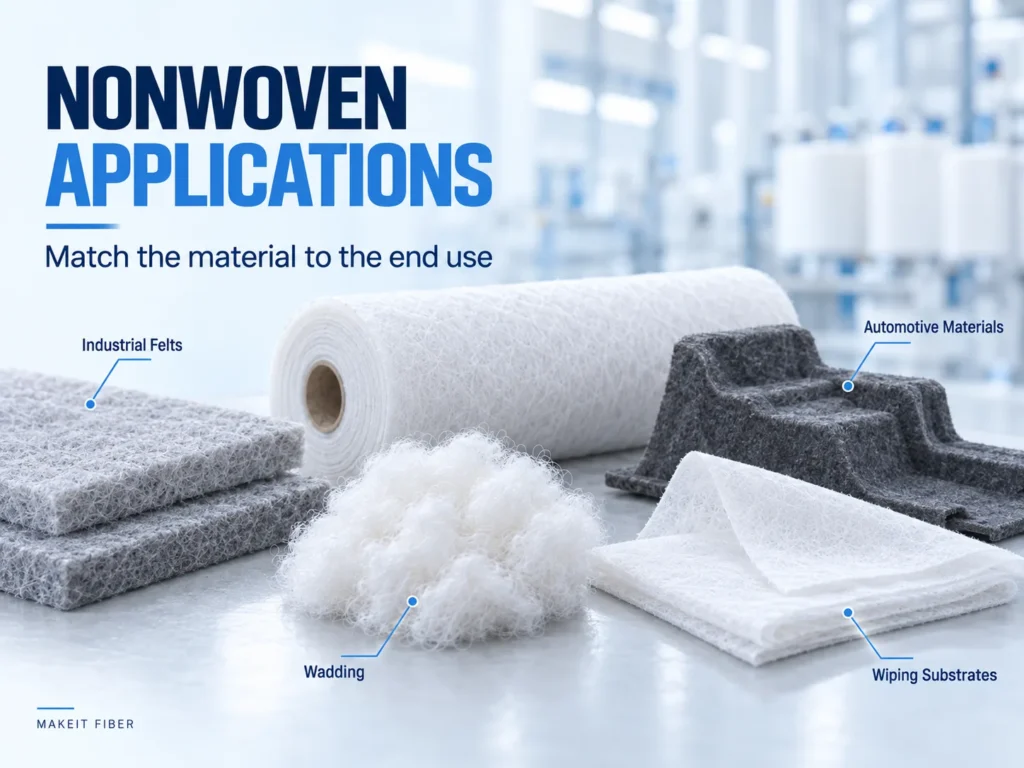
1. Common Nonwoven Applications for Polyester Staple Fiber
Start here, not with a spec sheet. Find your application first, then narrow down what actually matters for it.
| Application | Buyer Priorities | What to Confirm |
|---|---|---|
| Needlepunched felts and industrial materials | Strength, uniformity and thickness | Fiber specifications, processing compatibility and finished-product targets |
| Automotive interiors and acoustic materials | Dimensional stability and application-specific performance | Customer test requirements and material suitability |
| Wadding and thermally bonded materials | Loft, structural stability and bonding performance | Base fiber, binder system and trial conditions |
| Spunlace wiping materials | Cleanliness, surface finish and blend compatibility | Suitable fiber grade and processing requirements |
| Wet-laid and specialty materials | Dispersion and application-specific fiber dimensions | Short-cut specifications and dedicated grade suitability |
Automotive, hygiene, and other performance-critical applications need their own testing. A supplier’s general product range is not the same thing as confirmed suitability for your specific application.
2. Match the Fiber to Your Web-Forming and Bonding Process
Here’s a distinction that gets blurred more often than it should: web forming and web bonding are two different stages, not one process category.
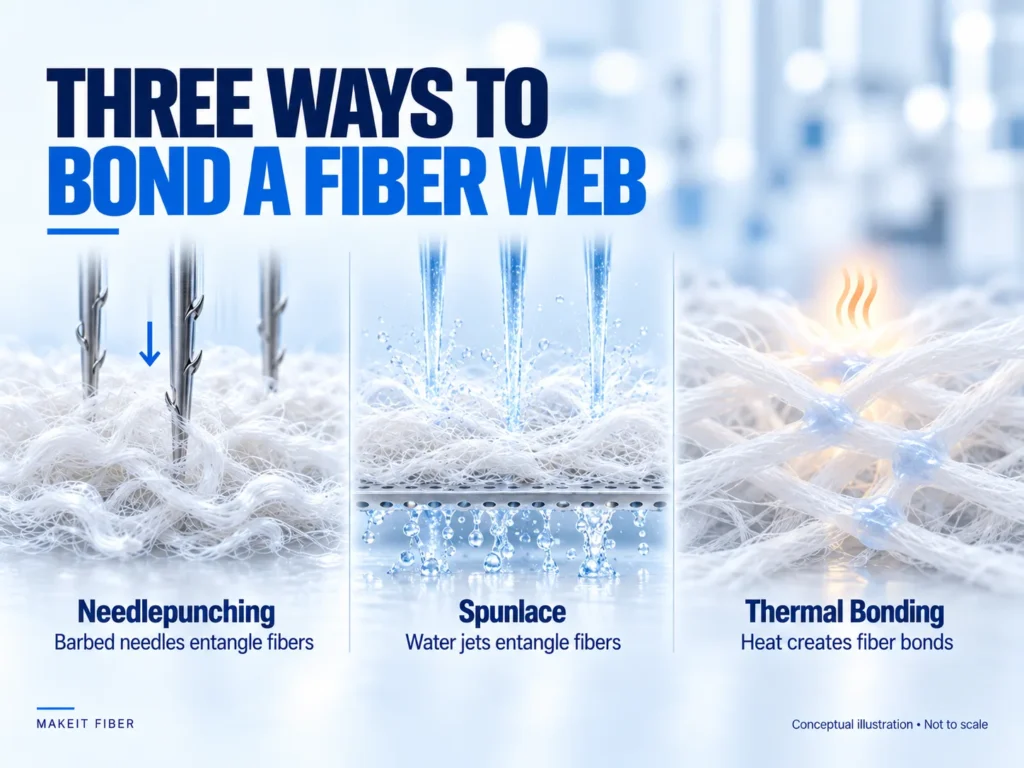
Web forming arranges the fiber into a web — carding, air-laid forming, wet-laid forming. Web bonding consolidates that web into a fabric — needlepunching, hydroentanglement (spunlace), thermal bonding. A fiber that suits one forming method won’t automatically suit every bonding method paired with it. That has to be checked, not assumed.
2.1 Carded Webs for Needlepunching
Needlepunching generally runs coarser, longer-cut fiber than hygiene-grade material, and it shows up across felts, geotextiles, filtration media, and automotive substrates.
Before ordering, confirm four things: what equipment and target fabric you’re running, which cut length, crimp level, and finish data actually matter for your card and needleloom, how you’ll document web uniformity and processing behavior during the trial, and which finished-fabric properties you’ll measure against your own spec.
There’s no universal “best” specification here. The right one is whatever gets validated on your own line.
2.2 Fibers for Spunlace Processing
Spunlace nonwovens — wipes, hygiene substrates — typically need finer, cleaner fiber than needlepunch grades. Before you commit to a fiber, check the intended end use and blend plan, the cleanliness level the process demands, whether a specific finish or low-foam requirement applies, and how carding, hydroentanglement, and finished-fabric results actually turn out in a trial.
One flag worth raising: fiber built for pillow or comforter filling is not automatically suited to spunlace. The cleanliness and finish requirements are different. Verify it — don’t assume it from a bedding-grade data sheet.
2.3 Thermally Bonded Webs and Binder Fibers
In thermally bonded nonwovens, two fibers do two different jobs. The base fiber gives bulk and structure. The binder fiber has a lower melting point, softens under heat, and bonds the web without adhesives.
The bonding system, the blend ratio, and the process temperature all need confirming for your specific combination of fiber and equipment. A number pulled from another supplier’s data sheet is a starting point, not a working parameter. For more on binder-fiber selection, see our Low Melt Fiber article.
Wet-laid and airlaid, briefly: these forming routes carry their own fiber-dimension and processing requirements. Don’t carry over carding-line cut-length guidance to either one — check them separately.
3. Why Matching Denier and Cut Length Is Not Enough
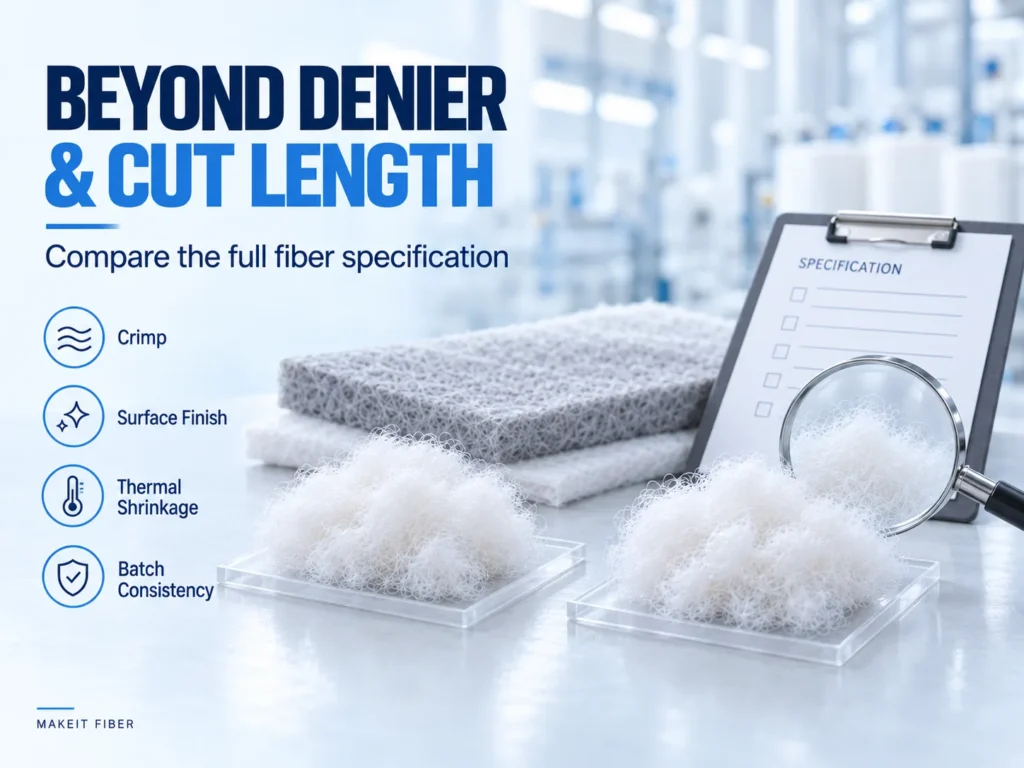
Same nominal denier. Same nominal cut length. Different fiber. That happens more often than spec sheets suggest, and it’s the single most common reason a “compatible” fiber underperforms on the line.
| Parameter | Buyer Question | Verification Approach |
|---|---|---|
| Denier / dtex | Are the units and agreed specifications consistent? | Review the specification sheet |
| Cut length consistency | How are length variation and abnormal long fibers controlled? | Request agreed inspection information |
| Crimp characteristics | What crimp information and test methods are available? | Compare supplier data and trial results |
| Surface finish | Is the finish suitable for the intended process? | Review finish information and run a trial |
| Tenacity and elongation | Do the properties match processing and product requirements? | Review relevant test results |
| Thermal shrinkage | Under what conditions was shrinkage measured? | Compare data under equivalent conditions |
| Cleanliness and color consistency | What acceptance criteria apply? | Agree on inspection requirements |
Two things to keep in mind when you’re comparing numbers across suppliers. First, a figure is only comparable if the test method and conditions behind it are comparable too — a shrinkage value from a different temperature or dwell time isn’t the same data point. Second, a matching product name or one set of nominal specs doesn’t prove equivalence. Tie every spec requirement back to your finished-product target and confirm it with a trial.
For denier-to-dtex conversion and the basics of cut length, that’s covered in our Polyester Staple Fiber Denier and Cut Length Guide — no need to repeat it here.
4. Virgin, Recycled and Low Melt Fibers: Different Selection Questions
These three terms get grouped together often. They shouldn’t be — they answer different questions.
Virgin vs. recycled is about raw-material source. Low melt is about a thermal-bonding function. A fiber can be recycled and low-melt at the same time. They’re not competing options on the same axis.
4.1 Virgin and Recycled PSF
The sourcing questions that actually matter: what raw-material-source requirements does your own customer or spec impose, what color, cleanliness, and batch consistency do you need, what traceability or documentation is required, and how does the fiber perform in your actual process and finished product?
Skip the shortcuts here. Virgin isn’t automatically higher-performing, and recycled isn’t automatically cheaper. Both depend on the specific grade, the supplier, and the application. Our Virgin vs. Recycled Polyester Staple Fiber article goes deeper on this comparison.
4.2 Low Melt Binder Fiber
Whether you need a binder fiber at all comes down to your product structure and bonding method — not the base fiber. Low-melt binder fibers are typically built with a lower-melting sheath or copolymer that softens and bonds other fibers under heat, and they show up across nonwovens, automotive insulation, hygiene, and filtration.
Any blend ratio or processing temperature still needs confirming against your own equipment and materials. Treat published figures as a reference point, not a fixed spec. More detail in our Low Melt Fiber article.
5. How to Evaluate Fiber Samples Before Bulk Orders
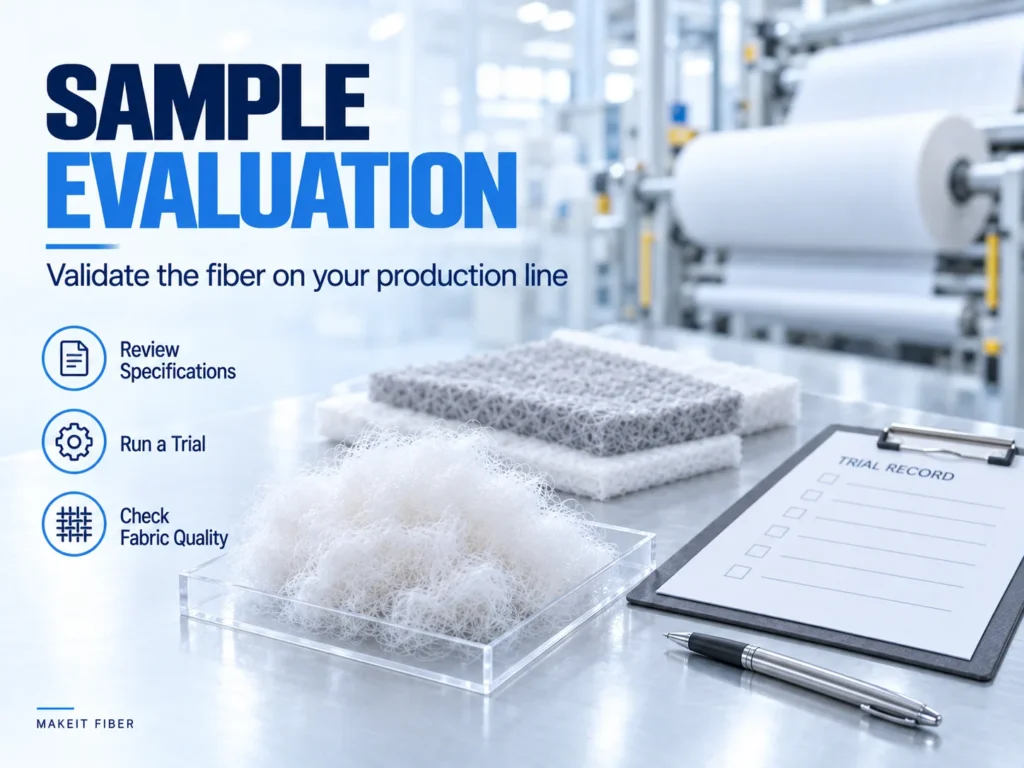
5.1 Review the Specification Sheet First
Check the sample ID and batch reference, the nominal specifications, the test conditions behind those numbers, any surface-finish information, and which purchasing documents apply.
5.2 Run a Controlled Production Trial
Record the fiber formulation or blend, the equipment and process conditions, the feed rate, the web-forming and processing behavior, and anything that went wrong. When you’re comparing multiple samples, hold conditions constant between runs. If you had to adjust something, note it — that adjustment is data too.
5.3 Evaluate the Finished Nonwoven
Pick the properties that matter for your end use: weight uniformity, thickness and hand feel, strength, dimensional change after heat treatment, or whatever else your customer specifies. Not every nonwoven needs every test.
| Fiber / Lot ID | Blend | Process Conditions | Processing Observations | Finished-Product Results | Decision |
|---|---|---|---|---|---|
Cost Check: Compare Fiber Cost per Accepted Output
Price per ton is the wrong number to compare if two fibers don’t process the same way. Track this instead: total fiber input cost, accepted finished-product weight, scrap or rework generated, and processing time or downtime during the trial.
Fiber cost per kg of accepted output = Total fiber input cost ÷ Accepted finished-product weight
This is a fiber-cost metric, not a full production-cost calculation — labor and energy aren’t in it. If fiber is blended, include every fiber input in the cost. And make sure any cross-supplier comparison uses the same accepted-output criteria. Without your own trial data, don’t estimate this number for a fiber you haven’t tested.
6. From Approved Sample to Bulk Delivery: What Buyers Should Confirm
A sample approval is a starting point, not a finish line. Four things turn it into a workable bulk order.
6.1 Document the Approved Sample
Keep the approved sample ID, its specifications, the trial conditions and results, and the scope both sides agreed the approval covers.
6.2 Agree on Purchase and Acceptance Requirements
Before the bulk order goes in, agree on the key parameters that matter for your process, the tolerance range around each one, the test methods, what inspection documentation the supplier provides, and how lot identification and traceability will work. Don’t assume a generic industry tolerance applies — confirm it for your specific material.
6.3 Discuss Change Notification
One question worth putting in writing: if the raw-material source, surface finish, or other agreed parameters change before a future shipment, does the supplier notify you first, and does that trigger re-confirmation? This is a negotiable purchasing term, not a standard you should assume exists by default.
6.4 Verify Incoming Material
On delivery, run the incoming inspection both sides agreed on, keep lot-level records, and compare against the approved sample where it matters.
| Stage | What to Record or Agree |
|---|---|
| Sample approval | Sample ID, specifications and trial results |
| Purchase confirmation | Acceptance criteria and test methods |
| Bulk delivery | Lot identification and agreed documentation |
| Incoming verification | Inspection results and comparison records |
7. What to Include in a Nonwoven Fiber RFQ
The more complete your inquiry, the faster and more accurate the response. Include:
End product and intended application
Web-forming and bonding process
Current or target fiber specifications
Blend composition, if applicable
Target fabric weight and performance requirements
Current processing or product issues
Sample quantity
Expected order volume
Delivery destination and target timing
That’s the difference between a supplier guessing at a spec and a supplier proposing one that’s actually right for your line.
8. Frequently Asked Questions
What denier and cut length should I choose for nonwoven production?
There’s no single specification that fits every application. It depends on your web-forming and bonding process, your equipment, your finished-fabric target, and what a trial confirms. Start with our Denier and Cut Length Guide for the underlying concepts.
Can recycled polyester staple fiber be used in nonwovens?
Yes, in many applications — but suitability depends on the specific grade, your process requirements, and quality consistency. A recycled source isn’t automatically equivalent to one fixed performance level, and it needs the same review and trial as any other fiber.
Is low melt fiber required for every polyester nonwoven?
No. It depends on the bonding method and product design. Needlepunched or hydroentangled fabrics don’t rely on a low-melt binder the way thermally bonded fabrics do.
Can the same PSF grade be used for needlepunching and spunlace?
Not automatically. Nominal specifications alone don’t answer this. Surface finish, cleanliness, and processing performance need checking for each route — needlepunch and spunlace place different demands on the fiber.
9. Discuss Your Nonwoven Fiber Requirements with MAKEIT
Evaluating polyester staple fiber for a nonwoven line? Share your end use, your web-forming and bonding process, and your target specifications. We’ll go through material options and sample requirements based on our current product range.