Color is one of those things buyers don’t think about.
Until it goes wrong.
A shade that looked perfect on the first shipment. Slightly off on the third. A repeat order that just doesn’t quite match the original, and nobody can figure out why.
A lot of these problems trace back to one thing: when the color was actually added to the fiber.
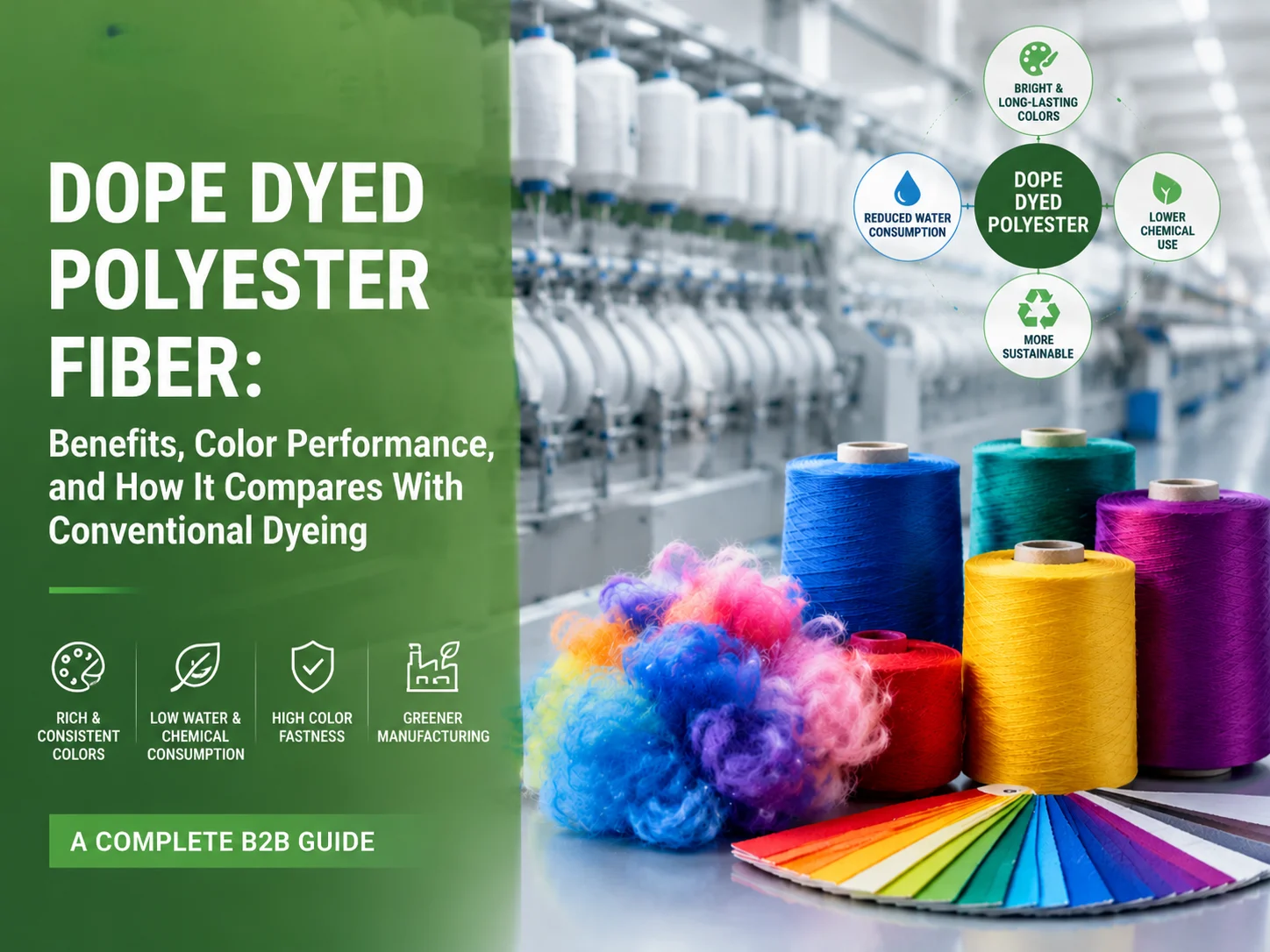
That’s where dope dyed polyester fiber comes in.
This guide breaks down what dope dyed polyester actually is, how it’s different from conventional dyeing, where it works well, and — this is the part most guides skip — how to approve a color properly before you commit to bulk production.
What Is Dope Dyed Polyester Fiber?
Dope Dyed, Solution Dyed, Spin Dyed: Same Idea, Different Names
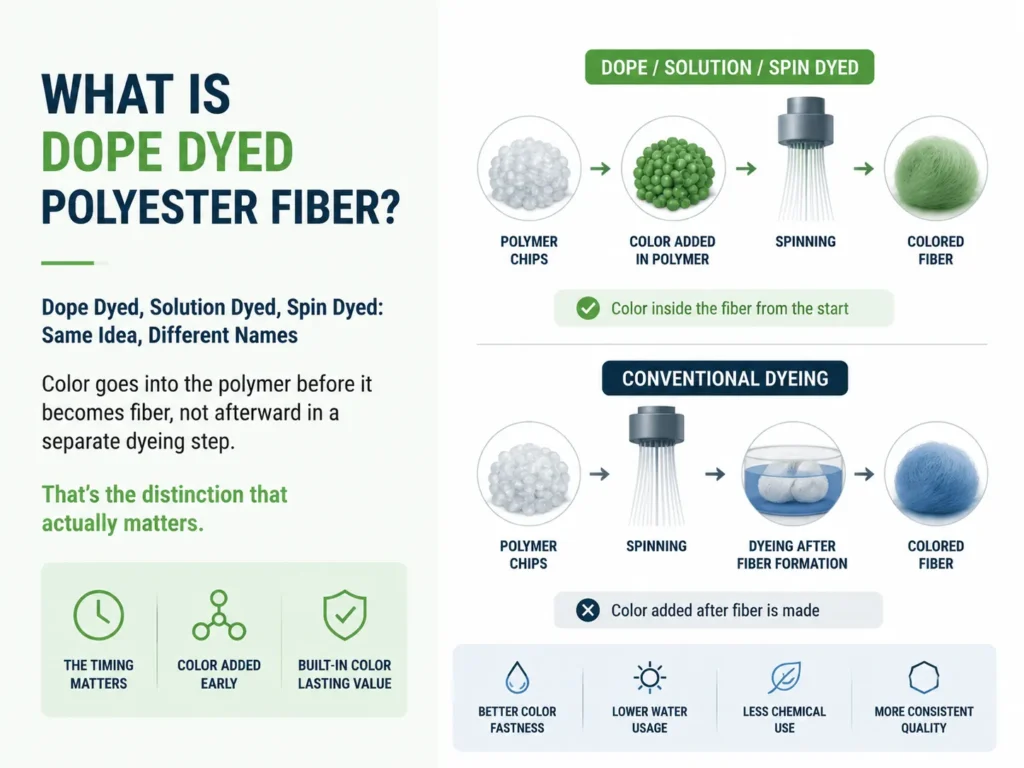
In polyester sourcing, you’ll hear “dope dyed,” “solution dyed,” and “spin dyed” used more or less interchangeably. All three describe the same core idea: color goes into the polymer before it becomes fiber, not afterward in a separate dyeing step.
That’s the distinction that actually matters. Not the name. The timing.
How It’s Different From Conventional Dyeing
Conventional dyeing starts with undyed fiber, yarn, or fabric. Color gets applied later, in a wet dyeing process.
Dope dyeing flips that order. Color masterbatch or pigment goes into the polymer before spinning. The fiber comes out already colored.
Here’s why that matters in practice: the color decision happens much earlier. Which means how you approve it — and how you manage it across repeat orders — needs to happen earlier too. More on that below.
For the bigger picture on how fiber properties shape finished products, see our guide on how textile fiber properties affect finished products. And if you’re still comparing fiber types more broadly, check out our polyester staple fiber types and specifications guide.
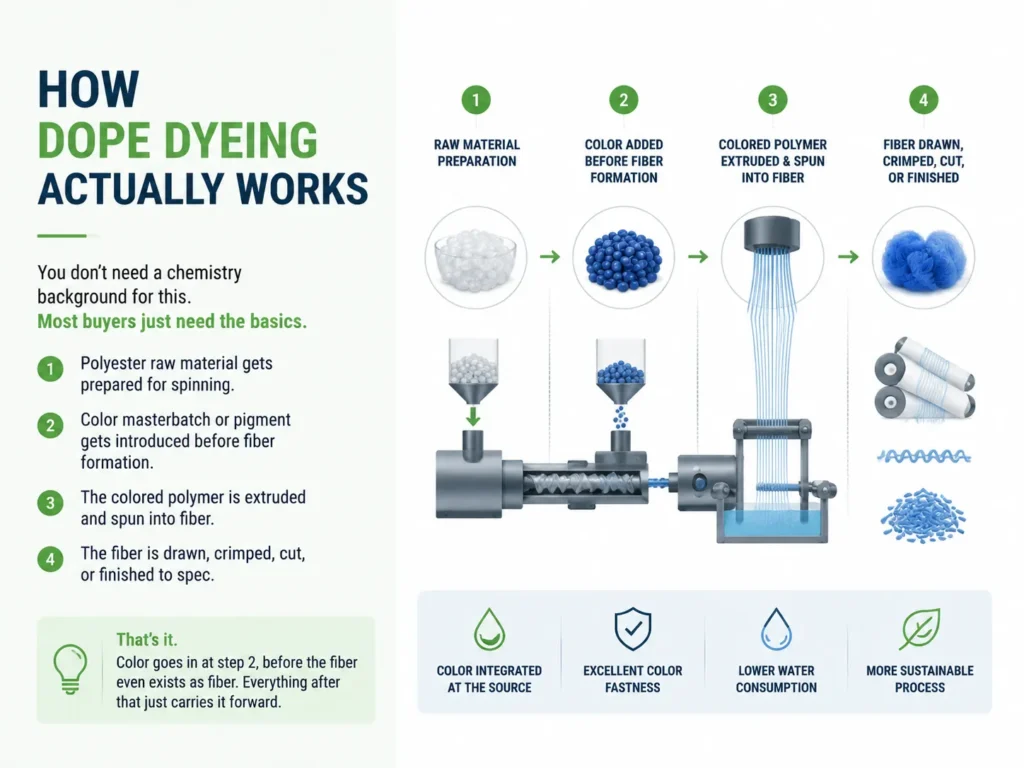
How Dope Dyeing Actually Works
You don’t need a chemistry background for this. Most buyers just need the basics.
- Polyester raw material gets prepared for spinning.
- Color masterbatch or pigment gets introduced before fiber formation.
- The colored polymer is extruded and spun into fiber.
- The fiber is drawn, crimped, cut, or finished to spec.
That’s it. Color goes in at step 2, before the fiber even exists as fiber. Everything after that just carries it forward.
How Dope Dyeing Actually Works
You don’t need a chemistry background for this. Most buyers just need the basics.
- Polyester raw material gets prepared for spinning.
- Color masterbatch or pigment gets introduced before fiber formation.
- The colored polymer is extruded and spun into fiber.
- The fiber is drawn, crimped, cut, or finished to spec.
That’s it. Color goes in at step 2, before the fiber even exists as fiber. Everything after that just carries it forward.
Key Benefits of Dope Dyed Polyester Fiber
More Consistent Color Across Production
Since color is built in at the fiber stage instead of applied later, dope dyed polyester tends to hold a target shade more consistently across large or repeat orders.
Tends to. Not automatically. Actual consistency still comes down to masterbatch quality, process control, and how tightly the original color was approved and documented.
Strong Color Durability for the Right Applications
Dope dyed polyester shows up a lot in applications where wash durability, rub resistance, or light exposure matter. It can perform well here.
But “good colorfastness” isn’t a blanket guarantee. What you actually need depends on the end use — we’ll get specific about that in a minute.
A Simplified Coloration Route
Skip the separate wet-dyeing stage, and some projects reduce the water, chemicals, and processing steps needed downstream.
Worth flagging: the actual reduction depends heavily on your specific process and what you’re comparing it against. If you see a specific water-savings or carbon-reduction percentage floating around online, treat it with some skepticism unless it’s backed by an actual study.
Better Planning for Repeat Programs
Once a color is approved at the fiber stage, it’s easier to build a repeatable spec around it. This matters most for long-running programs — home textile lines, automotive programs, branded products — where matching last year’s shade to this year’s order actually counts for something.
Dope Dyed vs. Conventional Dyed Polyester
Neither one wins across the board. Here’s how they actually stack up.
| Factor | Dope Dyed Polyester Fiber | Conventionally Dyed Polyester |
|---|---|---|
| When color is added | Before or during fiber spinning | After fiber, yarn, or fabric formation |
| Color consistency | Highly consistent when color and process are controlled | Depends on dyeing process, substrate, and batch control |
| Color flexibility | Best for approved, repeatable colors | More flexible for small runs or frequent color changes |
| Wet-processing demand | Can reduce need for later wet dyeing | Typically requires a downstream dyeing stage |
| Buyer focus | Color approval, MOQ, masterbatch control, repeat consistency | Dye method, shade matching, dyehouse capability, finishing |
Bottom line: dope dyed polyester is strong for stable, repeatable color programs. Conventional dyeing usually makes more sense for frequent color changes, smaller quantities, or complex post-dyeing effects like gradients or overdyeing.
Where Dope Dyed Polyester Fiber Gets Used
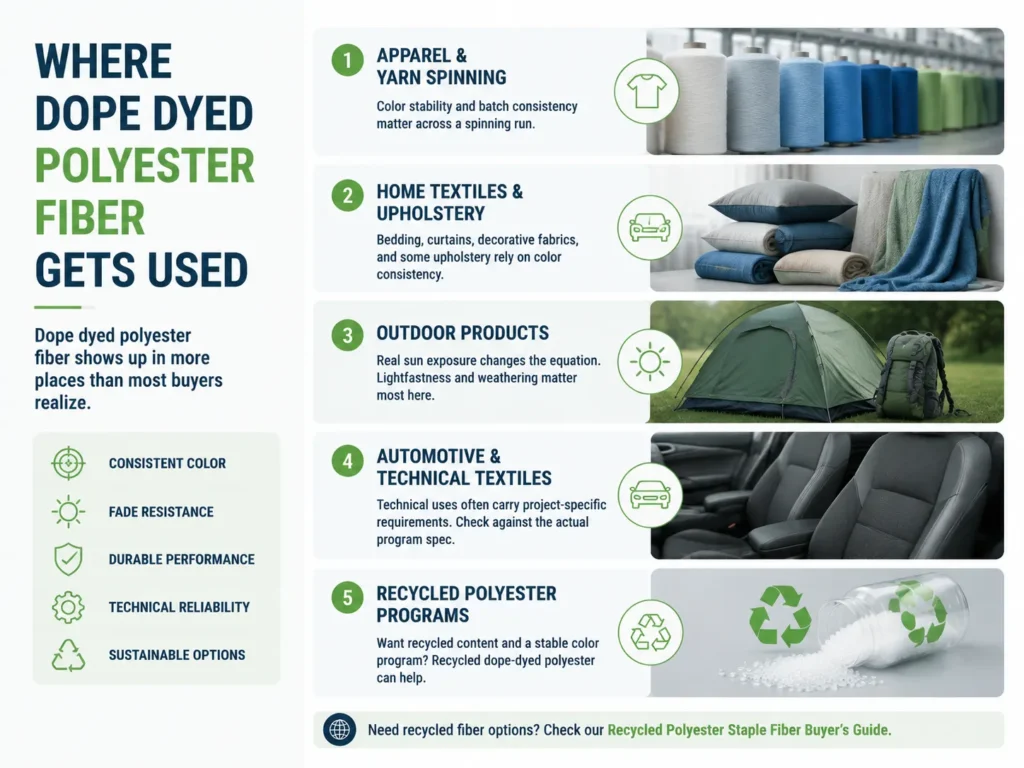
Apparel and Yarn Spinning
Color stability and batch consistency matter across a spinning run. Fineness, cut length, spinnability, and target shade all need to be confirmed together, not one at a time.
Home Textiles and Upholstery
Bedding, curtains, decorative fabrics, and some upholstery lean on dope dyed polyester’s color consistency. Watch for shade variation and whether the supplier can hold the same color across orders placed months or years apart.
Outdoor Products
Real sun exposure changes the equation. Lightfastness and weathering matter more here than how good the color looks on day one. Don’t skip sample testing — outdoor performance is exactly where assumptions get expensive.
Automotive and Technical Textiles
Interior trim, acoustic materials, and other technical uses often carry project-specific requirements around lightfastness, heat aging, odor, or flame retardancy. These need to be checked against the actual program spec, not a generic datasheet.
Recycled Polyester Programs
Need both a recycled-content target and a stable color program? Recycled dope-dyed polyester can sometimes cover both. Worth a direct conversation with your supplier about what’s actually available. For more on sourcing recycled fiber, see our recycled polyester staple fiber buyer’s guide.
Which Color Performance Tests Actually Matter?
Here’s something that gets glossed over constantly: “good colorfastness” isn’t one universal requirement. What you should test for depends entirely on where the fiber ends up.
| End Use | Priority Color Checks | Why It Matters |
|---|---|---|
| Apparel and home textiles | Wash fastness, rubbing fastness, shade consistency | Appearance after repeated care and daily use |
| Outdoor products | Lightfastness, weathering, shade stability | UV exposure changes perceived color over time |
| Automotive interiors | Lightfastness, heat aging, batch consistency | Long-term appearance across a multi-year program |
| Nonwovens and industrial products | Batch consistency, thermal-process stability | Color needs to survive conversion processing |
Confirm the specific test method and acceptance criteria for your application before finalizing anything. A general colorfastness claim on a spec sheet isn’t the same thing.
How to Approve a Dope-Dyed Color Before Bulk Production
This is the step that saves you from the “the color doesn’t match” call three months from now.
Step 1: Provide a Clear Color Reference
Pantone code. Physical swatch. Approved fabric sample. Whatever you use, make it something concrete. “Navy blue” leaves way too much room for interpretation.
Step 2: Define Viewing Conditions and Tolerance
What lighting is this judged under? What tolerance is actually acceptable? For anything high-stakes, get this into the technical spec or quality agreement — not just a conversation nobody wrote down.
Step 3: Test the Sample in Your Actual Process
Start with the fiber sample. Then push for testing in the real yarn, fabric, or nonwoven process if you can. Color looks different once it’s spun, woven, or bonded compared to raw fiber.
Step 4: Approve a Production Reference
Once it checks out, lock in the approved sample, color code, and test requirements as your official reference. For repeat orders, this reference is what every new batch gets checked against. Not memory. Not “it looked about right.”
When Dope-Dyed Fiber Might Not Be the Right Call
Not every color program fits this approach, and it’s worth being straight about that.
- Small or frequently changing color runs. Developing and approving a masterbatch takes time and usually comes with a minimum order quantity. Changing colors every few weeks? This will slow you down more than help.
- Complex visual effects. Gradients, prints, overdyeing — these usually need a more flexible dyeing route than dope dyeing offers.
- Unconfirmed performance requirements. Strict lightfastness or compliance needs? Test samples before committing to bulk. Don’t assume “dope dyed” automatically clears the bar.
- Late-stage design changes. The color locks in early here. Changing your mind after approval is more disruptive than it might be with conventional dyeing.
What to Confirm Before You Order
Approved color reference and acceptable shade tolerance
- Fiber type, denier, cut length, crimp, structure, and finish
- Required colorfastness or weathering test methods and acceptance criteria
- Whether recycled content or specific documentation is needed
- MOQ, color-development lead time, and repeat-order lead time
- Sample and production reference-approval process
- Batch consistency, packaging, labeling, and traceability expectations
FAQ
What is dope dyed polyester fiber?
Polyester fiber colored by adding masterbatch or pigment before spinning, rather than through a separate dyeing step afterward. Also commonly called solution dyed polyester.
Is dope dyed the same as solution dyed?
Usually used interchangeably in polyester sourcing, but it’s worth confirming your supplier’s exact process and specification when placing an order.
Is dope dyed polyester more colorfast?
It can offer strong color durability for suitable applications, but the real requirement depends on end use, test method, and acceptance criteria for your specific project.
Can dope dyed polyester match a Pantone color?
Yes, colors can be developed against a Pantone code or physical swatch, but always confirm with an actual sample before bulk production — not just the color code.
What is the difference between dope dyed and piece dyed polyester?
Dope dyed fiber is colored before spinning. Piece dyed material is colored afterward, usually at the fabric stage. This affects color consistency, flexibility, and how repeat orders get managed.
Is dope dyed fiber suitable for recycled polyester?
It can be, depending on the supplier’s material and process capabilities. Confirm directly whether recycled content and dope dyeing can be combined for your target color and application.
Work With MAKEIT for Dope Dyed Fiber Solutions
The right color solution isn’t just about matching a Pantone number. It depends on your application, your performance requirements, your order volume, and how consistently that color needs to hold across repeat production.
MAKEIT is a polyester staple fiber manufacturer supplying spinning mills, nonwoven producers, home textile brands, and industrial converters across global markets. Alongside dope-dyed polyester staple fiber, our product range includes virgin, recycled, hollow conjugated, low melt, and functional fiber options — supported by quality systems including ISO 9001, ISO 14001, and ISO 45001, along with GRS certification for recycled-content programs.
Our team works directly with customers on color reference review, sample approval, and specification documentation, so what gets approved at the sample stage is what actually shows up in your production run — order after order.