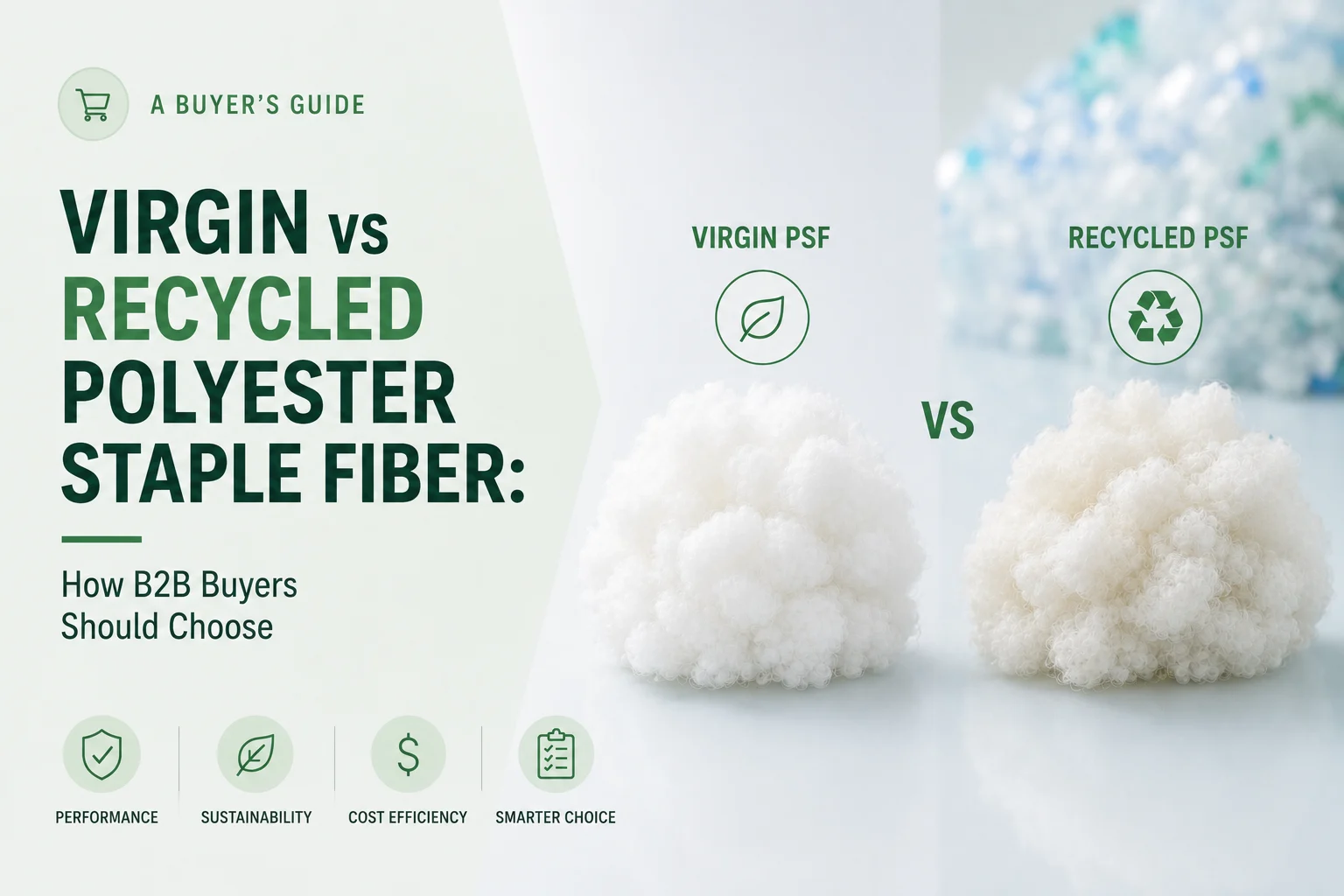
If you’ve priced out polyester staple fiber recently, you’ve heard both pitches.
“Virgin fiber performs better.”
“Recycled fiber is the responsible choice.”
Here’s the problem: both pitches are selling you a shortcut. And shortcuts are exactly how buyers end up with a container of fiber that doesn’t match the sample.
The real answer is less exciting but a lot more useful: virgin and recycled polyester staple fiber can both work — or both fail — depending on how closely the actual fiber specification matches what you’re building. The raw material source is one input. It’s not the decision.
In this guide, I’ll show you exactly how to make that decision, including:
- What genuinely differs between virgin and recycled PSF — and what doesn’t
- Whether one is actually “better” (spoiler: wrong question)
- How to choose by application, from pillow filling to nonwoven to spinning
- The five questions that prevent a bad sourcing call
- Why two suppliers can quote the “same spec” and ship different fiber
- What GRS certification actually proves — and where buyers get it wrong
Let’s dig in.
What Is the Difference Between Virgin and Recycled Polyester Staple Fiber?
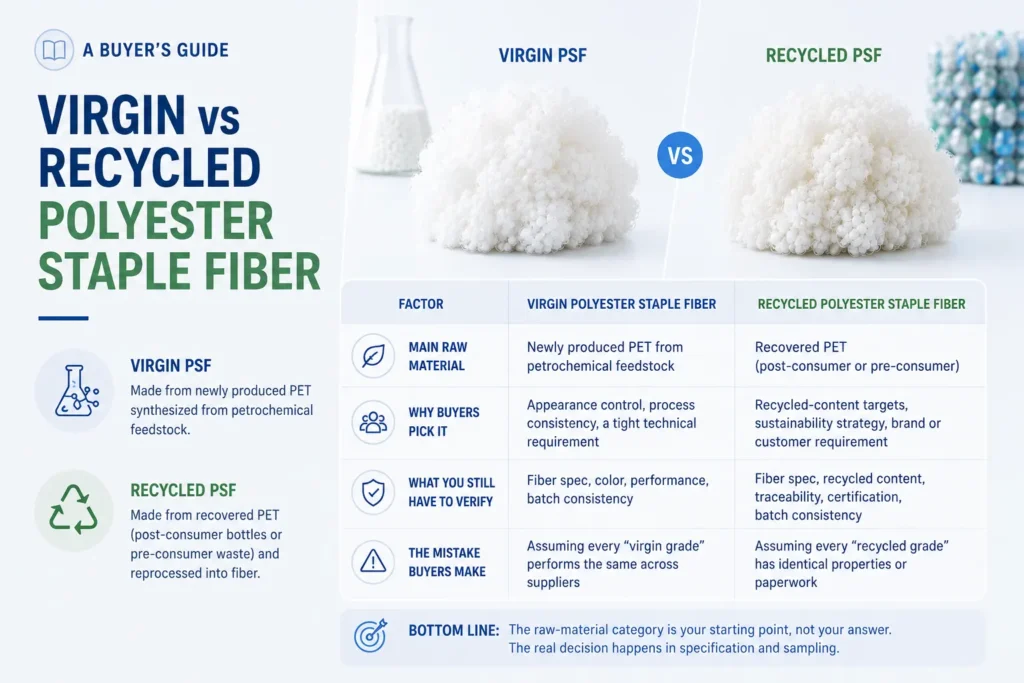
At the raw-material level, it’s simple:
- Virgin polyester staple fiber comes from newly produced PET, synthesized from petrochemical feedstock.
- Recycled polyester staple fiber comes from recovered PET — usually post-consumer bottles or pre-consumer production waste — reprocessed into fiber-grade polymer.
That’s where most comparisons stop. It’s also where they stop being useful.
Here’s what that one-line definition doesn’t tell you: how the fiber will actually perform, look, or run on your production line. That comes down to feedstock purity, processing conditions, fiber design, and quality control — and both virgin and recycled fiber can be done well or done badly.
| Factor | Virgin Polyester Staple Fiber | Recycled Polyester Staple Fiber |
|---|---|---|
| Main raw material | Newly produced PET from petrochemical feedstock | Recovered PET (post-consumer or pre-consumer) |
| Why buyers pick it | Appearance control, process consistency, a tight technical requirement | Recycled-content targets, sustainability strategy, brand or customer requirement |
| What you still have to verify | Fiber spec, color, performance, batch consistency | Fiber spec, recycled content, traceability, certification, batch consistency |
| The mistake buyers make | Assuming every “virgin grade” performs the same across suppliers | Assuming every “recycled grade” has identical properties or paperwork |
Bottom line: the raw-material category is your starting point, not your answer. The real decision happens in specification and sampling — which is exactly what most sourcing guides skip.
[Internal link: see Recycled Polyester Staple Fiber for the full breakdown of recycled PSF production and applications, and What Is Polyester Staple Fiber? for fiber structure basics.]
Is Virgin or Recycled Polyester Fiber Better?
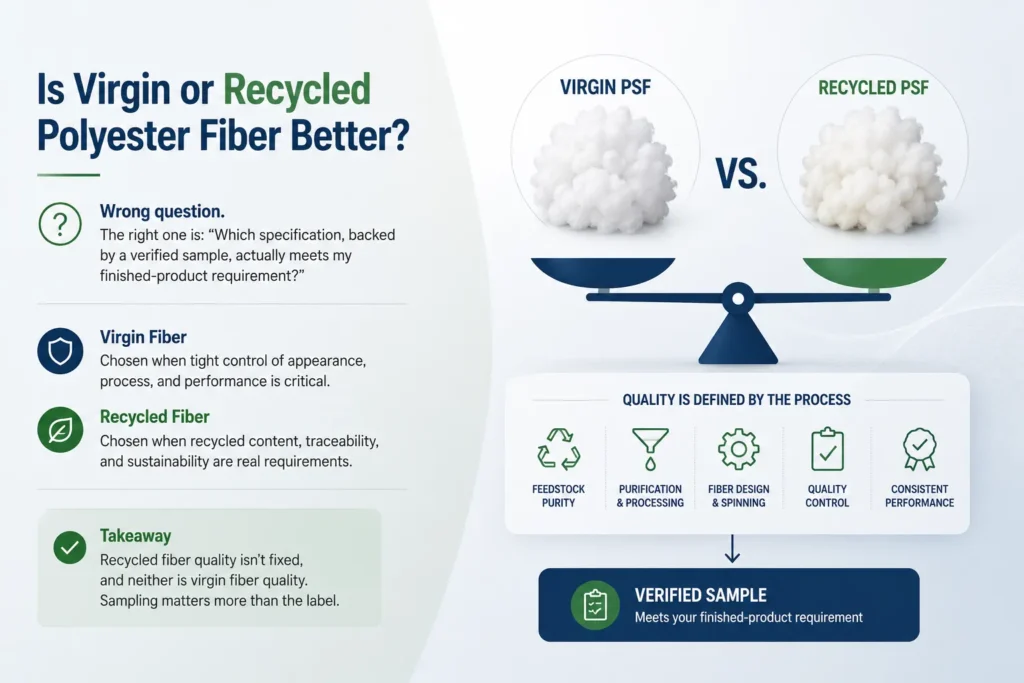
Wrong question. Here’s the right one: “which specification, backed by a verified sample, actually meets my finished-product requirement?”
But let’s answer the wrong question anyway, because it’s worth understanding why it doesn’t hold up.
Virgin fiber usually gets picked when a project needs tight control — a specific look, a locked-in processing profile, a performance target the buyer isn’t willing to gamble on. Recycled fiber usually gets picked when recycled content or traceability is a real requirement, not just a nice-to-have — and for a growing number of buyers, it now is a hard requirement from their own customers.
Now here’s where it gets interesting. The research on recycled PET performance doesn’t land cleanly on either side.
Under well-controlled conditions — clean feedstock, optimized purification and processing — mechanically recycled PET can be spun into fiber that approaches virgin PET performance. That’s a real finding, not marketing copy.
But flip to a different study, and the picture changes: contamination from bottle caps, labels, and mixed feedstock, combined with repeated thermomechanical processing, can measurably knock down strength and degradation resistance compared with virgin PET.
Same raw material category. Two very different outcomes. The variable isn’t “recycled vs. virgin” — it’s how tightly the process was controlled.
Takeaway: recycled fiber quality isn’t fixed, and neither is virgin fiber quality. That’s exactly why sampling matters more than the label on the spec sheet.
How to Choose Between Virgin and Recycled PSF by Application
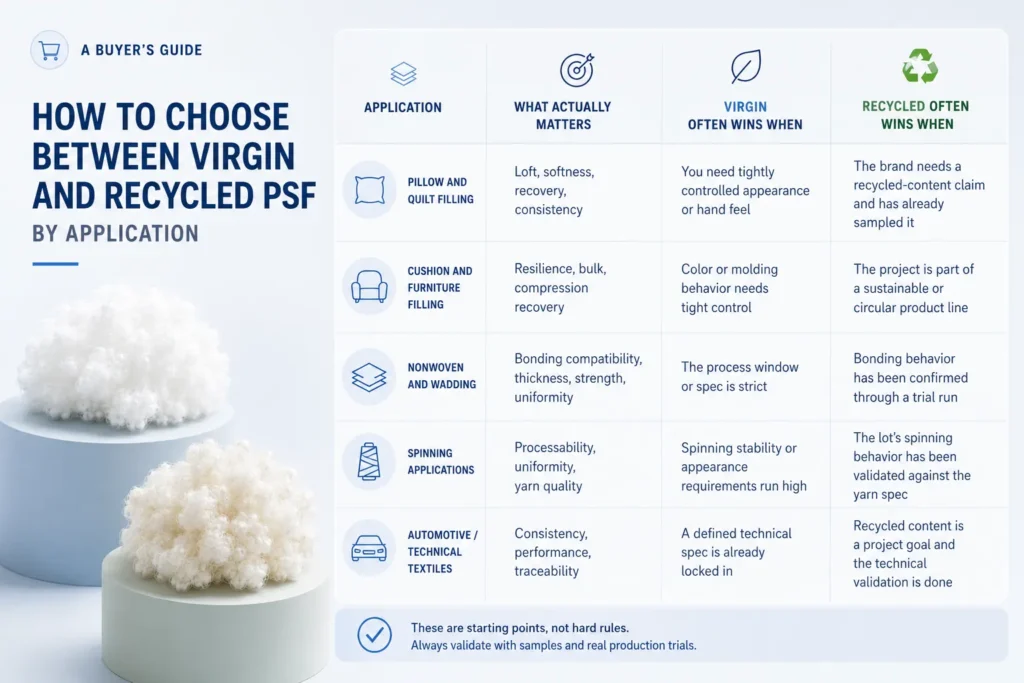
Let’s get concrete. Here’s how the decision typically plays out by end use — treat these as starting points, not rules carved in stone.
| Application | What Actually Matters | Virgin Often Wins When | Recycled Often Wins When |
|---|---|---|---|
| Pillow and quilt filling | Loft, softness, recovery, consistency | You need tightly controlled appearance or hand feel | The brand needs a recycled-content claim and has already sampled it |
| Cushion and furniture filling | Resilience, bulk, compression recovery | Color or molding behavior needs tight control | The project is part of a sustainable or circular product line |
| Nonwoven and wadding | Bonding compatibility, thickness, strength, uniformity | The process window or spec is strict | Bonding behavior has been confirmed through a trial run |
| Spinning applications | Processability, uniformity, yarn quality | Spinning stability or appearance requirements run high | The lot’s spinning behavior has been validated against the yarn spec |
| Automotive / technical textiles | Consistency, performance, traceability | A defined technical spec is already locked in | Recycled content is a project goal and the technical validation is done |
Notice something? Every single “recycled wins” column ends with proof — a sample, a trial, a validation. That’s not a coincidence. Recycled content is a sourcing decision. It’s not a performance guarantee. Treat it like one and you’ll find out the hard way, at scale.
Five Questions That Prevent a Bad Sourcing Call
This is the section that actually saves you money. Run through these before you commit to either option on a new program.
1. What does the finished product actually need?
Pillow, quilt, wadding, nonwoven, spinning, automotive? Are you optimizing for softness, loft, resilience, strength, or bonding — or is recycled content itself the requirement your customer is handing you?
2. What’s the real fiber specification?
Solid, hollow, hollow conjugated, siliconized? What denier, cut length, crimp, and finish does this call for? Is there an agreed tolerance — or is “close enough” a problem waiting to happen on your line?
3. How much color consistency do you actually need?
Raw white, optical white, colored, dope-dyed? How sensitive is the finished product to whiteness, black specks, or batch-to-batch drift? Here’s a tip: this is exactly where recycled fiber quality tends to vary more than buyers expect. Check it early — not after a full container has shipped.
4. Is recycled content a target, a claim, or a certification requirement?
Most buyers skip this question. It’s also the one that causes the most damage later.
“Using recycled material” and “being able to make a certified recycled-content claim” are two different things. If your customer requires GRS or a specific recycled-content claim, don’t take a supplier’s word for it — and don’t take a certificate logo on a homepage as proof, either.
Here’s how GRS actually works: a Scope Certificate shows that a facility is certified to process recycled material under the standard. That’s a statement about the factory. It’s not proof about your shipment.
Proof for your specific order comes from a Transaction Certificate (TC) tied to that batch, documenting the pre-consumer and post-consumer recycled content for that lot. If you need a claim that holds up, ask for the TC matched to your order — not just the general certificate.
5. Has this actually been through samples and a production trial?
Don’t approve bulk volume off a data sheet and a product photo. Here’s the sequence that actually protects you:
text
Specification discussion ↓ Initial sample ↓ Finished-product evaluation ↓ Pilot production trial ↓ Technical approval ↓ Bulk order with agreed batch requirements
Skip straight from spec sheet to bulk order, and that’s where most virgin-vs-recycled problems actually start. It’s rarely the raw material’s fault — it’s the missing step in between.
Why "Same Specification" Doesn't Mean Same Performance
Here’s something that trips up even buyers who’ve been doing this for years.
Two suppliers can quote the exact same listing — “7D × 64mm hollow conjugated recycled polyester fiber” — and ship you noticeably different fiber. Same words on the page. Different material in your hands.
What’s hiding behind an identical-looking spec sheet:
- Raw material source and feedstock purity
- Recycled content type and percentage
- Fiber structure consistency
- Crimp uniformity
- Siliconized finish quality
- Whiteness and visual consistency
- How the fiber opens on your specific line
- Bulkiness and loft
- Packing compression and bale handling
- Batch-to-batch control
- The actual production equipment behind the label
Takeaway: a product name is not a quality specification. It’s a starting point for a conversation. Before you approve bulk production, compare actual technical data, sample behavior, finished-product performance, and traceability documents — not just the headline spec.
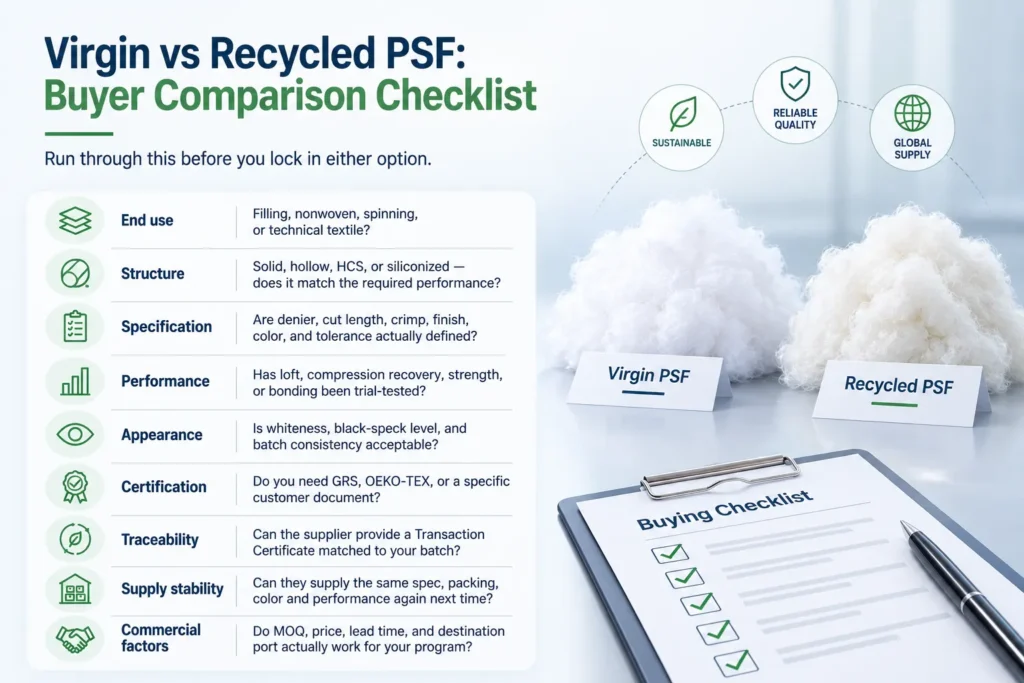
Virgin vs Recycled PSF: Buyer Comparison Checklist
Run through this before you lock in either option:
| Decision Area | What to Check Before Choosing |
|---|---|
| End use | Filling, nonwoven, spinning, or technical textile? |
| Structure | Solid, hollow, HCS, or siliconized — does it match the required performance? |
| Specification | Are denier, cut length, crimp, finish, color, and tolerance actually defined? |
| Performance | Has loft, compression recovery, strength, or bonding been trial-tested? |
| Appearance | Is whiteness, black-speck level, and batch consistency acceptable? |
| Certification | Do you need GRS, OEKO-TEX, or a specific customer document? |
| Traceability | Can the supplier provide a Transaction Certificate matched to your batch? |
| Supply stability | Can they supply the same spec, packing, color, and performance again next time? |
| Commercial factors | Do MOQ, price, lead time, and destination port actually work for your program? |
Frequently Asked Questions
Is recycled polyester staple fiber as strong as virgin polyester fiber?
It depends entirely on feedstock purity and how the recycling process was controlled. Under well-controlled conditions, mechanically recycled PET fiber can approach virgin-fiber performance. Under less controlled conditions — contamination, mixed feedstock, repeated reprocessing — strength and degradation resistance can measurably drop. This is exactly why sample testing beats trusting the label.
Can recycled polyester fiber be used for pillow and quilt filling?
Yes — as long as the fiber specification, color consistency, and any required certification actually match what the finished product needs. Validate it with samples. Don’t assume it behaves identically to virgin fiber out of the gate.
Is GRS certification enough to prove a shipment contains recycled material?
Not on its own. A Scope Certificate confirms the facility is certified to handle recycled material. It doesn’t verify any single order. For that, you need the Transaction Certificate tied to your specific batch.
What is the difference between post-consumer and pre-consumer recycled polyester?
Post-consumer material comes from products that already completed their use cycle — think PET bottles. Pre-consumer material comes from production waste that never reached a consumer. Both can count as recycled content, but the type and percentage should be documented per batch, especially if you need a specific claim.
When should a buyer choose virgin polyester staple fiber?
When the project needs tightly controlled appearance, a locked-in processing profile, or a performance target you’re not willing to re-validate against a variable feedstock. It’s a specification call, not a “safer default.”
Can virgin and recycled polyester staple fiber be blended?
Often, yes. Blends balance cost, appearance, recycled-content targets, and performance. Confirm the ratio through sampling and a production trial — don’t lift it from a general guideline.
What should buyers test before approving recycled polyester fiber?
At minimum: fiber spec match, color and appearance consistency, how it processes on your actual equipment, finished-product performance, and the documentation you’ll need for any recycled-content claim.
Ready to Lock In the Right Specification?
Since 2007, MAKEIT has been supplying polyester staple fiber — both virgin and recycled — to bedding, filling, nonwoven and textile manufacturers worldwide. Our recycled fiber is GRS certified, and our production is backed by ISO 9001, ISO 14001 and ISO 45001 systems, with testing referenced against Intertek and SGS standards. We’ve also supplied fiber into supply chains serving brands such as Inditex, so we know what “verified” actually needs to look like on paper — not just on a spec sheet.
Tell us your end use, target specification, and whether you need a recycled-content claim or certification. We’ll help you evaluate the right fiber option — virgin, recycled, or a blend — before you commit to a sample or a quote.