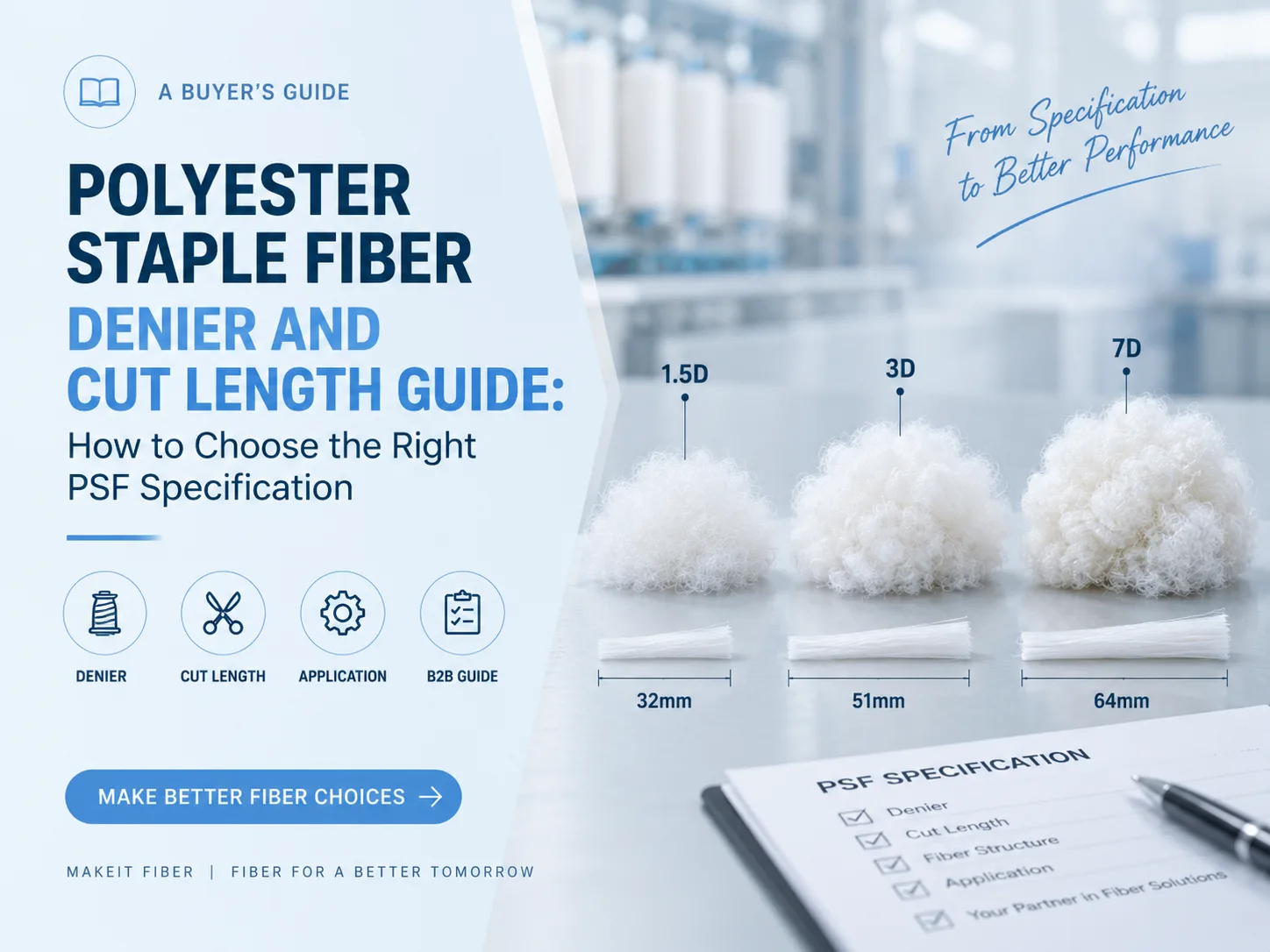
A specification like 1.5D × 38mm or 7D × 64mm looks simple enough — two numbers, done. But those two numbers influence processing compatibility, softness, bulk, resilience and how the finished product actually performs once it leaves your production line.
This is also where a lot of sourcing comparisons go wrong. Buyers frequently compare polyester staple fiber (PSF) using denier and cut length alone, assume that matching numbers means matching fiber, and place an order based on that assumption. It’s an understandable shortcut. It’s also how mismatched samples and inconsistent bulk shipments happen.
This guide walks through how to read, compare and validate a PSF specification before you sample or place a bulk order — including:
- What denier actually tells you (and what it doesn’t)
- What cut length affects in processing and in the finished product
- How to match both to your end use and your equipment
- Why two suppliers quoting the same “7D × 64mm” can ship noticeably different fiber
- Why the number on a purchase order isn’t the same as what a production batch actually delivers
Quick Reference: Common Polyester Staple Fiber Denier and Cut Lengths
Before getting into the detail, here’s a general reference point for how denier and cut length tend to cluster by use case.
| PSF Range | Typical Cut Length | General Direction |
|---|---|---|
| <1D–1.2D | 25–38mm | Microfiber / fine applications |
| 1.2D–2D | 32–51mm | Spinning / fine nonwoven |
| 3D–6D | 38–64mm | Nonwoven / filling |
| 7D–15D | 51–64mm | Filling / padding |
| 15D+ | 64mm+ | Coarse filling / industrial applications |
Important: these are general starting points based on common market practice, not universal purchasing specifications. The right combination for your project depends on your equipment, your process, and the finished-product target — all covered below.
What Does Denier Mean in Polyester Staple Fiber?
How Denier Is Calculated
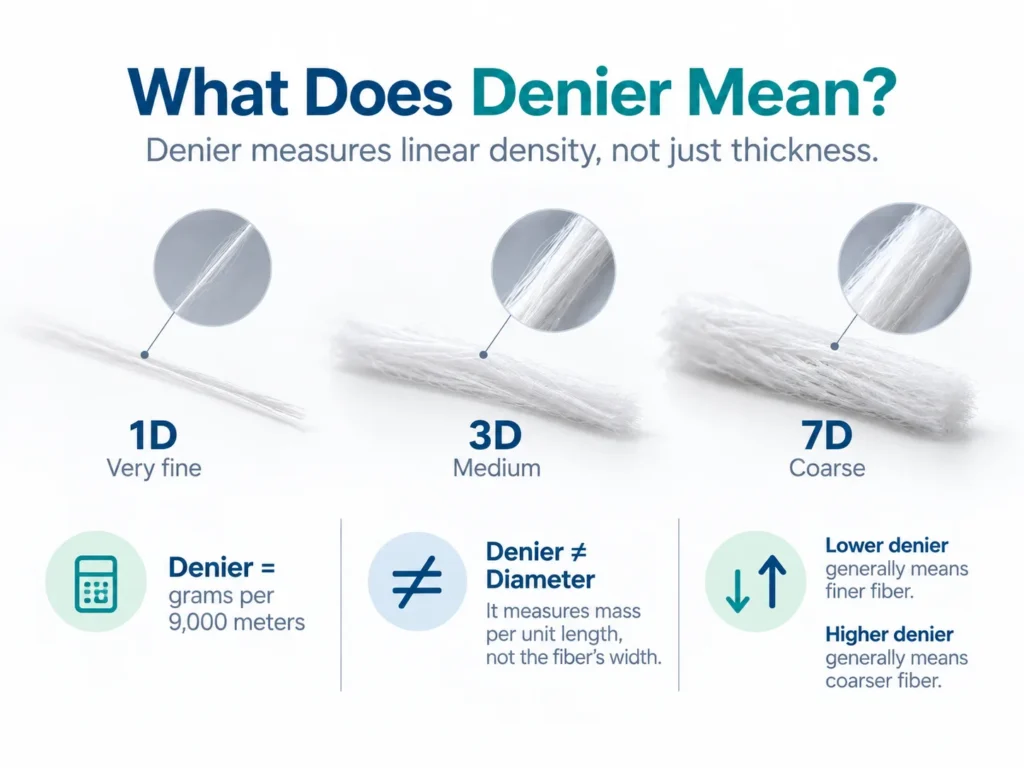
Denier measures how much a fixed length of fiber weighs. Specifically, it’s grams per 9,000 meters of fiber.
- 1D → 9,000 meters weighs 1 gram
- 3D → 9,000 meters weighs 3 grams
- 7D → 9,000 meters weighs 7 grams
A lower denier generally means a finer fiber. But — and this matters more than it sounds — denier is a measurement of linear mass density. It is not, on its own, a measurement of physical diameter. More on that in a moment.
Fine vs Medium vs Coarse Denier PSF
Changing the denier changes several things at once:
- Softness — finer fibers generally feel softer against the skin or in a finished textile
- Bulk — at the same total mass, finer fibers mean more individual fibers, which can affect loft and volume
- Resilience — coarser fibers often contribute more structural support and recovery
- Surface area — finer fibers have more surface area per unit mass, which can affect bonding, dye uptake and friction
- Processing behavior — carding, drafting and blending behavior change with fiber fineness
None of this means “finer is always better” or “coarser is always better.” A fine-denier fiber that feels great in a spinning blend may be the wrong choice for a filling application that needs bulk and recovery. The right denier depends on what you’re building, not on a general preference for fine or coarse fiber.
Denier Is Not the Same as Fiber Diameter
This is one of the more common misunderstandings in PSF sourcing, and it’s worth being precise about.
Denier tells you linear mass density — grams per 9,000 meters. Diameter is a physical dimension — how wide the fiber actually is. The two are related, but not interchangeable, because the same denier can correspond to different actual cross-sectional dimensions depending on:
- Solid vs. hollow construction — a hollow fiber has a lower effective cross-sectional mass than a solid fiber of the same outer diameter, so a hollow fiber at a given denier may have a larger physical diameter than a solid fiber at the same denier
- Round vs. shaped cross-section — trilobal, conjugated or other shaped cross-sections distribute mass differently than a simple round fiber
- Hollow ratio — for hollow fiber, the percentage of the cross-section that’s hollow directly affects how denier translates to physical size
- Polymer density — different polymer formulations can carry slightly different densities, which shifts the mass-to-diameter relationship
Key takeaway: denier is a useful specification for comparing linear density between fibers, but it doesn’t fully describe the geometry of a polyester staple fiber. Two fibers rated at the same denier can look and feel different in your hand if one is solid and the other is hollow.
Denier vs dtex: How to Read International PSF Specifications
If you’re sourcing internationally, you’ll run into both denier and dtex on technical data sheets — sometimes on the same sheet from different suppliers.
- 1 denier ≈ 1.111 dtex
- 1 dtex = 1 gram per 10,000 meters
| Denier | Approx. dtex |
|---|---|
| 1D | 1.11 dtex |
| 1.2D | 1.33 dtex |
| 1.5D | 1.67 dtex |
| 3D | 3.33 dtex |
| 7D | 7.78 dtex |
| 15D | 16.67 dtex |
This isn’t just a unit-conversion footnote. When you’re comparing quotes from suppliers in different regions, a spec sheet quoted in dtex versus one quoted in denier can look like two different fibers when they’re actually close to identical. Converting to a common unit before comparing avoids a false mismatch — or worse, a false match.
What Does Cut Length Mean in Polyester Staple Fiber?
Cut length is the nominal length of each individual staple fiber after the continuous filament tow is cut. Common lengths in the market include 25mm, 32mm, 38mm, 44mm, 51mm, 64mm and 76mm.
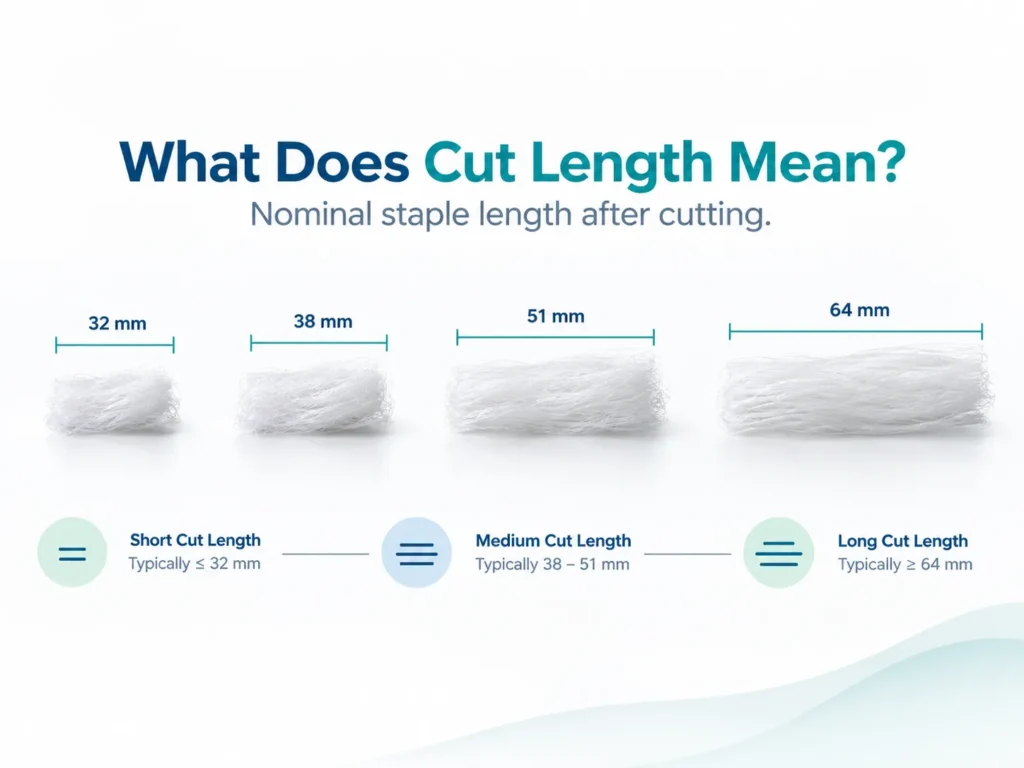
Why Are 32mm, 38mm, 51mm and 64mm Common?
These lengths didn’t emerge randomly — they align with established processing systems in spinning, nonwoven and filling equipment that have been built and calibrated around certain staple-length ranges over decades of industry practice. That’s why you’ll see the same handful of lengths repeated across supplier catalogs.
That said, “common” doesn’t mean “universal” or “correct for every application.” The right cut length for your project depends on your specific processing line, not just on what shows up most often in a product catalog.
Short vs Medium vs Long Cut Length
Shorter staple length can influence:
- how the fiber opens and blends with other fibers
- the number of fiber ends per unit of processed material
- carding behavior
- yarn or web formation
Longer staple length can influence:
- fiber-to-fiber entanglement
- network strength in a nonwoven or filling structure
- bulk and resilience in some applications
- compatibility with specific processing equipment
Key takeaway: longer cut length does not automatically mean better performance. It has to match the process and the equipment it’s running through — a longer fiber that jams on a carding line isn’t a better fiber for that application, regardless of what it might offer on paper.
How Denier and Cut Length Work Together
Denier and cut length shouldn’t be chosen independently of each other. It’s the combination that determines how a fiber behaves during processing and how it performs in the finished product.
| Example Specification | Interpretation | Common Direction |
|---|---|---|
| 0.8D × 25mm | Very fine + short | Microfiber / soft applications |
| 1.2D × 32mm | Fine + short | Fine textile / nonwoven |
| 1.5D × 38mm | Fine + cotton-type length | Spinning / blends |
| 3D × 51mm | Medium fineness + medium length | Nonwoven / filling |
| 7D × 64mm HCS | Coarser + long + hollow conjugated | Filling |
| 15D × 64mm | Coarse + long | Structural / high-bulk filling |
These pairings reflect what’s commonly used and often considered a typical starting point for each direction — not a fixed rule. A buyer with an unusual processing setup or an uncommon finished-product target may reasonably land outside these ranges, and that’s fine as long as it’s validated with a sample and a trial run rather than assumed.
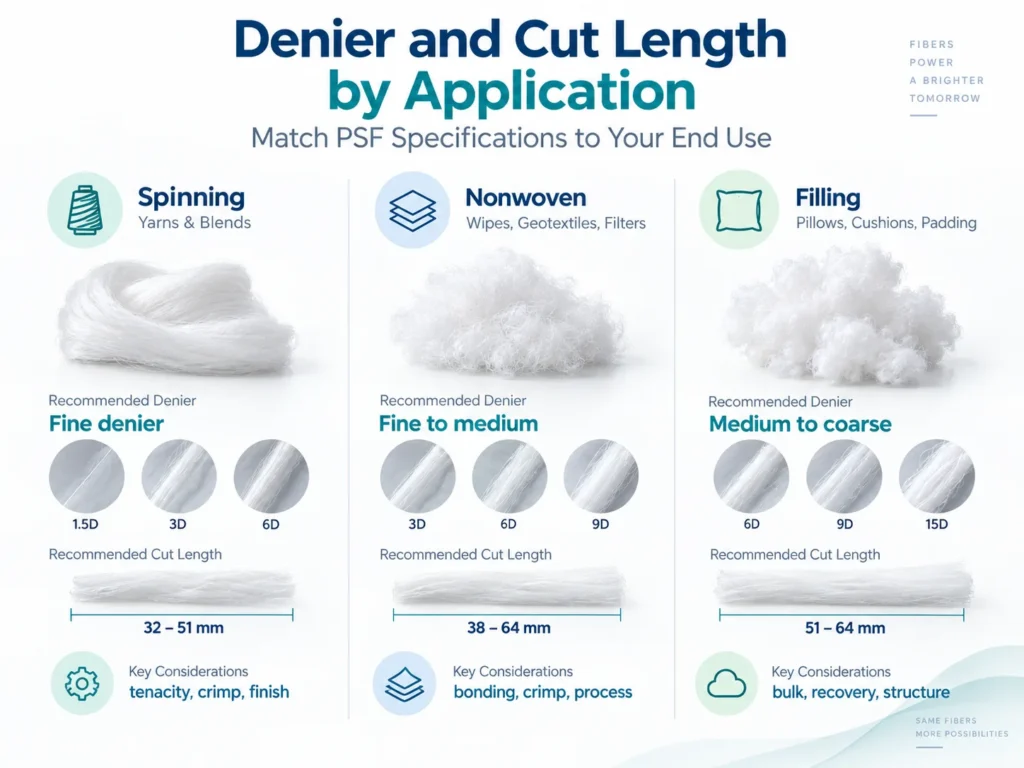
How to Choose PSF Denier and Cut Length by Application
This is where the specification decision actually gets made — by working backward from what you’re producing.
PSF for Yarn Spinning
Spinning applications generally point toward the finer end of the denier range, paired with cotton-type staple lengths that suit the spinning system in use. Beyond denier and length, spinning buyers also need to consider:
- blending compatibility with cotton, viscose or other fibers
- tenacity and elongation, which affect how the fiber handles drafting and twisting
- crimp, which influences cohesion during spinning
- finish, which affects friction and static behavior on the spinning line
The right combination also depends on whether the line is ring spinning or open-end spinning, and what blend ratio is being targeted — these process details change what “the right denier” actually means for a given yarn count.
PSF for Nonwoven Fabrics
“Nonwoven” isn’t one application — it’s several, and each one has different fiber requirements:
- Needle punching typically works with a different fiber profile than thermal bonding
- Thermal bonding requires attention to how the fiber (or a blended low-melt component) behaves under heat
- Spunlace has its own requirements around fiber fineness and processability
Denier, cut length, crimp, bonding behavior and surface finish may all need to shift depending on which of these processes is actually running. A specification that works well for needle-punched felt won’t necessarily transfer cleanly to a thermally bonded structure.
PSF for Pillow and Bedding Filling
For pillow and bedding filling, buyers generally look toward medium-to-coarser denier fiber, often in the 51–64mm cut length range as a common starting direction, frequently in a hollow or hollow conjugated structure. Siliconized versus non-siliconized finish is another key variable, since it affects loft, recovery and hand feel.
This topic deserves more depth than we can cover here — for a full breakdown of denier, cut length, structure and finish selection specifically for bedding pillows, see our guide: Polyester Fiber Specifications for Bedding Pillows.
PSF for Sofa, Cushion and Upholstery Filling
Upholstery filling applications tend to prioritize:
- resilience — how well the fill holds up under repeated sitting or leaning pressure
- support and firmness, matched to the design of the finished piece
- compression recovery over the product’s expected service life
- overall bulk relative to fill weight
These priorities often push buyers toward coarser or higher-crimp fiber options than a softer bedding application would call for, though the right choice always depends on the specific cushion or upholstery design.
PSF for Automotive and Industrial Nonwovens
Automotive interior padding, acoustic materials, felt, insulation and other industrial nonwoven structures each carry their own denier, cut length and structural requirements, often shaped by regulatory, durability or acoustic-performance targets specific to the end product. These are typically specialized enough to warrant a dedicated conversation with a technical team rather than a general recommendation.
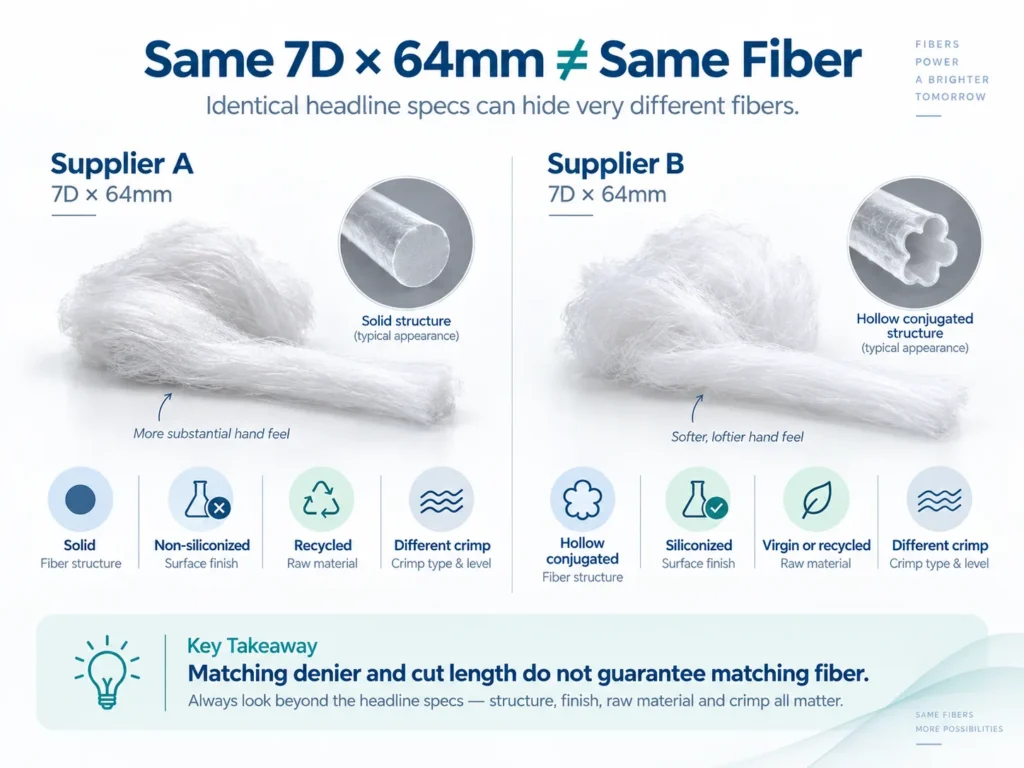
Why Two 7D × 64mm Polyester Fibers May Perform Differently
Here’s a scenario that comes up constantly in B2B sourcing: Supplier A and Supplier B both quote “7D × 64mm PSF.” Are they offering the same fiber?
Not necessarily.
| Parameter | Supplier A | Supplier B |
|---|---|---|
| Denier | 7D | 7D |
| Cut length | 64mm | 64mm |
| Structure | Solid | Hollow conjugated |
| Finish | Dry / non-siliconized | Siliconized |
| Raw material | Recycled | Virgin or recycled |
| Crimp | Different | Different |
| Hollow ratio | N/A | Specified |
| Tenacity | Different | Different |
| Elongation | Different | Different |
Even with identical denier and cut length, each of these differences can change how the fiber actually behaves:
- Structure affects loft, bulk and how the fiber recovers after compression
- Finish affects hand feel, friction and how easily the fiber flows through filling or processing equipment
- Raw material source affects color consistency, appearance and sometimes processing behavior
- Crimp affects cohesion and how well the fiber resists migration or clumping
- Tenacity and elongation affect how the fiber holds up during processing and in the finished product
Core takeaway: denier and cut length describe only part of a polyester staple fiber specification. Treating them as the whole specification is exactly how two “identical” quotes end up delivering two different fibers.
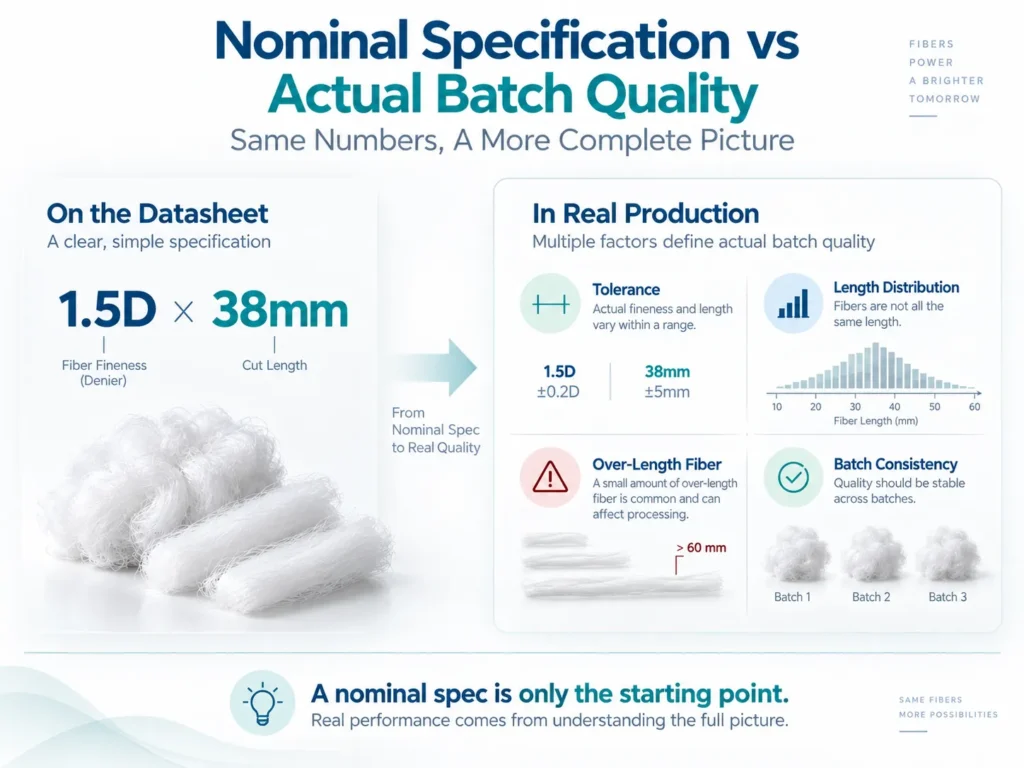
Nominal Specification vs Actual Batch Quality
A purchase order might say 1.5D × 38mm. Real production doesn’t work that cleanly — fiber is controlled within specified tolerances, not manufactured to hit an identical theoretical value on every single filament.
Denier Variation
Buyers should confirm the nominal denier, the tolerance the supplier is working within, and — where relevant — the testing method or QC basis behind those numbers. There’s no universal tolerance value that applies across all suppliers and processes, so this needs to be confirmed directly rather than assumed.
Cut Length Deviation
A nominal 38mm cut length doesn’t mean every single fiber in the batch measures exactly 38.000mm. The relevant question isn’t whether every fiber is identical — it’s whether the actual length distribution stays within the quality range you and the supplier have agreed on.
Over-Length and Double-Length Fibers
Fibers that run noticeably longer than the nominal cut length, or double-length fibers that weren’t fully separated during cutting, can create real processing problems:
- roller wrapping during carding or drafting
- unstable carding performance
- uneven feeding into downstream equipment
- drafting issues in spinning
- uneven fiber distribution in the finished web or fill
These issues rarely show up on a spec sheet. They show up on the production floor, which is exactly why sample trials matter.
Why Batch-to-Batch Consistency Matters
For any buyer running repeat production, consistency between batches matters just as much as hitting the nominal spec on a single sample. Inconsistent batches can shift spinning behavior, carding performance, web formation, filling performance and finished-product appearance — even when every batch technically “meets spec” on paper.
Strong B2B takeaway: for repeat production, consistency against your approved sample can matter as much as the nominal denier and cut length shown on the datasheet.
What Else Should Buyers Specify Besides Denier and Cut Length?
| Parameter | Why It Matters |
|---|---|
| Fiber structure | Solid / hollow / conjugated construction affects bulk and performance |
| Raw material | Virgin / recycled route affects sourcing and documentation |
| Crimp | Influences bulk, cohesion and processability |
| Finish | Influences friction, softness, static and processing behavior |
| Tenacity | Relevant to mechanical performance and processing |
| Elongation | Affects processing behavior |
| Luster | Affects appearance |
| Color | Must match finished-product requirements |
| Hollow ratio | Relevant to filling performance |
| Oil content | Can affect carding, friction and static behavior |
| Certification | GRS / OEKO-TEX / customer-specific requirements |
| Tolerance | Defines acceptable production variation |
A complete RFQ should describe the application and performance target — not just a two-number specification.
Common Mistakes When Selecting PSF Denier and Cut Length
Mistake 1 — Choosing by Denier Alone
“7D” tells a supplier almost nothing about structure, finish, raw material or crimp. It’s a starting point for a conversation, not a complete order.
Mistake 2 — Assuming Finer Fiber Is Always Better
Finer fiber often means softer, but it can also mean less bulk, different processing behavior and a different cost profile. Whether that’s a good trade-off depends entirely on what you’re building.
Mistake 3 — Assuming Longer Fiber Means Better Performance
Longer cut length can improve entanglement and bulk in some applications — and cause processing problems in others, depending on the equipment it’s running through.
Mistake 4 — Ignoring the Processing Equipment
Spinning, carding, blow filling, needle punching and thermal bonding each have different tolerances for fiber length, fineness and finish. A specification chosen without reference to the actual equipment is a specification chosen blind.
Mistake 5 — Comparing Suppliers Only by “1.5D × 38mm”
As covered above, matching denier and cut length numbers is not the same as matching fiber. Compare full technical data sheets and, ideally, approved physical samples — not just the two headline numbers.
A Practical B2B PSF Selection Process
- Define the finished product.
- Confirm the processing method.
- Identify the starting denier range.
- Match cut length to the equipment and process.
- Select fiber structure: solid / hollow / conjugated.
- Specify crimp, finish and other key parameters.
- Confirm tolerances and technical documentation.
- Request samples.
- Run a machine trial and evaluate the finished product.
- Approve the final specification before bulk ordering.
The principle behind all ten steps: Application → Process → Specification → Sample → Machine Trial → Bulk Approval. Skipping steps in the middle is where most specification mismatches originate.
PSF Specification Checklist for RFQs
| Item | Example |
|---|---|
| Application | Pillow filling |
| Denier | 7D |
| Cut length | 64mm |
| Structure | Hollow conjugated |
| Finish | Siliconized |
| Raw material | Recycled PET |
| Color | Raw white |
| Crimp | Supplier specification / agreed requirement |
| Certification | GRS if required |
| Quantity | XX MT |
| Destination | Port / Country |
| Sample | Required before bulk order |
A copy-ready RFQ line you can send directly to a supplier:
We are looking for [denier] × [cut length] polyester staple fiber for [application]. Please advise suitable fiber structure, finish, available tolerances, technical data, sample availability, MOQ and lead time.
Example: How to Read a Complete PSF Specification
Take this specification: 7D × 64mm Hollow Conjugated Siliconized Recycled PSF
Breaking it down:
- 7D → linear density
- 64mm → nominal cut length
- Hollow Conjugated → fiber structure
- Siliconized → surface finish
- Recycled → raw-material route
Even with all five elements defined, a buyer still needs to confirm: tolerance, crimp, hollow ratio, tenacity, elongation, oil/finish level, color, certification and packaging. That’s not excessive due diligence — it’s the difference between a spec sheet and a fiber you can actually build a product around.
Frequently Asked Questions
What does 1.5D × 38mm mean in polyester staple fiber?
It means the fiber has a linear density of 1.5 denier (1.5 grams per 9,000 meters) and a nominal cut length of 38mm. This is a common specification for spinning and blending applications, though the complete picture also depends on structure, finish and raw material.
What denier polyester staple fiber is used for spinning?
It depends on the spinning process and the target yarn count. Finer deniers are commonly used for spinning applications, but the exact value should be matched to your specific yarn target and blend composition rather than chosen from a general rule.
What cut length is commonly used for polyester staple fiber?
Common cut lengths in the market include 32mm, 38mm, 51mm and 64mm, largely because these align with established spinning, nonwoven and filling equipment. The right length for your project still depends on your specific processing line.
Is 7D polyester fiber thicker than 3D fiber?
7D has a higher linear density than 3D, meaning more mass per unit length. This generally corresponds to a thicker fiber, but denier isn’t a direct measurement of physical diameter — structure and cross-section also affect actual fiber size.
What is the difference between denier and dtex?
Denier measures grams per 9,000 meters; dtex measures grams per 10,000 meters. 1 denier is approximately 1.111 dtex. Both describe linear mass density — they’re just different units, common in different regions.
Is longer polyester staple fiber better?
Not automatically. Longer fiber can improve entanglement and bulk in some applications, but it needs to be compatible with your processing equipment. Mismatched length can cause more processing problems than it solves.
Can two PSF products with the same denier and cut length perform differently?
Yes. Structure, finish, crimp, raw material source and batch consistency can all differ even when denier and cut length are identical, and each of these affects how the fiber actually performs.
Final Takeaway: Start With Application, Not Just Denier
Three points worth remembering from this guide:
- Denier describes linear density — not physical diameter, and not the whole specification.
- Cut length is a key processing and application parameter — but longer or shorter isn’t inherently better.
- Neither parameter alone defines the final performance of PSF — structure, finish, raw material and batch consistency all matter too.
Start with your end product and processing system, define the complete specification, verify supplier tolerances and technical data, and confirm performance through samples and machine trials before placing a bulk order.
Need help selecting a PSF specification? Share your application, current specification, processing method and target performance with MAKEIT to discuss suitable polyester staple fiber options and sample availability.