If you manufacture bedding pillows, you already know that “polyester fiber” isn’t really a specification. It’s a starting point.
The real decision comes down to five variables: fiber structure, denier, cut length, crimp, and finish. Get these wrong — even slightly — and you end up with a pillow that flattens after three months, clumps in the wash, or feels nothing like the sample you approved.
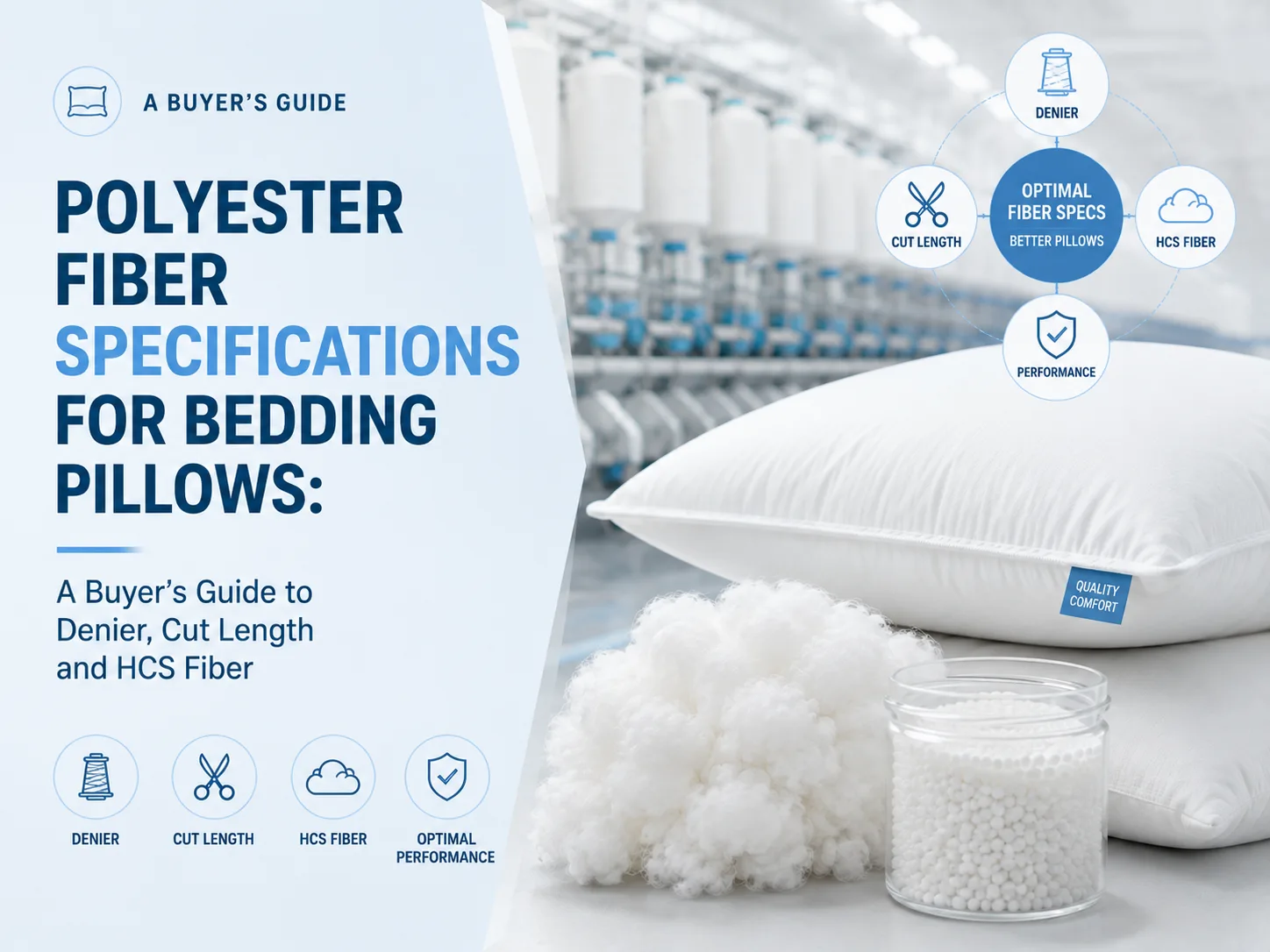
In this guide, I’ll walk you through exactly how to specify polyester fiber for bedding pillows, including:
- Why Hollow Conjugated Fiber (HCS) became the default choice for pillow filling
- The 5 specifications that actually determine finished-pillow performance
- How your filling method (blow filling, carding, manual filling) changes what “the right spec” even means
- Why “7D HCS” on a product listing tells you almost nothing on its own
- A ready-to-use RFQ checklist so your next supplier quote comes back accurate the first time
Let’s get into it.
What Makes Hollow Conjugated Fiber Suitable for Bedding Pillows?
Here’s the short version: hollow conjugated fiber (HCS) solves two problems at once — bulk and bounce-back.
Most bedding pillows on the market today are filled with some version of HCS. Not because it’s the only option, but because its structure happens to line up well with what a pillow needs to do: feel full, feel light, and spring back after your head’s been on it for eight hours.
Let’s break down why that structure works.
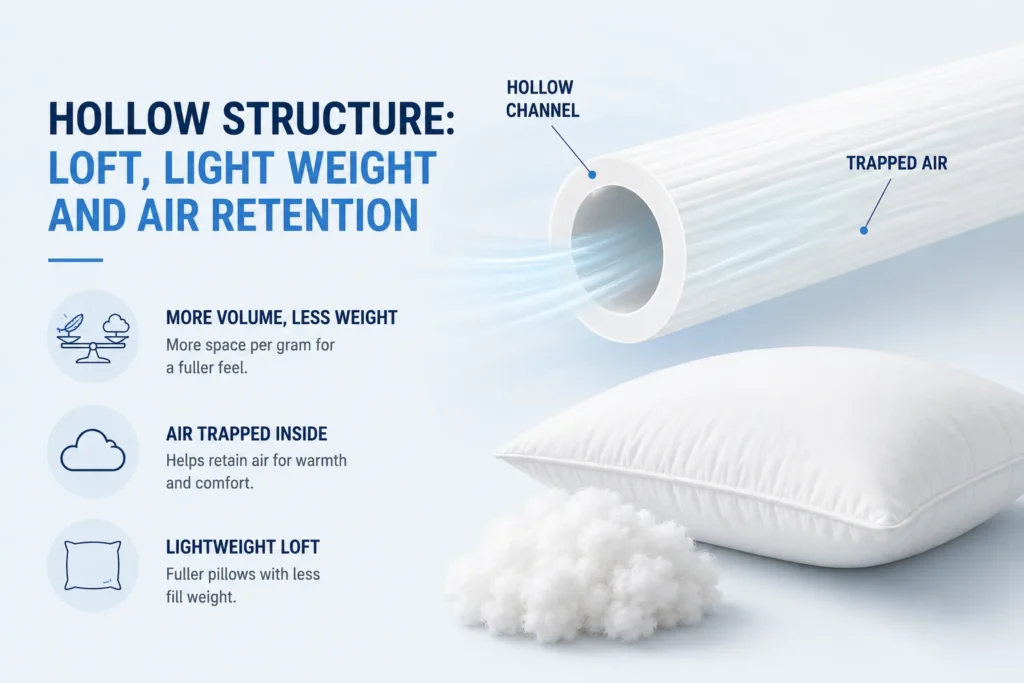
Hollow structure: loft, light weight and air retention
A hollow fiber has a channel running through its core instead of a solid cross-section. That single design change does a lot of work:
- Less material, more volume. A hollow fiber takes up more space per gram than a solid fiber of the same denier. That’s why hollow fiber pillows can feel “fuller” without needing more fill weight.
- Air gets trapped inside the fiber, which plays into how insulating and light the pillow feels.
But — and this is important — hollow structure alone doesn’t make a good pillow. Denier, crimp, finish, and how much fiber you actually put in each pillow all interact with the hollow structure. If your fiber supplier’s pitch stops at “it’s hollow,” ask what loft and weight they’re targeting. That’s the real conversation.
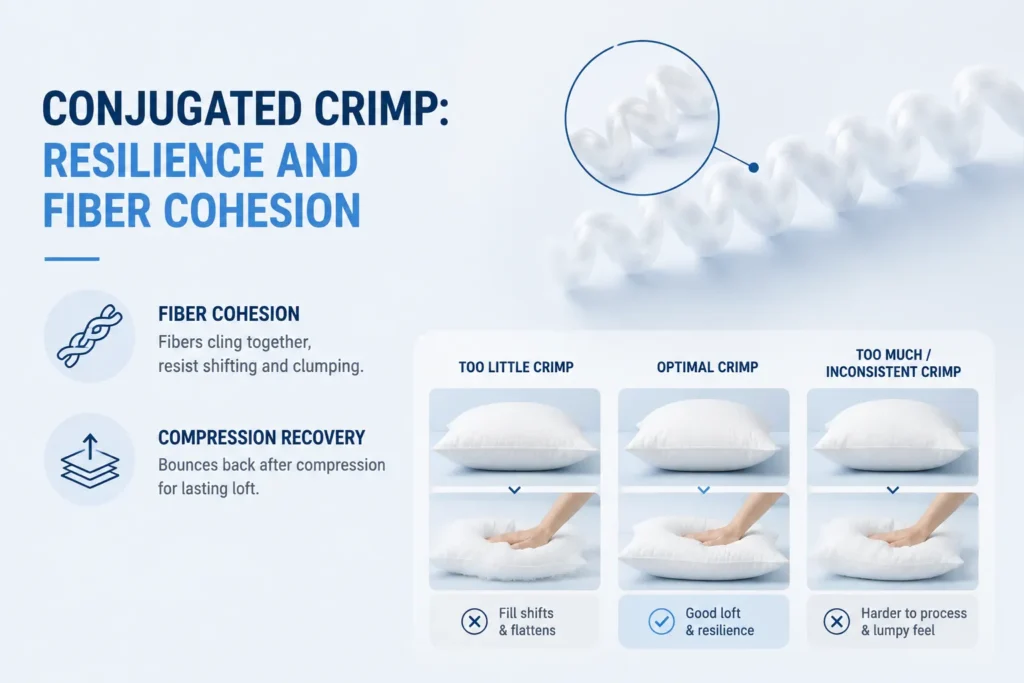
Conjugated crimp: resilience and fiber cohesion
The “conjugated” part refers to a built-in spiral crimp, usually three-dimensional, that’s set into the fiber during manufacturing.
This crimp is doing the heavy lifting when it comes to:
- How well fibers cling together inside the pillow (so they don’t shift and clump)
- How well the fill bounces back after being compressed — think shipping, storage, or a full night’s sleep
Here’s a mistake I see buyers make constantly: assuming more crimp automatically means a better pillow. It doesn’t. Too little crimp and the fill migrates and flattens. Too much — or inconsistent crimp — and the fiber becomes harder to process, with a rougher, lumpier hand feel.
The fix isn’t chasing a crimp number on a data sheet. It’s requesting a sample fill and physically checking how much loft comes back after compression.
Siliconized vs. non-siliconized HCS fiber
Silicone finish is a surface treatment, not a structural feature — which means it needs to be evaluated on its own, separately from denier or crimp.
| Selection Factor | Siliconized HCS Fiber | Non-Siliconized HCS Fiber |
|---|---|---|
| Surface feel | Smoother to the touch | More natural fiber-to-fiber grip |
| Filling behavior | Usually easier to run on loose or blow-filling lines | Depends heavily on your specific process setup |
| When it makes sense | You want a softer feel and smoother fiber flow | You’re optimizing for cost, or need a specific bonding behavior |
| How to validate | Run a sample fill, then check hand feel on the finished pillow | Run an actual trial on your filling line |
Neither option wins by default. It comes down to your filling method and the hand feel you’re targeting.
[Internal link: see our guide to Hollow Conjugated Fiber for the full breakdown of fiber structure and manufacturing.]
Five Polyester Fiber Specifications That Actually Affect Pillow Performance
This is the part most fiber overviews gloss over. They’ll tell you fiber is “soft” and “durable” without explaining what actually controls softness and durability.
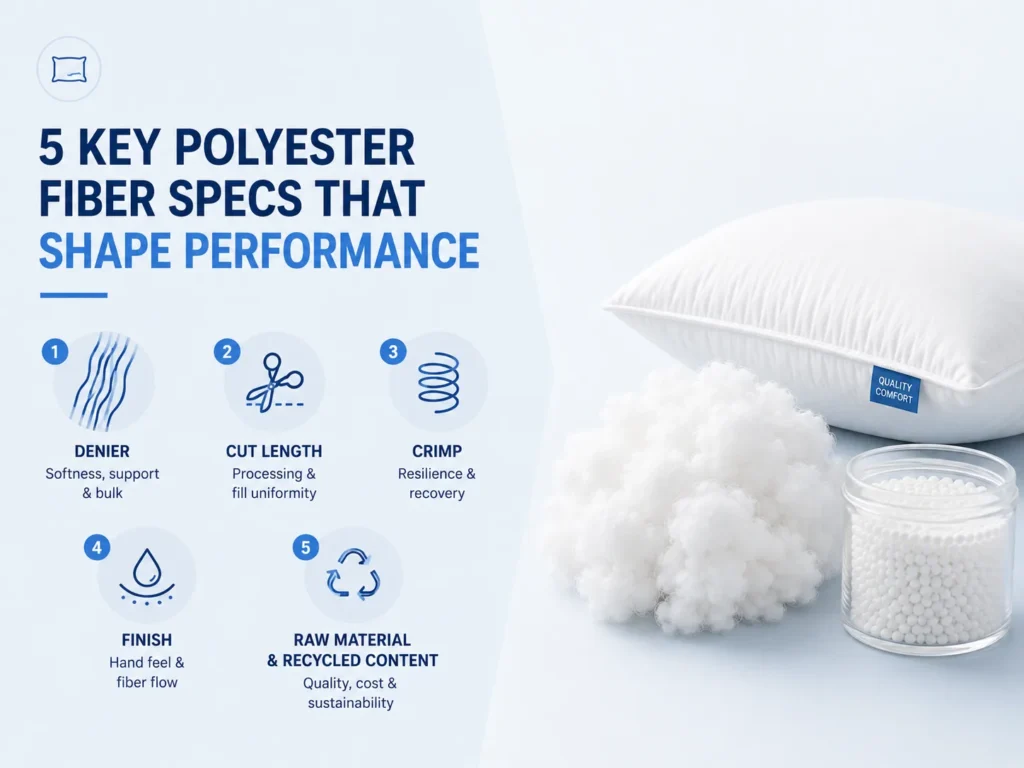
Here are the five specs that do:
1. Denier: balancing softness, support and bulk
Denier tells you how thick each individual filament is. And it has a direct line to how the pillow feels in your hand:
- Finer denier → softer, more downlike feel
- Coarser denier → more perceptible body, more support
There’s no universal “best” denier. It depends entirely on what you’re building. An economy pillow, a hotel pillow, and a premium downlike pillow will typically call for different deniers — sometimes even a blend within the same pillow.
Bottom line: confirm denier against your target fill weight, desired loft, and expected use life. Don’t just pick “whatever the supplier recommends” without asking why.
2. Cut length: processing compatibility and fill uniformity
Cut length is the one spec that gets ignored until it causes a production problem.
Here’s why it matters: the same fiber structure and denier can behave completely differently depending on cut length, because cut length determines how well the fiber opens, cards, and flows through your specific machinery. A cut length that runs beautifully on a carding line might clump or jam on a blow-filling line.
The takeaway: match cut length to your actual equipment, and confirm it with a trial run — not a spec sheet. Mismatched cut length is one of the most common (and most avoidable) causes of clumping and uneven fill.
3. Crimp: resilience after repeated compression
Crimp specification is usually expressed as crimps per unit length, and it’s tightly linked to how well your pillow recovers its shape after being squashed — in a shipping carton, on a store shelf, or under someone’s head.
Instead of fixating on the crimp number itself, ask your supplier to demonstrate compression recovery: how much loft comes back after a defined compression cycle. That tells you far more than the raw spec.
4. Finish: siliconized, slickness and fiber flow
We covered this above, but it’s worth repeating: finish changes hand feel and processing behavior. If your production involves blending fibers, thermal bonding, or specific wash requirements downstream, confirm how your chosen finish interacts with those steps before you commit to volume.
5. Raw material and recycled content
Virgin polyester, recycled polyester, or a blend — the choice usually comes down to three things: appearance/whiteness targets, cost, and whether your brand (or your customer) needs a recycled-content claim or certification.
If you need something like GRS certification, lock this down at the spec stage — including which certificate applies to the specific product and batch, and what documentation (like a transaction certificate) ships with each order.
One more thing: don’t assume recycled fiber behaves identically to virgin fiber across every batch. Color consistency and sometimes processing behavior can shift between recycled lots. Test with samples first.
[Internal link: see Recycled Polyester Staple Fiber for more on sourcing and certification.]
How to Match Fiber Specifications to Pillow Type and Filling Process
Here’s something most guides miss entirely: the “right” fiber spec changes depending on what pillow you’re making and how you’re filling it.
Let’s tackle both.
Choosing fiber for different pillow categories
| Pillow Category | Typical Buyer Priority | Questions to Ask Your Supplier |
|---|---|---|
| Economy retail pillow | Cost control, acceptable loft, production efficiency | What fill weight and price point are we targeting? |
| Hotel pillow | Consistent loft, recovery, and washability over hundreds of cycles | How often will this be compressed, laundered, replaced? |
| Premium downlike pillow | Softness, high loft, a luxury feel | Do we need a finer fiber, a blend, or a fiber-ball format? |
| Support/firm pillow | Controlled firmness, shape retention | Do we need firmer fill, zoning, or blended deniers? |
| Decorative cushion | Form retention, “full” visual appearance | Is looking full more important than sleeping comfort? |
| Sustainable bedding pillow | Recycled content, traceability | What certification and documentation do we need? |
How manual filling, blow filling, carding and fiber-ball processing differ
This is the section I’d bookmark if I were sourcing fiber for the first time.
| Filling Method | What to Confirm With Your Supplier |
|---|---|
| Manual filling | How consistently the fiber opens by hand, batch to batch |
| Blow filling | Fiber flow, finish (siliconized or not), and fill-weight consistency per pillow |
| Carding or wadding | Cut length, crimp, web formation, and compatibility with any bonding step |
| Fiber-ball processing | Fineness, surface finish, and how it behaves once processed into ball form |
| Thermal bonding | Whether you need a low melt fiber blended in, and what temperature the bonding runs at |
If your process involves thermal bonding — say, for a structured or quilted pillow — you’ll typically blend in a low melt fiber component rather than relying on it alone. Don’t guess the blend ratio or bonding temperature. Confirm both through an actual production trial.
[Internal link: see Low Melt Fiber for how thermal bonding fiber works.]
Beyond Fiber Specs: How to Actually Evaluate Pillow Filling Quality
Here’s an uncomfortable truth: a product name like “7D HCS” or “15D hollow conjugated fiber” tells you the denier and structure — and basically nothing else. Two pillows filled with fiber carrying the exact same product name can perform completely differently if the rest of the spec isn’t controlled.
Why "7D HCS" isn't a complete purchasing specification
A real spec sheet for pillow filling fiber should include:
- Fiber type and structure (solid, hollow, or hollow conjugated)
- Denier target and tolerance
- Cut length target and tolerance
- Finish (siliconized or non-siliconized)
- Crimp specification
- Raw material source (virgin, recycled, or blend ratio)
- Color or whiteness requirement
- Packing format and bale weight
- Certification or traceability documentation, if applicable
- Batch ID and a process for flagging spec changes
If a supplier can only hand you a product name and a denier number, that’s your cue to ask more questions before you place a bulk order.
Sample approval and finished-pillow quality checks
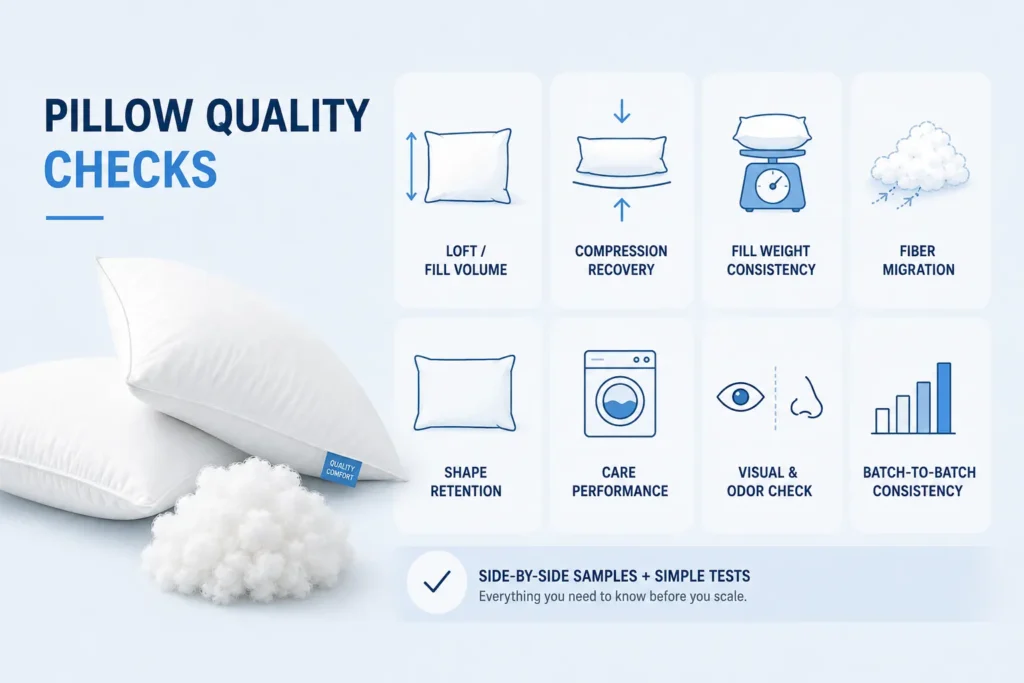
Before you scale to production volume, agree on what “good” looks like — on the finished pillow, not just on the raw fiber:
- Initial loft or fill volume at a set fill weight
- Compression recovery after a defined compression cycle
- Fill weight consistency across multiple sample units
- Fiber migration or clumping after handling
- Overall shape retention
- Wash or care performance, if relevant to the end product
- Basic visual and odor checks
- Batch-to-batch consistency once you’re running at volume
You don’t need a lab for most of this. A side-by-side sample comparison and a simple compression test will tell you almost everything you need to know before committing to a large order.
Batch consistency and change control
One thing worth locking down early: how will your supplier handle a change to raw material source, denier tolerance, or finish between batches — and how will they tell you? It’s an easy detail to skip during initial sampling, and an expensive one to discover you’ve skipped once you’re running a recurring program.
Virgin vs. Recycled Polyester Fiber for Pillows: How to Decide
This isn’t a “which one is better” question. It’s a specification question — one that should weigh finished-pillow performance, brand or customer requirements, certification needs, appearance, cost, and supply consistency.
| Decision Area | Virgin Polyester Fiber | Recycled Polyester Fiber |
|---|---|---|
| Why you’d choose it | Consistent appearance, proven performance, specific product positioning | Sustainability commitments, recycled-content claims, circular sourcing goals |
| What to validate | Whiteness, performance consistency, agreed spec | Recycled content %, certification, suitability for the end use |
| Smart sourcing move | Confirm spec and request samples before scaling | Confirm spec and documentation (certificates, transaction records) |
| Common mistake | Assuming every virgin-grade fiber performs the same across suppliers | Assuming every recycled-grade fiber has the same color or behavior across batches |
The right answer depends on matching the fiber source to what your finished pillow — and your own commitments — actually require. Not on defaulting to whichever one sounds better in a sales pitch.
Pillow Filling Fiber RFQ Checklist for Bedding Manufacturers
Want your next quote to come back accurate on the first try? Send your supplier this, filled out:
- End use: standard pillow, hotel pillow, premium pillow, cushion, or other bedding product
- Filling method: manual filling, blow filling, carding, fiber-ball processing, or thermal bonding
- Target fiber type: solid, hollow, hollow conjugated, or siliconized HCS
- Raw material: virgin, recycled, or blended ratio
- Target denier
- Target cut length
- Required finish: siliconized or non-siliconized
- Desired hand feel: soft, fluffy, supportive, firm, or downlike
- Target fill weight or finished pillow dimensions
- Compression recovery / durability expectations
- Color or whiteness requirement
- Required certifications or traceability documentation
- Sample request
- Estimated order volume (per order and/or annual)
- Delivery destination or port
Fill this out before your next RFQ. It takes ten minutes and typically saves you multiple rounds of back-and-forth on samples that don’t hit the mark.
Frequently Asked Questions
What polyester fiber is commonly used for pillow filling?
Hollow conjugated polyester staple fiber (HCS) is one of the most common choices, thanks to its hollow core and built-in crimp, which together balance loft, weight, and resilience. The exact denier, cut length, and finish still need to match your specific pillow category and filling process.
How do denier and cut length affect pillow filling?
Denier controls hand feel and support — finer deniers feel softer, coarser deniers add more body. Cut length controls how well the fiber processes on your filling line and how evenly it distributes. Both need to be confirmed against your actual production setup, not chosen from a generic recommendation.
Is siliconized fiber necessary for pillow filling?
Not always. Siliconized fiber typically gives you a smoother hand feel and easier flow, which suits blow-filling or loose-filling processes. Non-siliconized fiber can be the better call for certain cost targets or process setups. It comes down to your filling method and target feel.
Can recycled polyester fiber be used for bedding pillows?
Yes — as long as the specification, color consistency, and certification match what you need. Always validate recycled content with samples rather than assuming it behaves identically to virgin fiber batch to batch.
What should I include in a pillow-fiber RFQ?
At minimum: end use, filling method, fiber type, raw material source, target denier and cut length, finish, desired hand feel, fill weight or dimensions, color requirements, certification needs, and estimated order volume. The more complete your RFQ, the more accurate the quote and sample you’ll get back.
Ready to Spec Your Next Pillow Filling Order?
ell us your pillow type, filling method, and target specification. Our team will review the right polyester staple fiber options for you before you commit to sampling or a quote.