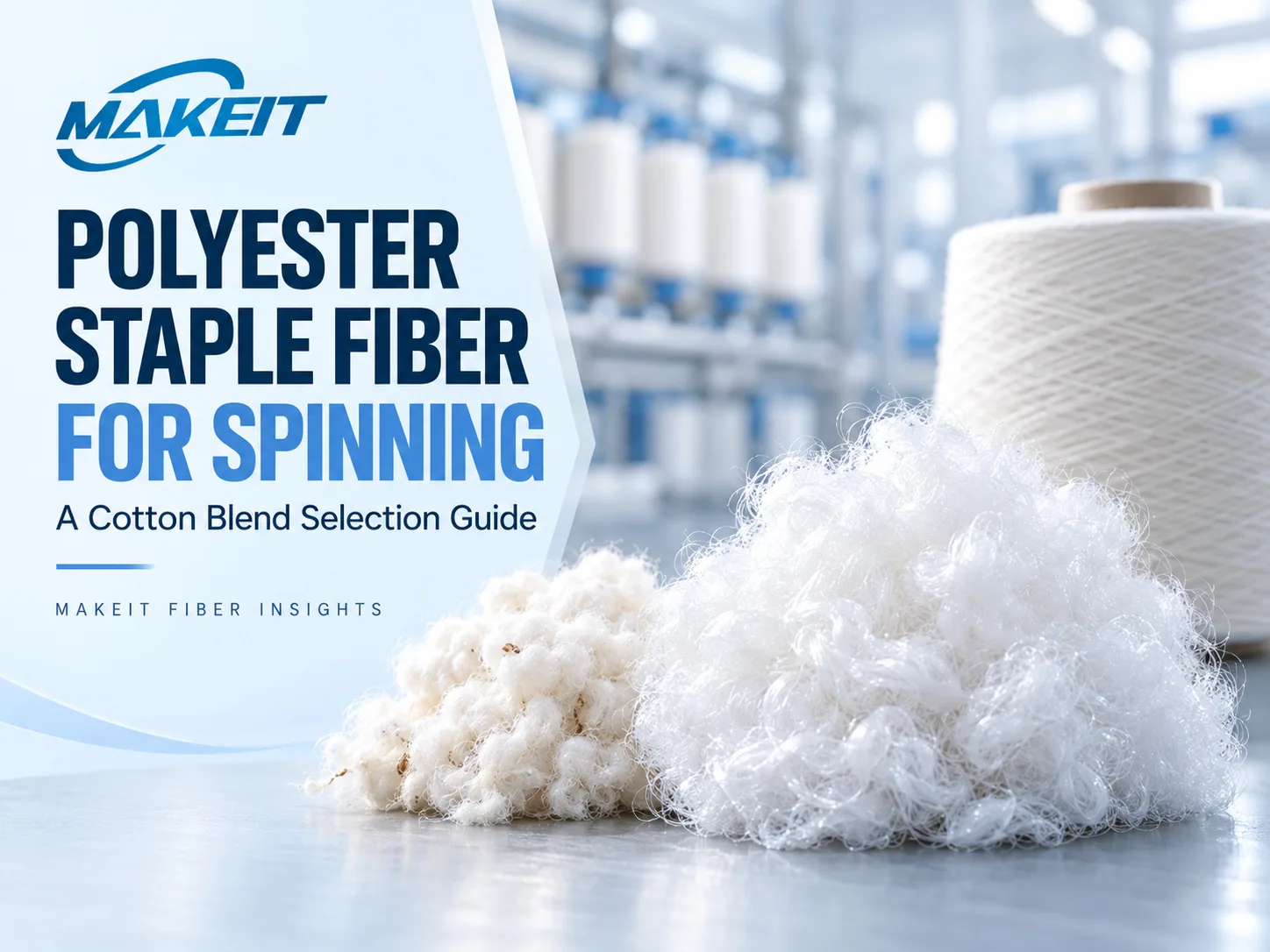
You have two quotes for polyester staple fiber (PSF). Both list the same denier. Both list the same cut length. One is cheaper.
Do you order from the cheaper supplier?
Not yet. Nominal denier and cut length tell you which product category you are looking at. They don’t tell you how the fiber will run in your carding, drawing, and spinning process.
This guide shows you how to turn your yarn requirements into a sourcing brief, compare offers on equal terms, and verify fit with a controlled spinning trial. It covers PSF as a raw material for polyester/cotton blending. It is not a guide to buying finished yarn.
Quick Answer: How to Choose PSF for Spinning
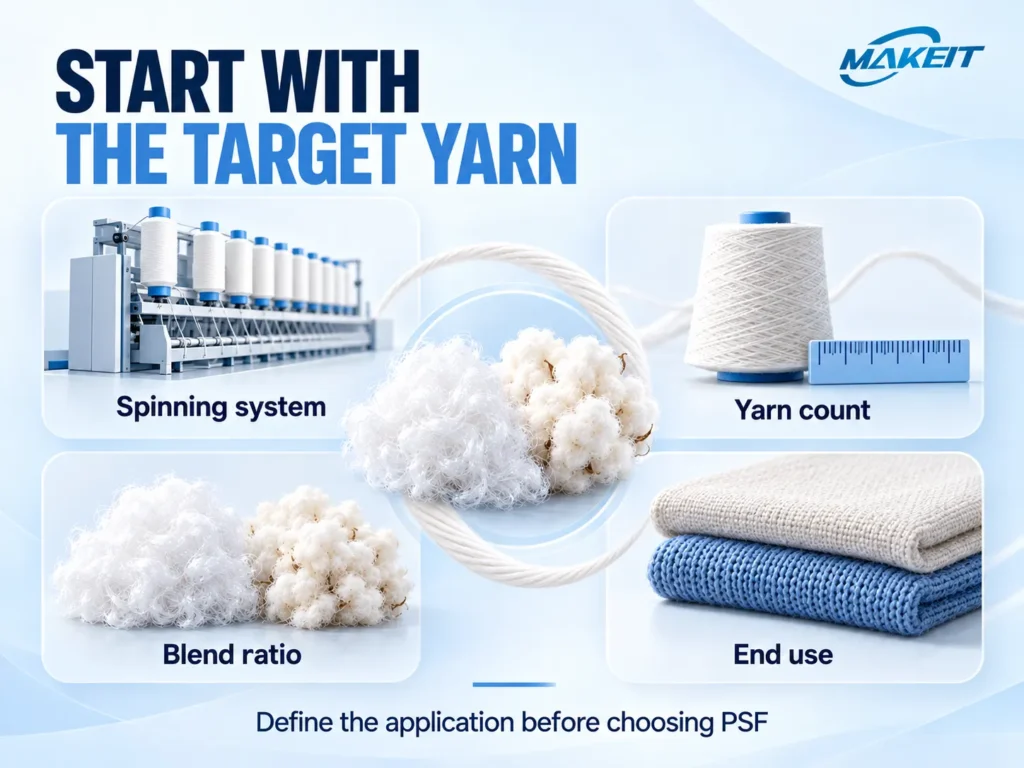
Define the yarn first. Note your spinning system, target yarn count, polyester/cotton ratio, and end use.
Compare full specifications. Ask for test methods and batch documentation, not just denier and length.
Run a comparative trial. Record the production conditions so the results can be compared.
Judge by accepted output. Look at cost per kilogram of accepted yarn, not fiber price alone.
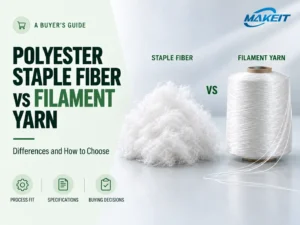
Still deciding between staple fiber and continuous filament? See our note on polyester staple fiber vs filament yarn.
In this guide:
Define your cotton blend and target yarn
The PSF properties to compare
Why identical denier and cut length don’t make offers equal
How to plan a comparative spinning trial
How to compare cost per kilogram of accepted yarn
What to send before requesting a sample
Step 1: Define Your Cotton Blend and Target Yarn
A PSF grade can’t be chosen in isolation. Start with what the fiber has to do in your mill, then work backward.
Separate supplier replacement from new yarn development
These are two different projects, and they need different information.
| Situation | What to clarify first |
|---|---|
| Replacing the PSF supplier for an existing yarn | Current fiber specification, quality baseline, reason for the change, and which process conditions must stay the same |
| Developing a new polyester/cotton yarn | End use, yarn count, blend ratio, equipment conditions, and the performance you need to verify |
In a replacement project, your current material is the benchmark. Your job is to show the new fiber matches it.
In a development project, there is no benchmark yet. You need to define one during the trial.
Build a clear application brief
Write down the following before you contact any supplier:
Spinning system and equipment conditions
Target yarn count, with the unit stated (Ne, Nm, or tex)
Blend ratio, with the component order stated (for example, 65/35 polyester/cotton)
Known cotton specification and lot information
End use: knitting or weaving
Current problems and the metrics you want to improve
One point trips up many buyers: the blend ratio alone does not determine the right PSF grade. A 65/35 polyester/cotton yarn can call for different fibers depending on the cotton, the system, and the final product.
If a parameter is unknown, mark it “to be confirmed.” Don’t guess. A guessed value in a brief can send the whole comparison in the wrong direction.
Step 2: Know Which PSF Properties to Compare
Ask every supplier for the same set of information, with units and test methods. Then the answers can sit side by side.
| Property | What to confirm with the supplier | How to read it |
|---|---|---|
| Fiber fineness | Nominal value, unit, and permitted range | Interpret against your target yarn and process |
| Cut length | Nominal length and any length-consistency data | Don’t rely only on the number printed on the packaging |
| Tenacity and elongation | Values, units, test method, and test conditions | Read the two together; higher is not automatically better |
| Crimp characteristics | Available crimp indicators and how they are measured | Treat as an indicator of processing fit |
| Fiber finish | Finish information, suitable processes, and available data | Confirm fit with your technical team and the supplier |
| Appearance and contamination | Color, foreign matter, and agreed inspection requirements | Check against your yarn appearance and quality targets |
| Batch consistency | Batch test records, tolerances, and traceability | Matters for bulk orders after the trial |
No single specification suits every machine. High tenacity, for instance, is not a universal advantage. What counts is whether the fiber runs well in your system and gives you the yarn you need.
For background on fineness and length, see our guide to polyester staple fiber denier and cut length.
Step 3: Don't Treat Same-Spec Offers as Equivalent
Back to the two quotes from the start.
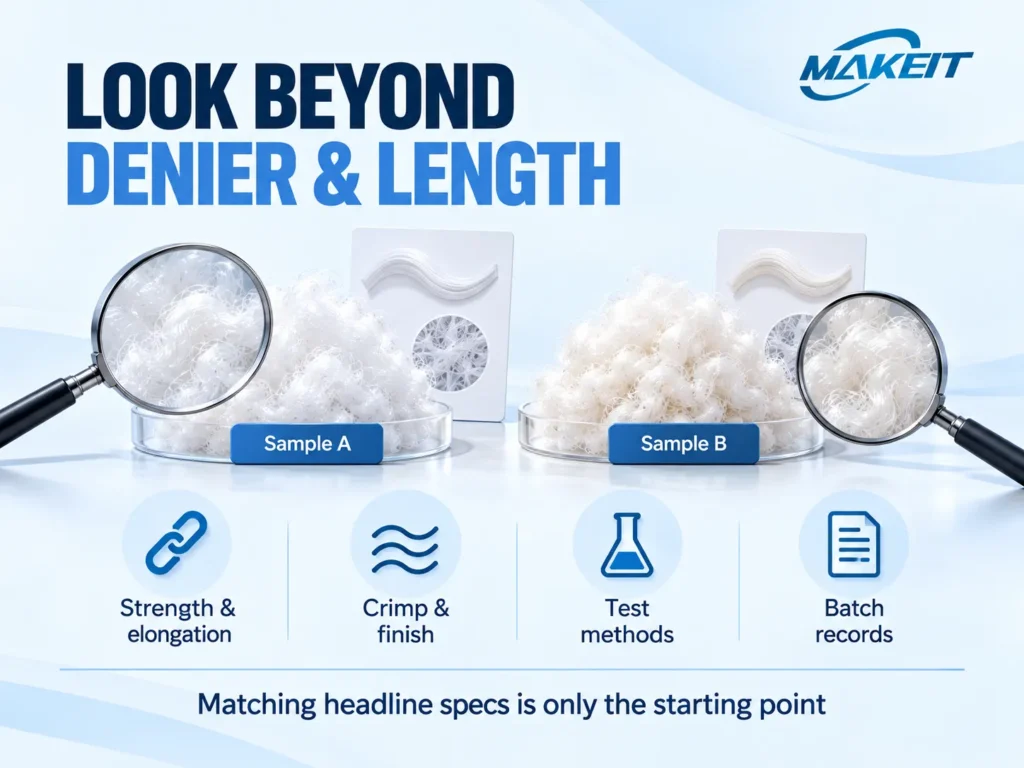
Nominal specifications describe the product category. Two offers can share headline numbers and still differ in crimp, finish, strength data, or batch consistency.
The table below is a hypothetical example. Both suppliers quote the same nominal denier and cut length. Fill it in before you compare prices.
| Item to check | Supplier A | Supplier B |
|---|---|---|
| Nominal specification and permitted range | To confirm | To confirm |
| Tenacity, elongation, and test method | To confirm | To confirm |
| Finish and crimp information | To confirm | To confirm |
| Sample lot number and test data | To confirm | To confirm |
| Link between sample and bulk supply | To confirm | To confirm |
| Packing, net weight, and quotation terms | To confirm | To confirm |
| Items still unconfirmed | To confirm | To confirm |
A blank cell does not mean a supplier is unqualified. It means that item still needs checking.
Also confirm that supply requirements and commercial terms are comparable before you compare unit prices. One quote may be ex-works and another delivered. Net weight per bale may differ.
Step 4: Plan a Comparative Spinning Trial
A trial shows how a fiber behaves in your mill. A plan written in advance keeps the results interpretable.
Establish a baseline with the current material
Record the lot of the PSF you use now, its normal production performance, and your current acceptance requirements.
Then state the purpose of the trial. You might be validating a replacement supplier, developing a new blend, or checking whether a processing or quality problem improves.
Keep trial conditions comparable
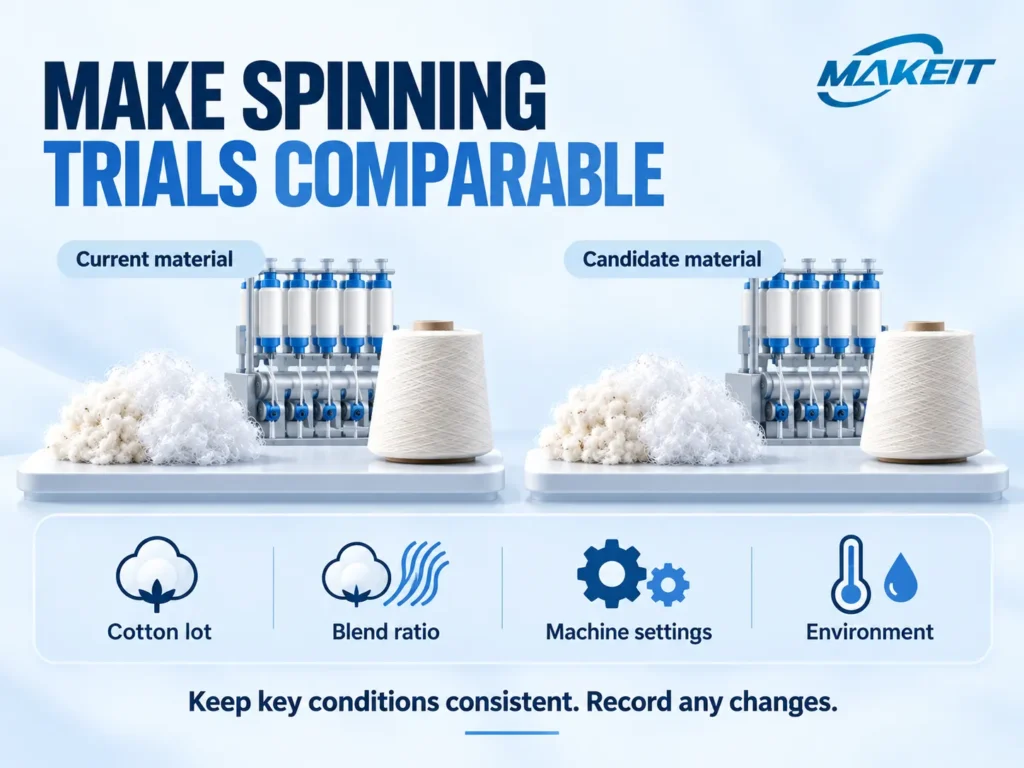
In the first round, hold the other main conditions constant. Record any you can’t hold constant.
| Category | What to record |
|---|---|
| Materials | PSF lot, cotton lot, blend ratio |
| Product target | Yarn count, twist, end-use requirements |
| Equipment and process | Machines, speeds, key settings |
| Environment | Temperature, humidity, and other routine plant records |
| Trial arrangement | Quantity fed, run time, sampling and test methods |
If the supplier recommends adjusting a process setting, run that as a separate, documented trial. Results from different conditions shouldn’t be treated as a direct comparison.
Evaluate processing and yarn results together
Choose measures that fit your own quality system. Typical ones are:
Processing stability, end breaks, and waste
Accepted output
Evenness, imperfections, and hairiness
Yarn strength and elongation
Where relevant, extend the check to weaving, dyeing and finishing, or the finished product.
This guide sets no universal pass threshold, because acceptable values depend on the yarn and the customer. A short trial that passes also doesn’t guarantee stable long-term supply. Keep monitoring later batches.
Investigate changes before assigning a cause
Watch out: When results change, check the raw-material lots, blend conditions, equipment settings, and environmental records together. A single result is not enough to blame the PSF.
Step 5: Compare Cost per Kilogram of Accepted Yarn
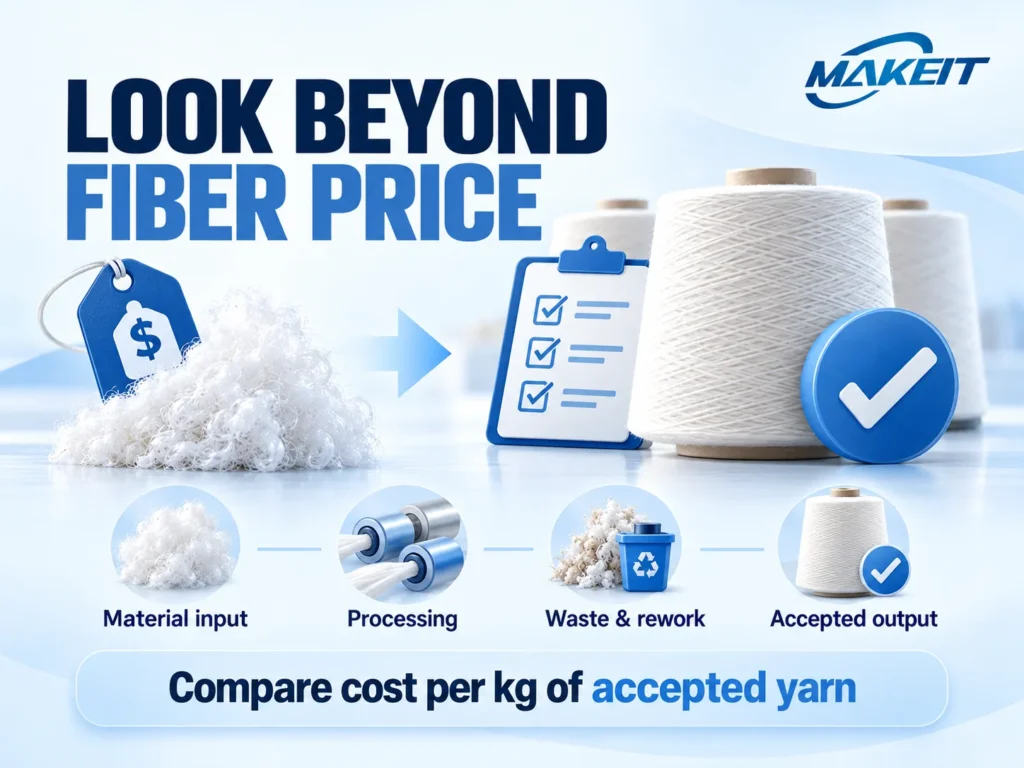
Price per kilogram of fiber and the real cost of producing yarn are different measures.
A lower fiber price can be offset by more waste, rework, or downtime. A higher price can pay for itself if more of the output is accepted.
For a fair comparison, record:
Total raw-material input cost, including the cotton in a blend
Processing cost over the same accounting scope
Rework and waste-disposal costs that can be attributed to the run
Accepted yarn output by weight
Downtime, counted only once so it isn’t double-counted
Then use this formula:
Cost per kg of accepted yarn = Total costs included in the comparison ÷ Accepted yarn output
Both options must use the same scope. For a polyester/cotton blend, include the whole raw-material input, not just the PSF price divided by yarn output.
This is a procurement comparison framework. It is not a promise of savings from any product. If you add worked numbers, label them as assumed data.
What to Send Before Requesting a PSF Sample
A complete brief shortens the back-and-forth. Please include:
Spinning system and equipment context
Target yarn count and end use
Polyester/cotton blend ratio
Current PSF specification, if available
Current processing or quality concerns
Sample evaluation requirements
Estimated order volume and destination
Looking for polyester staple fiber for cotton blending? Share your spinning system, target yarn, blend ratio, and current specification with MAKEIT to discuss suitable Textile Fiber options and sample requirements.
Frequently Asked Questions
What should I specify when buying polyester staple fiber for spinning?
Give your spinning system, target yarn, blend ratio, any known fiber specification, and how you plan to validate the material. Add the quality issues you want to solve. The checklist above covers the full list.
Can two PSF grades with the same denier and cut length be used interchangeably?
Not on those two values alone. Compare the other relevant properties, such as strength, crimp, and finish. Then confirm in your own process and yarn results.
Does the polyester/cotton blend ratio determine the PSF specification?
No. The ratio is important background. The specification also depends on the cotton, the spinning system, the target yarn count, and the end use.
How should a spinning mill evaluate a new PSF supplier?
Check the documents and test methods first. Confirm that samples can be traced to a lot. Run a comparative trial against your current material. Then agree acceptance requirements and keep monitoring later batches.