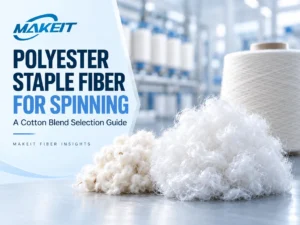
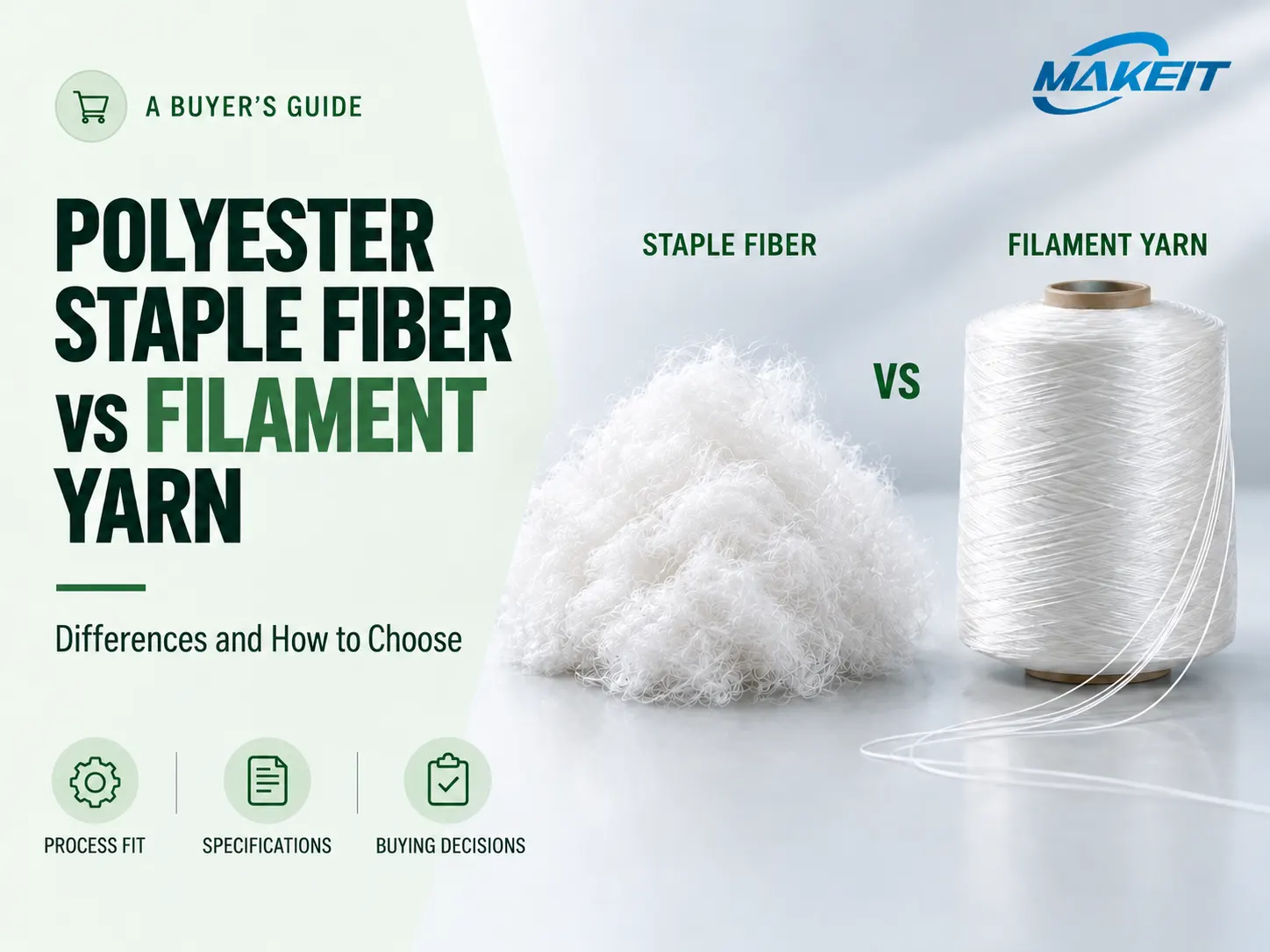
Polyester staple fiber (PSF) is polyester cut to a set length. To become yarn, it goes through a staple spinning route.
Polyester filament yarn (PFY) is made of continuous filaments. What it needs before weaving or knitting depends on the form you buy.
So which one should you choose? Start with what your production line takes in. Then check target performance and commercial terms.
In this guide, you’ll see how the two compare, how to read their specifications without mixing up the numbers, and how to compare costs and verify samples before a bulk order.
Polyester Staple Fiber vs Filament Yarn: At a Glance
The core difference is physical form. That form decides what you buy and what you still have to do with it.
Here’s the side-by-side view:
| Polyester staple fiber (PSF) | Polyester filament yarn (PFY) | |
|---|---|---|
| Physical form | Discrete fibers cut to a set length | Continuous filaments bundled into yarn |
| What you purchase | Fiber, usually baled | Yarn, usually on packages |
| Processing route | Staple spinning into spun yarn, or carding and opening for nonwoven and filling | Depends on type: some forms need further drawing or texturing, others are closer to ready for weaving or knitting |
| Key specifications | Denier or dtex per fiber, cut length, crimp, finish | Total denier, filament count, yarn type (POY, FDY, DTY) |
| Typical applications | Spun yarn, blends with cotton or viscose, carded nonwovens, fiberfill | Woven and knitted fabrics made from filament yarn |
| What to verify | Fit with your spinning, carding, or filling process | Yarn type, preparation steps, and target fabric |
You’ll notice the table gives no “stronger” or “weaker” label.
That’s deliberate. Strength only compares fairly when linear density, test method, and product grade match.
Staple Fiber, Spun Yarn, and Filament Yarn: What Are You Buying?
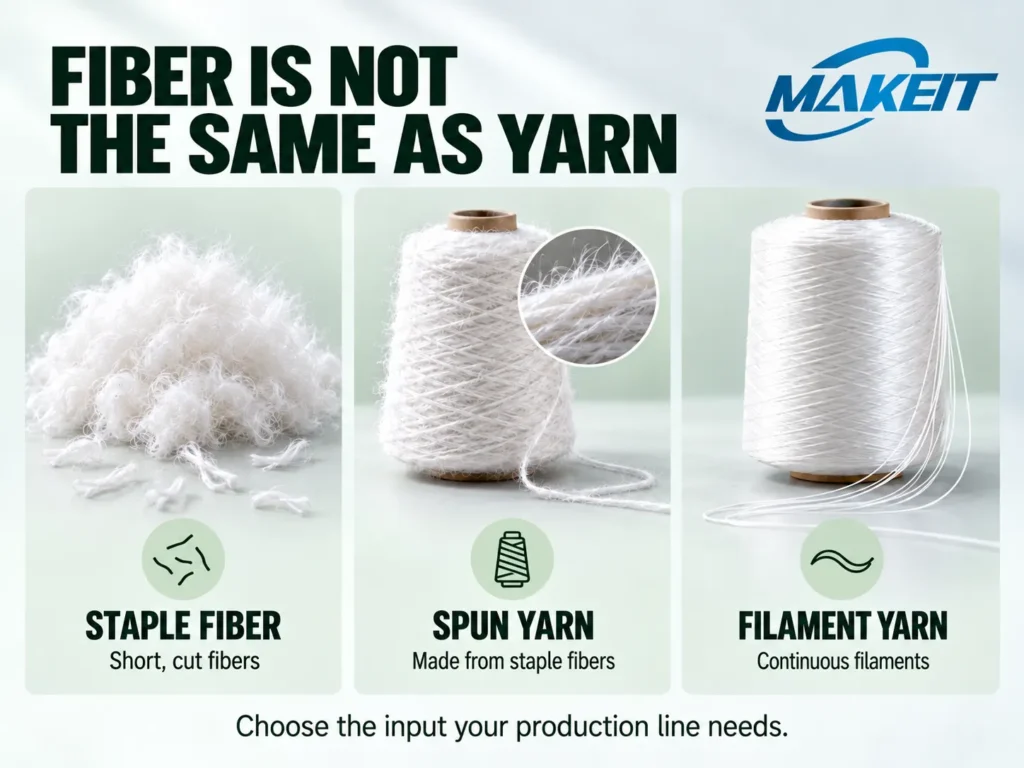
Three different things often get called “polyester” in a purchasing conversation.
Mixing them up causes most of the confusion. Here are the two routes side by side:
PSF → staple spinning → spun yarn → weaving or knitting
Suitable filament yarn → required preparation → weaving or knitting
Polyester staple fiber: the input for staple-based processing
PSF is a raw material. A spinning mill opens it, blends it if needed, and spins it into yarn.
But spinning isn’t the only route. Carded nonwoven lines and filling operations also use staple fiber, without making yarn first.
Need a primer? See what polyester staple fiber is.
Polyester spun yarn: yarn made from staple fibers
Polyester spun yarn is what spinning produces from staple fibers.
It’s a yarn, not a fiber. A quote for spun yarn covers a different stage of the supply chain than a quote for a PSF bale.
Polyester filament yarn: continuous-filament yarn
Filament yarn is made of continuous filaments, and it’s supplied in different states.
POY (partially oriented yarn) usually needs further processing, such as drawing or texturing. FDY (fully drawn yarn) and DTY (draw textured yarn) arrive at later stages.
So don’t treat POY, FDY, and DTY as one product. Which one fits depends on your process and your target fabric.
The key purchasing point: a weaving or knitting mill without spinning capacity normally needs to buy suitable yarn. Buying PSF means you also need conversion capacity, either your own or outsourced.
How Do They Affect Processing and Product Performance?
Fiber form influences processing and fabric character. But it doesn’t decide the outcome alone.
Yarn structure, texturing, fabric construction, and finishing all change the result. What follows are common tendencies, not rules.
Processing compatibility and blending
Staple fiber can be blended with other staple fibers, such as cotton or viscose, during spinning. That’s a main reason spinning mills buy PSF.
Compatibility depends on fiber length, fineness, crimp, and your machinery.
One caution: blending staple fibers is not the same as combining different yarns by interlacing, or making core-spun structures. Those are separate routes.
Surface appearance, bulk, and hand feel
Spun yarns tend to look fuller, because fiber ends project from the yarn surface. Filament yarns often give a smoother, more uniform surface.
Does that mean filament is always bright, slick, or stiff? No. Textured filament yarns can be bulky and soft, and finishing can change the picture again.
Strength, pilling, and dimensional requirements
Whether a material meets your strength, pilling, or shrinkage needs depends on the specific product and the fabric made from it.
Test these on your target structure, using suitable methods. A general statement about “staple” or “filament” can’t settle the decision.
How to Read the Specifications Without Comparing the Wrong Numbers
Here’s where buyers trip up.
The word “denier” describes different things in PSF and in filament yarn. If you compare the numbers without checking what each one refers to, you compare the wrong things.
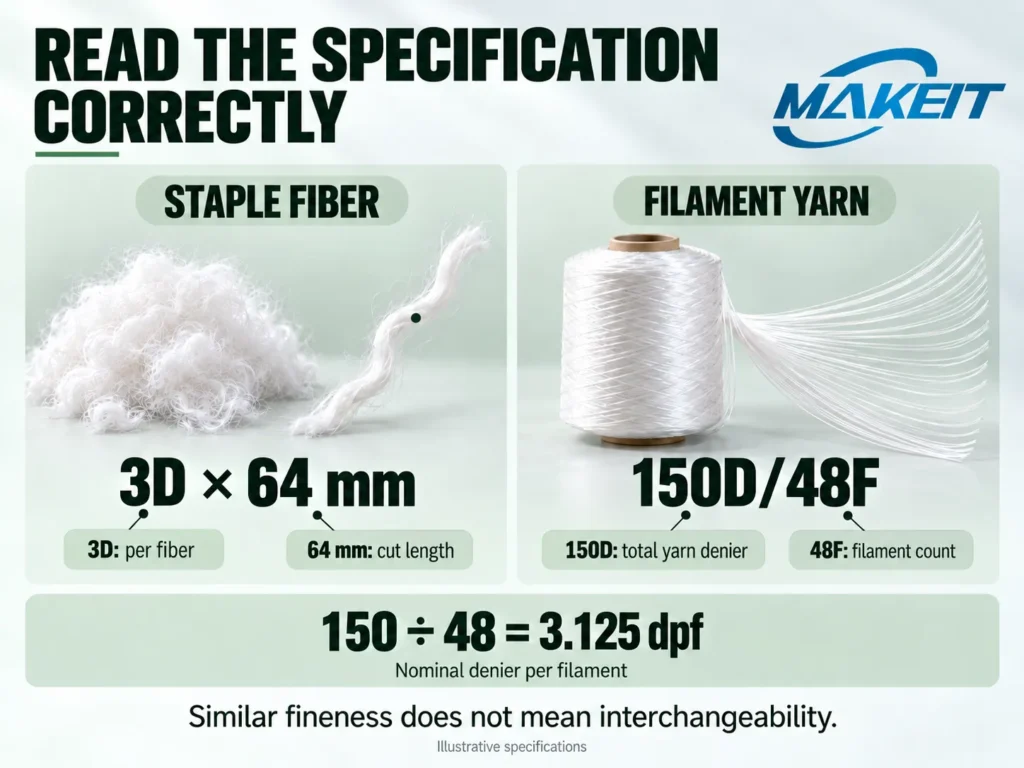
Staple fiber: denier or dtex plus cut length
For PSF, denier or dtex describes a single fiber. Cut length gives its length.
You need both to judge whether a fiber suits your process.
Filament yarn: total denier plus filament count
For filament yarn, the first number is usually the total denier of the whole bundle. The filament count tells you how many filaments make up that bundle.
You need both numbers to know how fine each filament is.
Worked example: similar fineness does not mean interchangeability
Illustrative specifications, not a MAKEIT product offer.
| Illustrative specification | What it describes | What it does not establish |
|---|---|---|
| PSF: 3D × 64 mm | A nominal 3 denier per fiber, cut to 64 mm | The total denier of a finished yarn, or whether the fiber suits a given line on its own |
| Filament yarn: 150D/48F | A bundle with a nominal total of 150 denier, made of 48 filaments | That each filament is 150 denier |
Let’s run the numbers:
Nominal denier per filament = 150 ÷ 48 = 3.125 dpf
On paper, 3 denier and 3.125 dpf look close. But that’s a nominal average.
The two materials still differ in length form, crimp, yarn structure, and processing fit. Similar fineness does not make them substitutes.
For more on how fineness and length interact in staple fiber, see polyester staple fiber denier and cut length.
Which Material Fits Your Production Route?
Start from your equipment and your product. Then work backward to the material.
This table gives the first purchasing question for each common scenario:
| Production scenario | First purchasing question | What to confirm |
|---|---|---|
| Staple-spinning mill | Will you buy PSF for your existing spinning process? | Equipment, fiber specification, blend requirements, target yarn |
| Weaving or knitting mill buying yarn | Which finished or pre-processing yarn should you buy? | Yarn type, linear density, preparation steps, target fabric |
| Carded nonwoven producer | Does PSF fit your carding and bonding process? | Fineness, cut length, crimp, process requirements |
| Opening or filling operation | Which filling staple suits your actual process? | Opening behavior, target filling performance, product requirements |
Not every nonwoven route buys PSF. Continuous-web processes such as spunbond are different from buying yarn packages and carding them.
Also, none of these rows describes a solution MAKEIT has validated for your plant. Confirm each fit with your own trials.
If you run a spinning mill, see our polyester staple fiber for spinning range, which covers pure polyester spinning and blends with cotton or viscose.
For carded nonwoven work, read polyester staple fiber for nonwoven applications.
How to Compare Costs at the Same Production Stage
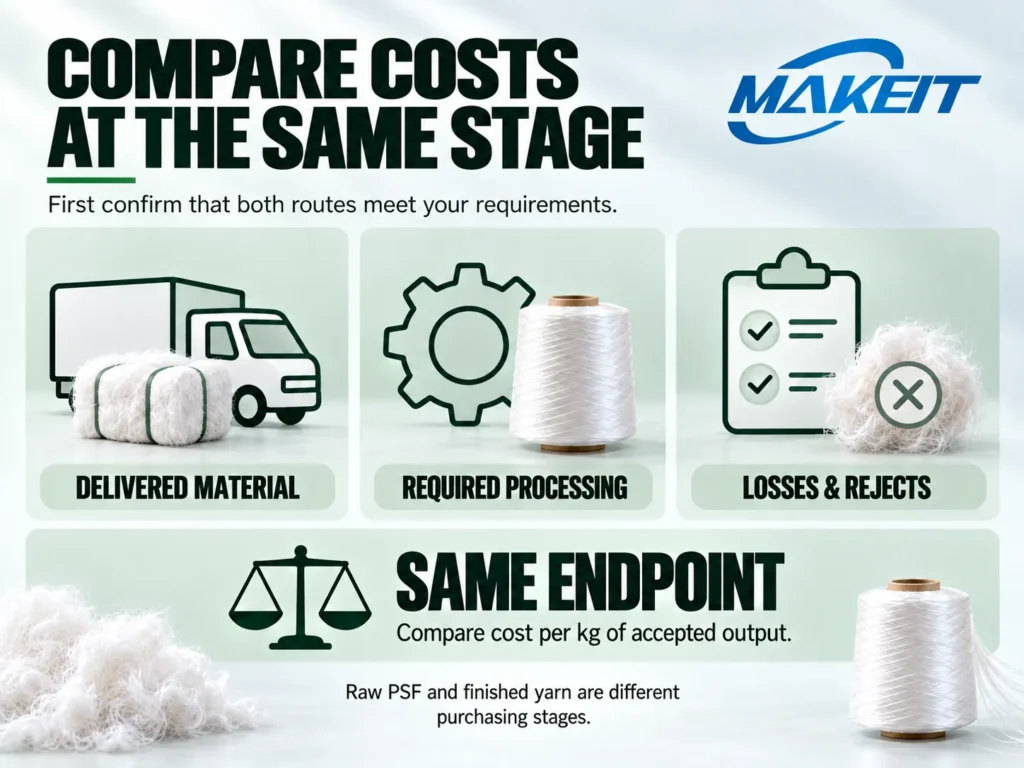
A cost comparison is only fair if both routes end at the same point.
Don’t compare a PSF price per kilogram with a filament yarn price per kilogram. They sit at different stages of the supply chain.
Define the comparison endpoint
First, confirm that both routes can meet your product requirements. Only then compare costs.
An example endpoint: “accepted yarn that meets the agreed requirements and is ready for weaving.”
Even with matched cost stages, the two yarns won’t necessarily perform the same.
Include conversion costs and usable output
| Cost item | PSF-to-spun-yarn route | Suitable filament-yarn route |
|---|---|---|
| Delivered purchase cost | Included | Included |
| Required conversion before the endpoint | In-house or outsourced spinning, and so on | Any necessary further processing, depending on the form purchased |
| Losses and rejected output | Use your actual records | Use your actual records |
| Output denominator | Accepted output weight | Accepted output weight |
Here’s the formula:
Cost per kg of accepted output = Total relevant cost to the defined stage ÷ Accepted output in kg
Keep the weight basis consistent. Purchased weight, net weight, and accepted output weight are three different numbers.
If you count the recovery value of waste, apply it the same way in both routes. Otherwise you deduct it twice, or count the loss twice.
We haven’t included sample prices or savings percentages. They’d depend on your market, grades, and conversion setup. If you build a numerical example internally, label it as an assumption and list the inputs.
What Should Buyers Verify Before a Bulk Order?
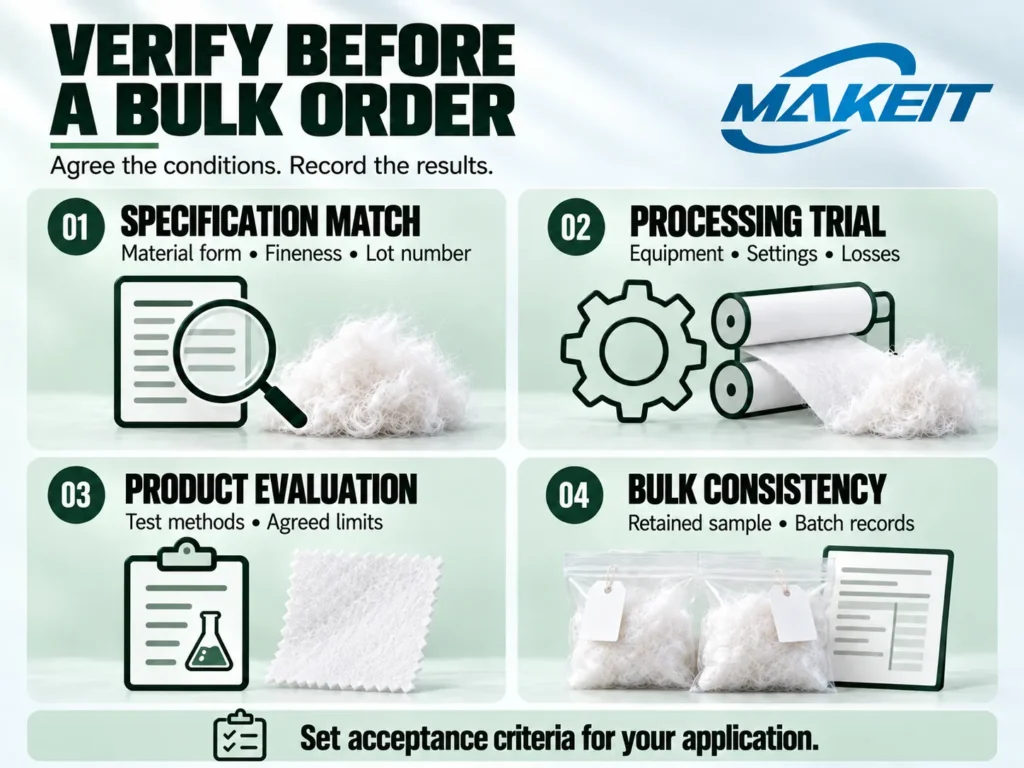
Before a bulk order, turn your verification plan into a record both sides can fill in.
Choose tests by end use. Not every material needs the same set, and no universal pass mark exists. Agree the limits with your supplier based on your product requirements.
Here’s a worksheet you can copy:
| Verification item | Conditions or information to record | Agreed acceptance criterion | Result | Decision |
|---|---|---|---|---|
| Specification match | Material form, fineness, cut length or filament count, lot number | The technical specification both parties confirmed | To complete | Accept / Review |
| Processing trial | Equipment, settings, running behavior, losses | Your baseline and the agreed conditions | To complete | Accept / Review |
| Target-product evaluation | Appearance, strength, shrinkage, or other items that suit the end use | Agreed methods and limits | To complete | Accept / Review |
| Bulk consistency | Sample versus delivered lot, sampling plan, records | The agreed bulk inspection requirements | To complete | Accept / Review |
Keep a retained sample. Record the lot number and trial conditions for every run, so later lots can be compared against it.
This table is a purchasing worksheet. It isn’t a certification or a performance guarantee.
Frequently Asked Questions
Is polyester staple fiber the same as polyester spun yarn?
No. PSF is the cut fiber used as an input. Polyester spun yarn is the yarn produced from staple fibers after spinning. They sit at different supply-chain stages and are specified differently.
Can staple fiber replace filament yarn on the same production line?
Usually not directly, because the two enter the process in different forms. Switching means confirming the production route, any conversion steps, and whether the result meets your target product.
Does the same denier mean the materials are equivalent?
No. Denier on a staple fiber describes one fiber. Total denier on a filament yarn describes the whole bundle. Divide total denier by filament count for a nominal per-filament value, as in the 150D/48F example above.
What information should I send when requesting a PSF quotation?
Send your end use, production process, current specification, blend requirements, target performance, and estimated purchasing volume. That lets the supplier assess fit before quoting.
Discuss Your PSF Requirements with MAKEIT
Evaluating polyester staple fiber for a spinning route? Send us:
End use and production process
Current fiber specification, if available
Blend requirements and target performance
Estimated purchasing volume
Start from the Textile Fiber page.