If you work anywhere near textile manufacturing, you’ve probably used the word “fiber” a hundred times.
Without really defining it.
That’s fine, most people don’t need the technical definition until they’re staring at a spec sheet trying to figure out why one material behaves differently than another on the production line.
So here’s the short version. Then we’ll get into what actually matters.
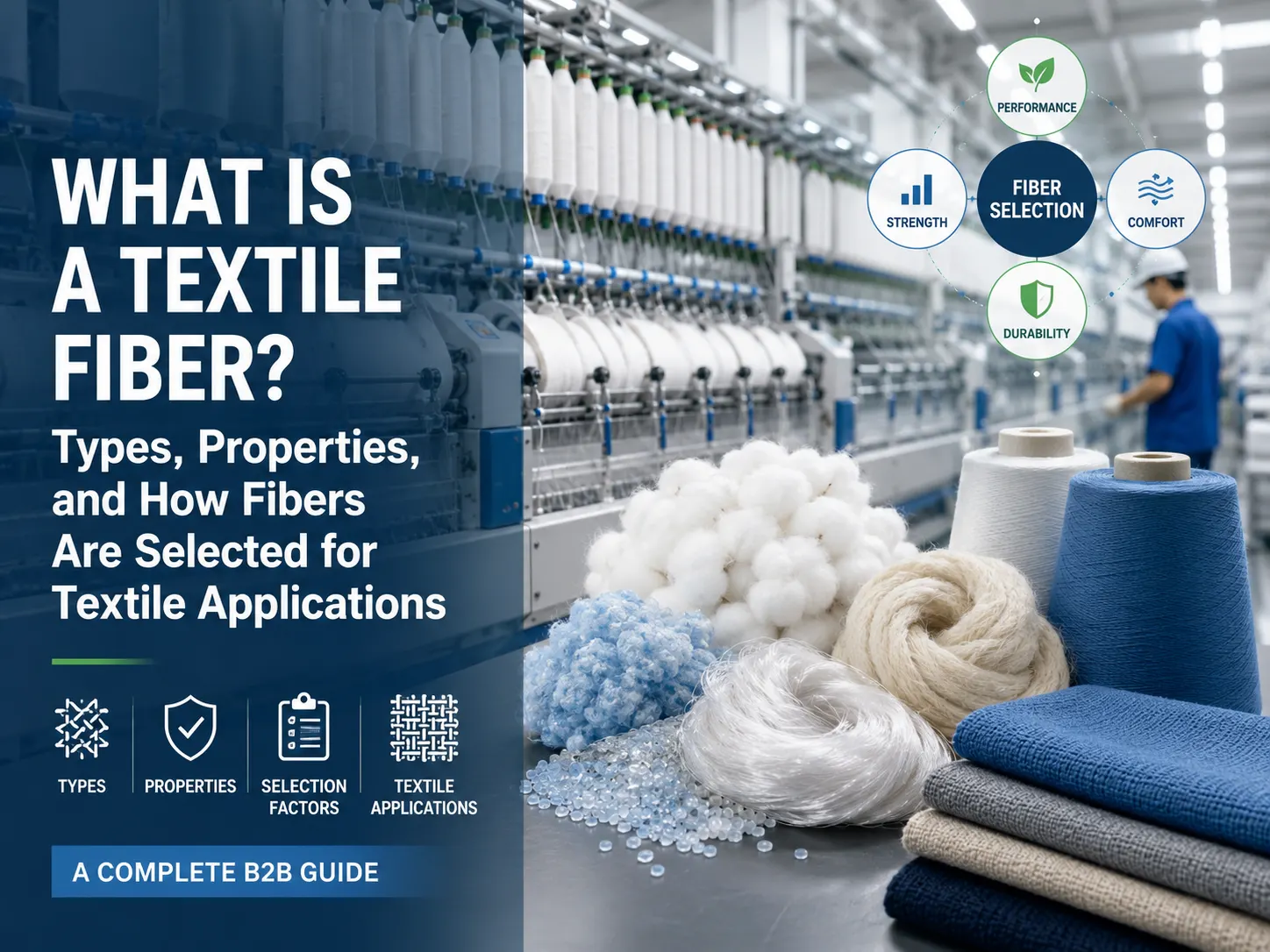
A textile fiber is a flexible, hair-like material that can be spun into yarn, formed into nonwoven fabric, or processed into a finished textile product. It can come from nature, be regenerated from a natural polymer, or be built entirely from synthetic material.
But here’s the part most guides skip: what actually makes a fiber “work” for your application isn’t where it came from. It’s a specific set of properties — length, strength, flexibility, and consistency.
Let’s break it down.
What Is a Textile Fiber?
Fiber Is Where Everything Starts
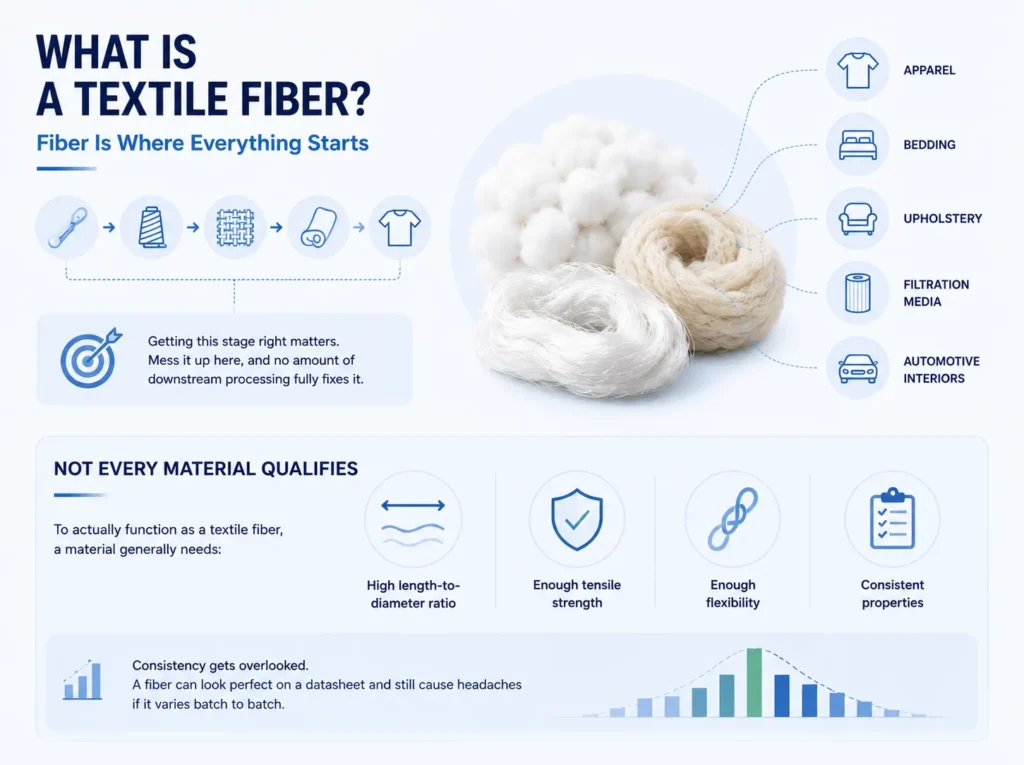
Every yarn. Every fabric. Every nonwoven material. All of it starts as fiber.
Apparel, bedding, upholstery, filtration media, automotive interiors — trace any of them back far enough, and you land on raw fiber before anything gets spun, woven, or bonded.
That’s why getting this stage right matters so much. Mess it up here, and no amount of downstream processing fully fixes it.
Not Every Material Qualifies
Fine and flexible isn’t enough. To actually function as a textile fiber, a material generally needs:
- A high length-to-diameter ratio — long and thin relative to its width
- Enough tensile strength to survive spinning, weaving, or bonding
- Enough flexibility to bend and twist repeatedly without breaking
- Consistent properties across a production run
That last one gets overlooked constantly. A fiber can look perfect on a datasheet and still cause headaches if it varies batch to batch.
The Main Types of Textile Fibers
Fibers fall into three broad buckets, based on where they come from.
| Category | Source | Common Examples | Typical Characteristics |
|---|---|---|---|
| Natural fibers | Plants or animals | Cotton, flax, wool, silk | Comfort, breathability, natural hand feel |
| Regenerated fibers | Natural polymers, chemically processed | Viscose, lyocell | Cellulosic feel, more manufacturing control |
| Synthetic fibers | Man-made polymers | Polyester, nylon, acrylic | Engineered for durability and consistency |
The right category is only the starting point. Fiber form, specification, and processing conditions are what actually determine whether a fiber fits a specific end use.
Natural Fibers
Cotton and flax come from plants. Wool and silk come from animals. Each brings its own strength — cotton breathes, wool insulates, silk drapes. The tradeoff is variability. These fibers are grown, not manufactured, so consistency is harder to control.
Regenerated Fibers
Viscose and lyocell start life as natural polymers, usually wood pulp, then get chemically processed into fiber form. You get a soft, cellulosic feel with more production consistency than raw natural fiber.
Synthetic Fibers
This is where it gets interesting for manufacturers. Polyester, nylon, and acrylic are built from man-made polymers, which means fiber structure, fineness, and finish can all be engineered to spec.
Polyester has become one of the most widely used synthetic fibers for exactly this reason. It’s adaptable.
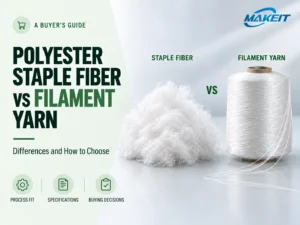
Staple Fiber vs. Filament Fiber
Here’s a distinction that trips up a lot of people new to sourcing: fiber type and fiber form are not the same thing.
Staple Fiber
Cut to a specific, finite length. Gets spun into yarn or used directly in filling and nonwoven applications. Polyester staple fiber is the classic example — produced, then cut to a defined length before anything else happens to it.
Filament Fiber
Continuous. No defined endpoint, at least in theory. Typically used for filament yarns and technical fabrics where a continuous strand adds strength or a cleaner surface finish.
Quick Comparison
| Factor | Staple Fiber | Filament Fiber |
|---|---|---|
| Fiber length | Cut to a defined length | Continuous |
| Typical processing | Spinning, filling, nonwoven | Filament yarn processing |
| Common applications | Yarn, filling, insulation, nonwovens | Apparel fabric, technical fabric |
| Example | Polyester staple fiber | Polyester filament yarn |
Want the full picture on how staple fiber is produced and specified? We cover that in our guide to polyester staple fiber types, uses, and selection.
The Properties That Actually Matter
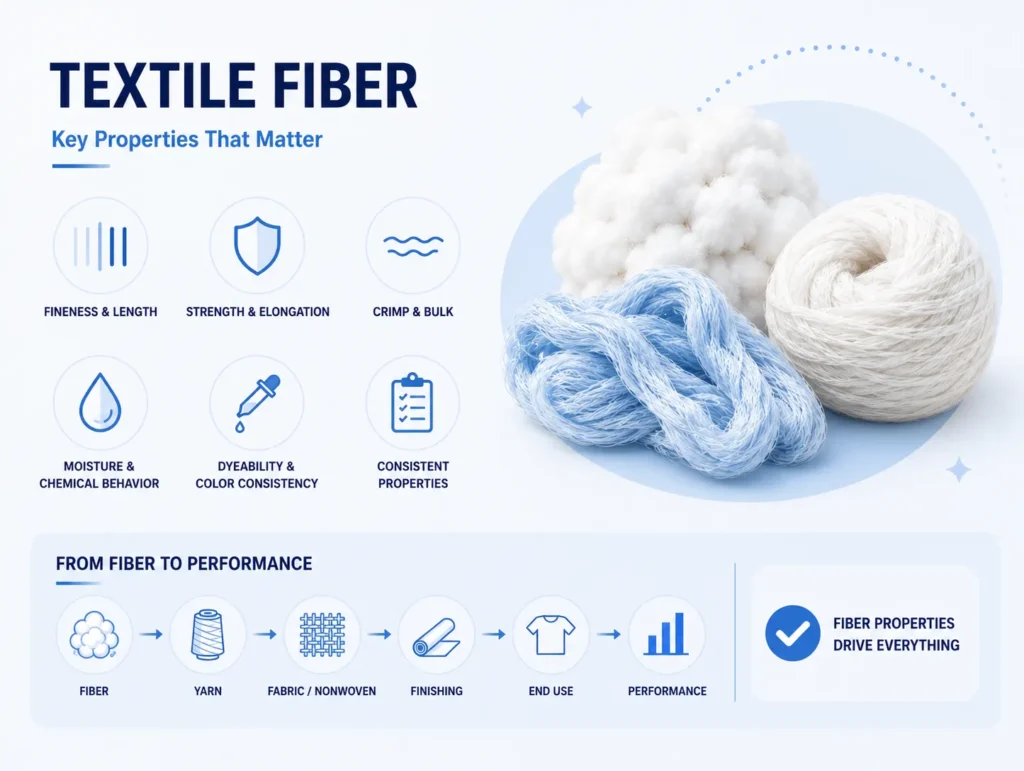
Here’s where most basic fiber overviews stop short. “Polyester is strong” or “cotton is breathable” doesn’t tell you much on its own. Here’s what actually drives real-world performance.
Fineness and Fiber Length
Fineness — usually measured in denier — affects softness and how the fiber covers in a yarn or web. Finer fibers feel softer. Coarser fibers add bulk and structure. Fiber length affects how well it cards, spins, or forms a stable web.
Tenacity and Elongation
Tenacity is strength: how much force before it breaks. Elongation is stretch: how far it goes before that happens. Neither number matters in isolation — the right balance depends entirely on the application. A filling fiber and an automotive fiber don’t need the same profile.
Crimp, Bulk, and Recovery
Crimp is the built-in waviness in a fiber, and it drives bulk, cohesion, and resilience. This is huge for filling applications. Good crimp means better loft retention after compression — exactly what you want in a pillow that gets sat on every day.
Moisture, Heat, and Chemical Behavior
Moisture absorption affects comfort and dry time. Thermal behavior matters anywhere heat-setting or thermal bonding is involved. Chemical resistance determines how well a fiber survives washing, UV exposure, or harsher industrial environments.
Dyeability and Color Consistency
For branded products, dyeability and batch-to-batch color match can matter just as much as any mechanical property on the spec sheet.
Fiber Properties Aren’t the Whole Story
Here’s something easy to miss: fiber properties are the starting point, not the finish line.
Crimp, denier, and tenacity all shape the final product. But so do yarn construction, fabric or nonwoven processing, finishing, and end-use conditions. Two products made with the exact same fiber can still perform differently once the downstream process changes.
| Fiber Property | What It Can Influence | What Else Must Be Considered |
|---|---|---|
| Fineness | Softness, surface feel, coverage | Yarn count, fabric density, finishing |
| Crimp | Bulk, cohesion, resilience | Carding method, filling technique, compression over time |
| Tenacity | Strength and durability | Yarn twist, fabric construction, seam design |
| Thermal behavior | Bonding and dimensional stability | Oven temperature, dwell time, blend ratio |
This is exactly why a datasheet alone rarely tells the full story. It narrows your options. It doesn’t replace testing under your actual production conditions.
How to Actually Select a Fiber for Your Application
Stop asking “what’s the best fiber.” Start asking “what does my application actually need.”
The fiber choice usually narrows itself down from there.
| End Use | Start With These Requirements | Relevant Fiber Considerations |
|---|---|---|
| Apparel and yarn | Comfort, appearance, wash durability | Fineness, moisture behavior, dyeability, strength |
| Bedding and filling | Loft, softness, long-term recovery | Hollow vs. solid structure, crimp, denier, finish |
| Nonwovens | Web formation, bonding strength, stiffness | Cut length, crimp, thermal response, binder compatibility |
| Automotive and technical textiles | Durability, compliance, batch consistency | Strength, heat resistance, flame-retardant options, test documentation |
| Sustainable product lines | Traceability, recycled-content targets | Material source, certification scope, batch documentation |
A couple of things worth flagging here.
For filling and bedding, hollow conjugated fiber structures usually beat solid fiber — they hold loft better after repeated compression. For nonwovens, cut length and thermal response matter more than they do for filling applications.
And if sustainability requirements are part of your brief, recycled polyester staple fiber deserves a closer look. We go deep on sourcing, applications, and how to verify recycled-content claims in our recycled polyester staple fiber buyer’s guide.
Before You Approve Any Fiber: A Real-World Testing Workflow
Most fiber sourcing problems don’t come from a bad fiber. They come from skipping a step here.
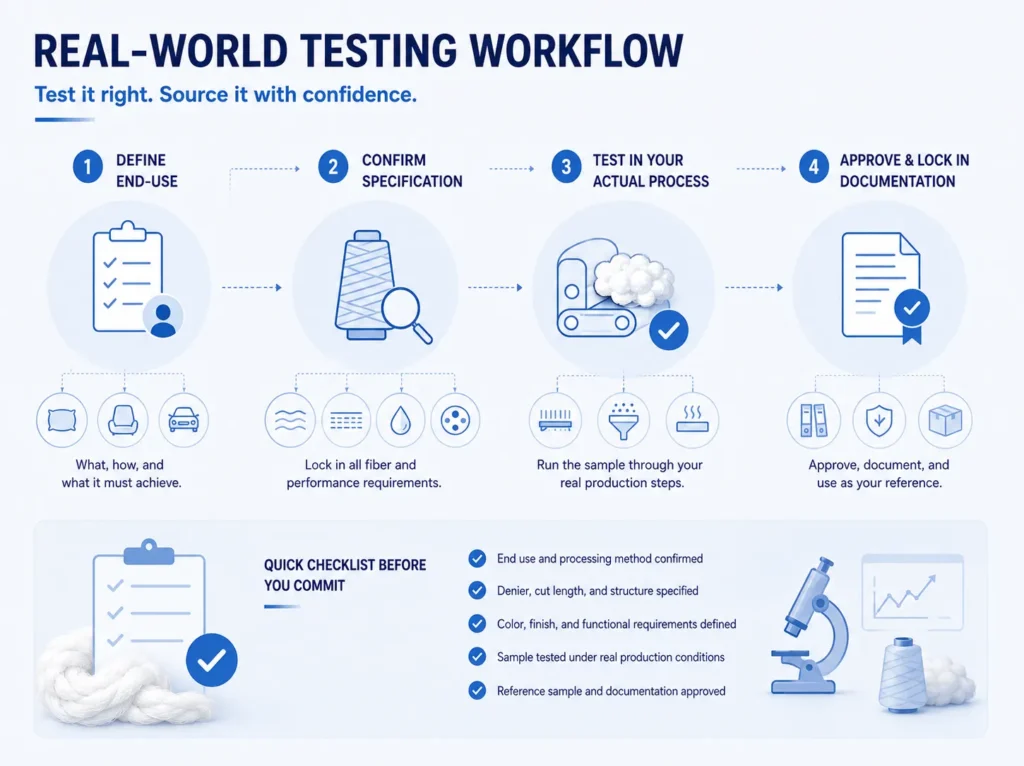
Step 1: Define the End-Use Requirement
What’s the final product? What process will it go through? What performance or compliance target does it need to hit?
Step 2: Confirm the Baseline Specification
Fiber type, denier, cut length, structure, color, finish, and any functional requirements — nail all of this down before you request a sample.
Step 3: Test a Representative Sample in Your Actual Process
This is the step everyone wants to skip. Don’t. A sample that looks fine on paper can behave completely differently once it hits your carding line, filling process, or thermal bonding step. Test it the way you’ll actually use it.
Step 4: Approve a Reference Sample and Lock In Documentation
Once a sample passes, approve it formally as your reference point. For repeat orders, use that reference to set incoming inspection criteria. This catches batch drift early — before it becomes a production problem.
Quick checklist before you commit to bulk sourcing:
- End use and processing method confirmed
- Denier, cut length, and structure specified
- Color, finish, and functional requirements defined
- Sample tested under real production conditions
- Reference sample and documentation approved
Why Polyester Staple Fiber Shows Up Everywhere
Among synthetic fibers, polyester staple fiber covers an unusually wide range of applications. There’s a simple reason for that: denier, cut length, crimp, structure, and finish can all be adjusted.
Same base material. Different specs for different jobs — spinning, filling, nonwoven, technical.
That flexibility is exactly why MAKEIT produces multiple PSF variants instead of one standard product, including virgin, recycled, hollow conjugated, low melt, and functional options. Still narrowing down which type fits your application? Our polyester staple fiber guide breaks down the types and how to choose between them.
FAQ
What is a textile fiber?
A flexible, hair-like material that can be spun into yarn or processed into fabric or nonwoven material. It can be natural, regenerated, or synthetic.
What makes a material suitable for textile use?
A high length-to-diameter ratio, enough tensile strength to survive processing, sufficient flexibility, and consistent properties across a production batch.
What is the difference between natural and synthetic textile fibers?
Natural fibers come from plants or animals and offer properties like breathability, but with more inherent variability. Synthetic fibers are engineered from man-made polymers, giving more control over consistency and specific performance traits.
Is polyester a textile fiber?
Yes. It’s a synthetic fiber produced as staple fiber (cut to length) or filament fiber (continuous), depending on the application.
What is the difference between staple fiber and filament fiber?
Staple fiber is cut to a set length and used for spinning, filling, or nonwoven work. Filament fiber is continuous and typically used for filament yarns and technical fabrics.
How do manufacturers choose a fiber for a textile application?
They start with the end-use requirement, confirm a baseline spec, test a representative sample under real production conditions, then approve a reference sample before scaling up.
Related Guides
Work With MAKEIT for Textile Fiber Solutions
There’s no such thing as the “best” textile fiber. Only the fiber that’s correctly matched to your application, your process, and your performance requirements.
MAKEIT manufactures a range of polyester staple fiber solutions — virgin, recycled, hollow conjugated, low melt, dope-dyed, and functional. Our team can help you narrow down the right spec, test it against your actual process, and get you the documentation your project needs.