MAKEIT Fiber at Fast Textile 2026: A First-Hand Booth Recap from Łódź, Poland
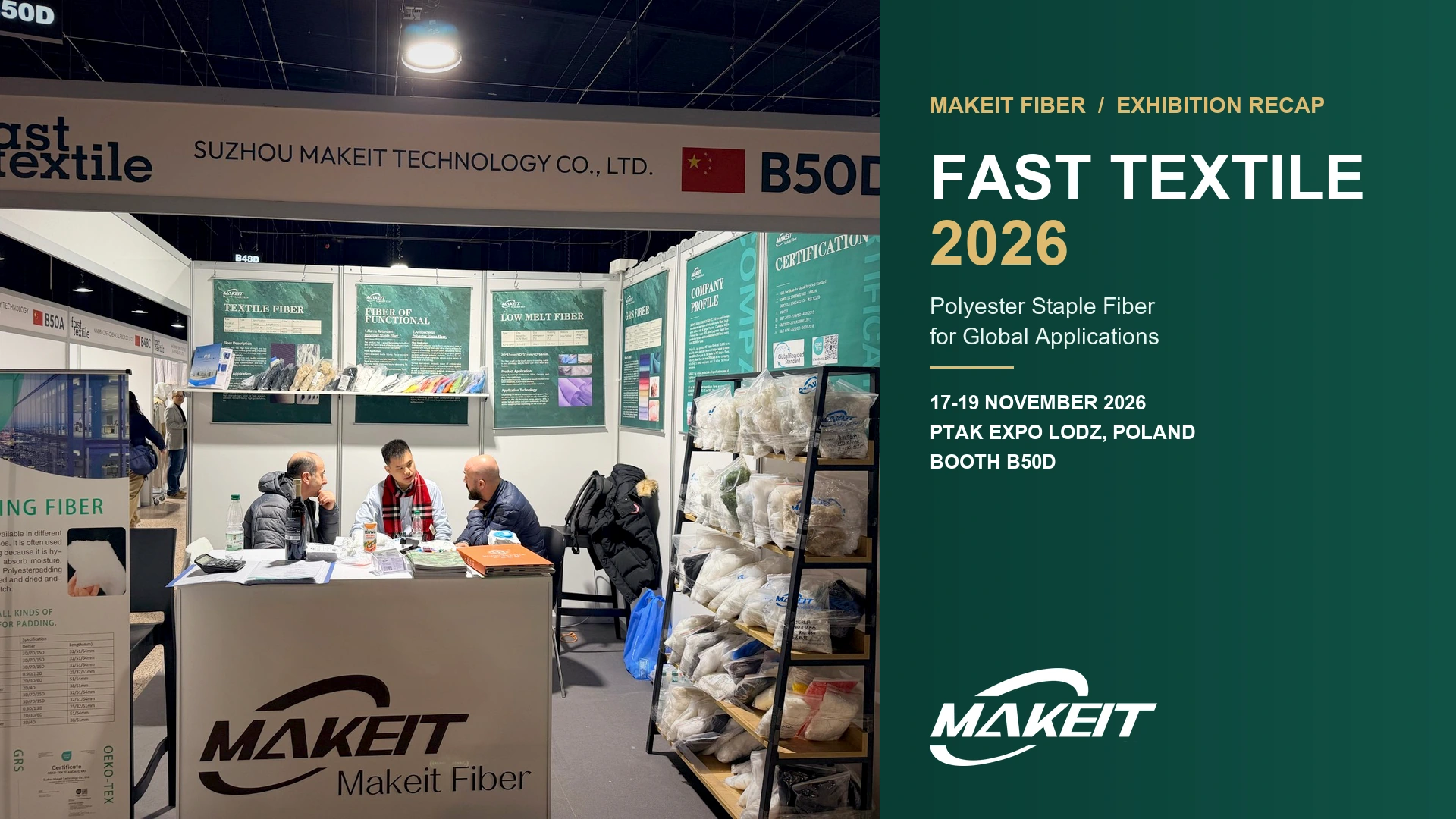
MAKEIT Fiber, the polyester staple fiber brand of Suzhou Makeit Technology Co., Ltd., exhibited at Fast Textile 2026 from 17 to 19 November at Ptak Expo Łódź in Rzgów, Poland. Our team was at Booth B50D with fiber samples, product boards and certification documents, and spent the three days talking with textile, filling and nonwoven buyers from across the region.
This is a first-hand recap written by the team that staffed the booth. It covers what we brought, which questions buyers actually asked, and what the certification documents on the wall meant in those conversations. If you are comparing polyester staple fiber suppliers for 2027 production, the specification notes below are the ones we used at the show.
Fast Textile 2026: event details
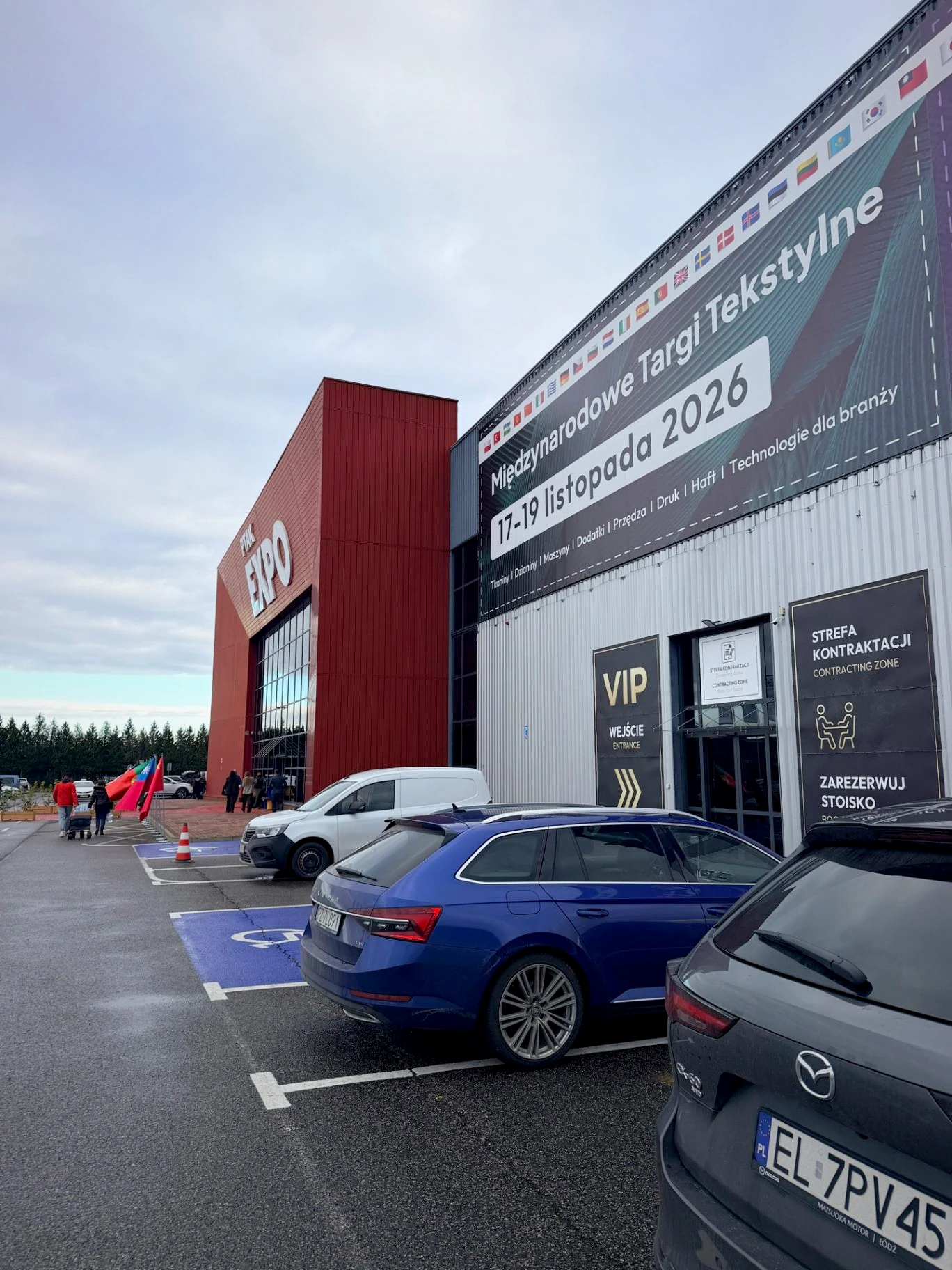
Fast Textile 2026 ran alongside Tekstyline 2026 at Ptak Expo Łódź, an exhibition and conference center in Rzgów, near Łódź, Poland. The halls brought together fabric, yarn, nonwoven and textile-machinery suppliers, with a large share of visitors coming from European markets.
| Item | Detail |
|---|---|
| Exhibition | Fast Textile 2026 (held with Tekstyline 2026) |
| Dates | 17–19 November 2026 |
| Venue | Ptak Expo Łódź, Tuszyniska 72/74, 95-030 Rzgów, Poland |
| MAKEIT booth | B50D |
| Exhibitor | Suzhou Makeit Technology Co., Ltd. |
| Brand | MAKEIT Fiber — “Your Fiber Solution” |
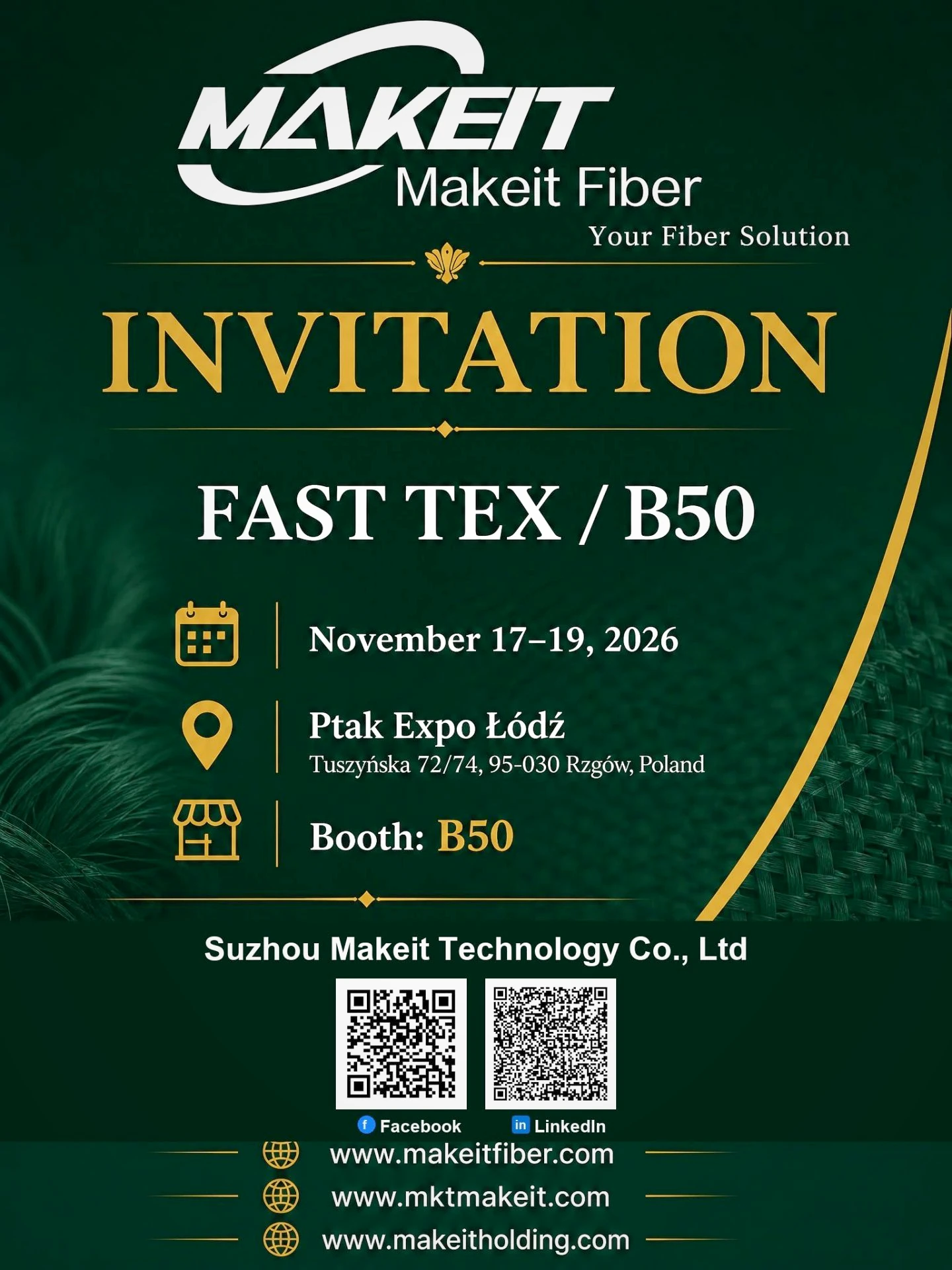
The invitation we sent before the show listed our stand as B50. The on-site booth signage and hall directory showed B50D, which is the number to use if you are looking for our stand in event listings or follow-up emails.
What MAKEIT brought to Booth B50D
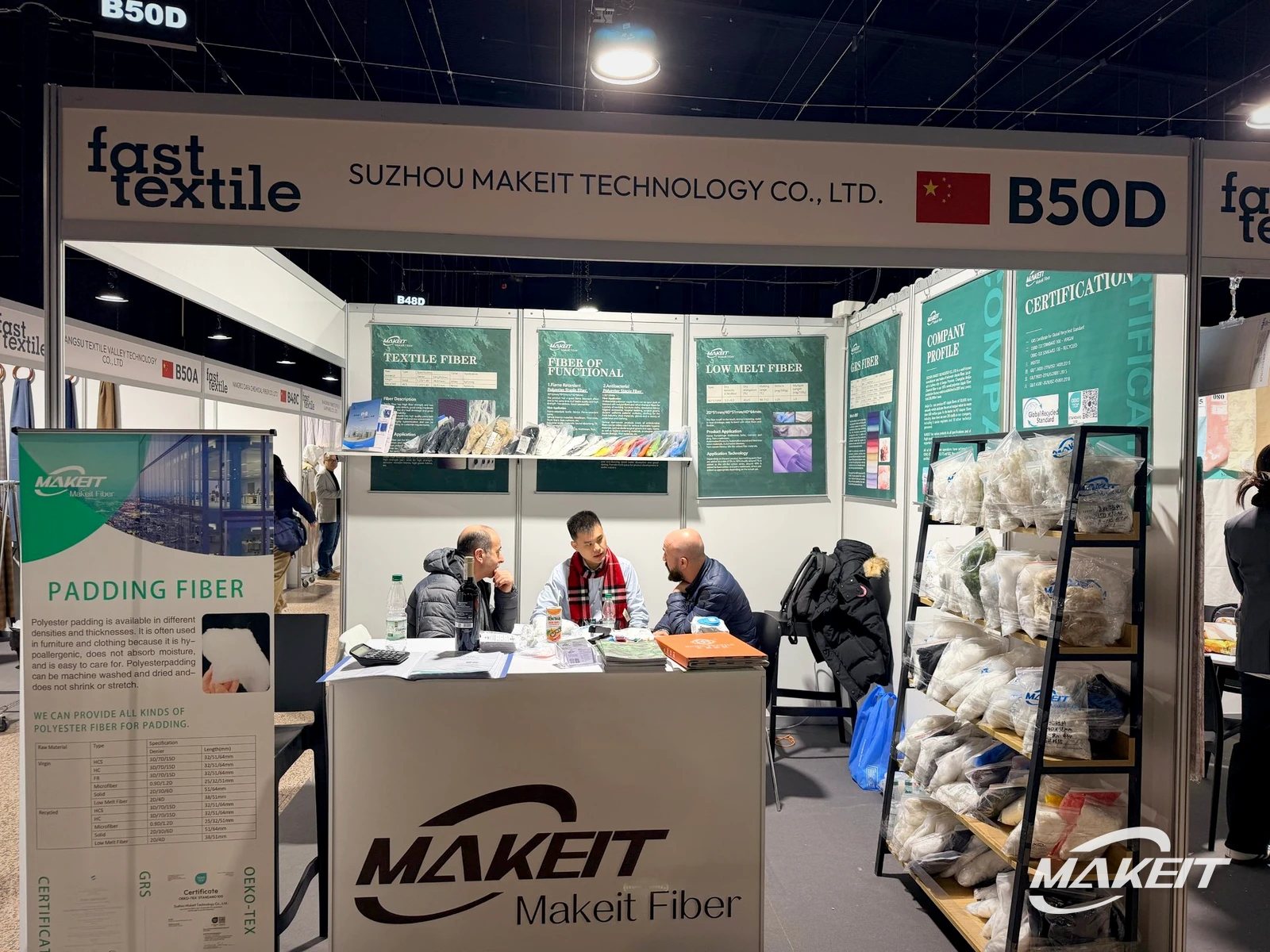
Our stand was built around one idea: buyers should be able to see, touch and ask about the exact fiber they would order. Three display boards carried the core range — Textile Fiber, Fiber of Functional, and Low Melt Fiber — with a separate company profile and certification board beside them. Sample bags of fiber were arranged on open shelves so visitors could handle them during the discussion.
Four product directions drew the most attention at the booth.
Textile fiber: the specifications buyers asked for first
The Textile Fiber board listed the baseline grades clearly: virgin and recycled raw material, solid and hollow-conjugated (HCS) fiber types, with denier options of 1.2D and 1.4D and cut lengths of 38 mm and 51 mm. The stated application was spinning.
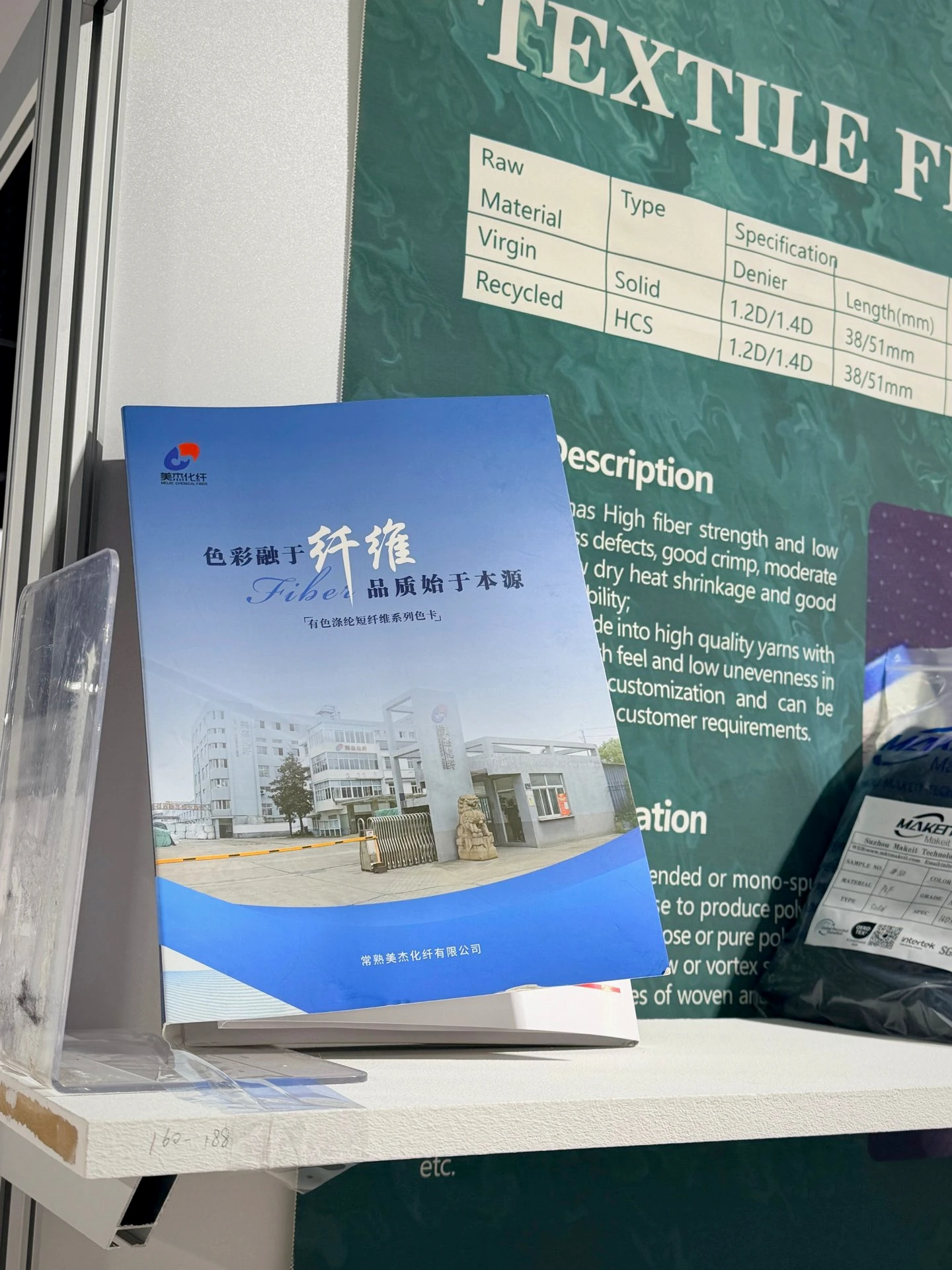
In practice, almost every spinning-mill visitor started with the same two questions: what denier, and what cut length. That matches how we describe fiber selection on our textile fiber page — fineness, length, tenacity, elongation and finish need to be read together, not one at a time. Where a buyer had a target yarn count in mind, we asked for the blend and spinning system before suggesting a grade.
Functional fiber: flame retardant and antibacterial grades
The Functional Fiber board listed two grades by name: a flame-retardant polyester staple fiber in 100% polyester, and an antibacterial polyester staple fiber in 100% PET at 1.5D × 38 mm. The board also pointed to end uses in bedding, medical textiles, hygiene nonwovens and protective textiles.
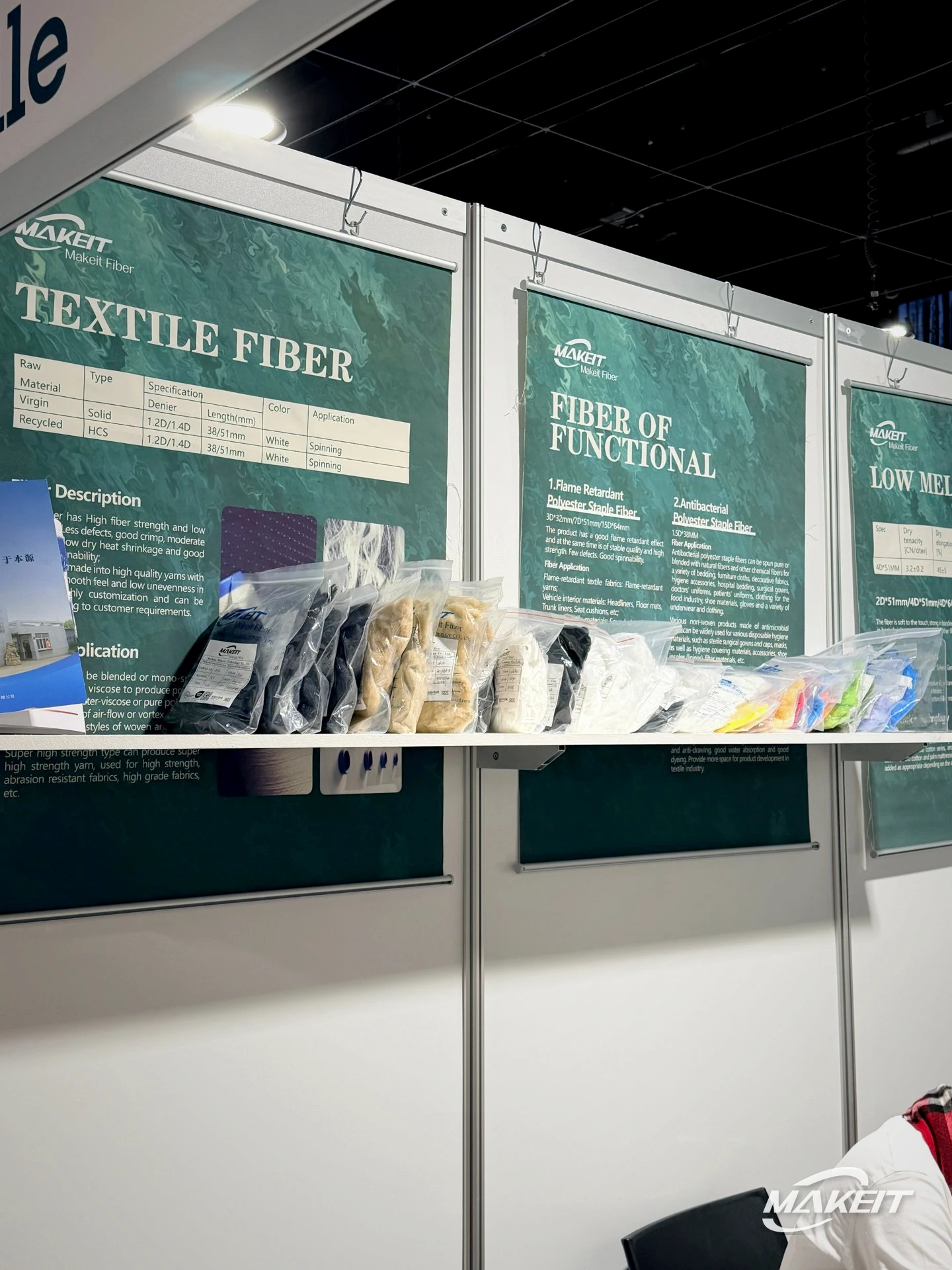
A point we repeated at the stand: a functional claim on a fiber is not the same as a performance claim on a finished product. Flame-retardant behavior depends on the test method, blend ratio and fabric construction. Antibacterial performance depends on the organism tested and the durability conditions. We asked buyers to define the finished-product test before selecting a grade, rather than choosing on the fiber description alone. Our functional fiber page carries the same caveat.
Low melt fiber and padding fiber
Low Melt Fiber had its own board, covering bonding fiber used in padding, thermal insulation and nonwoven structures. The padding-fiber stand nearby described a BPA-free polyester padding available in different deniers and thicknesses, intended for furniture, bedding and clothing, and noted that it is machine washable, dries quickly and does not shrink or stretch.
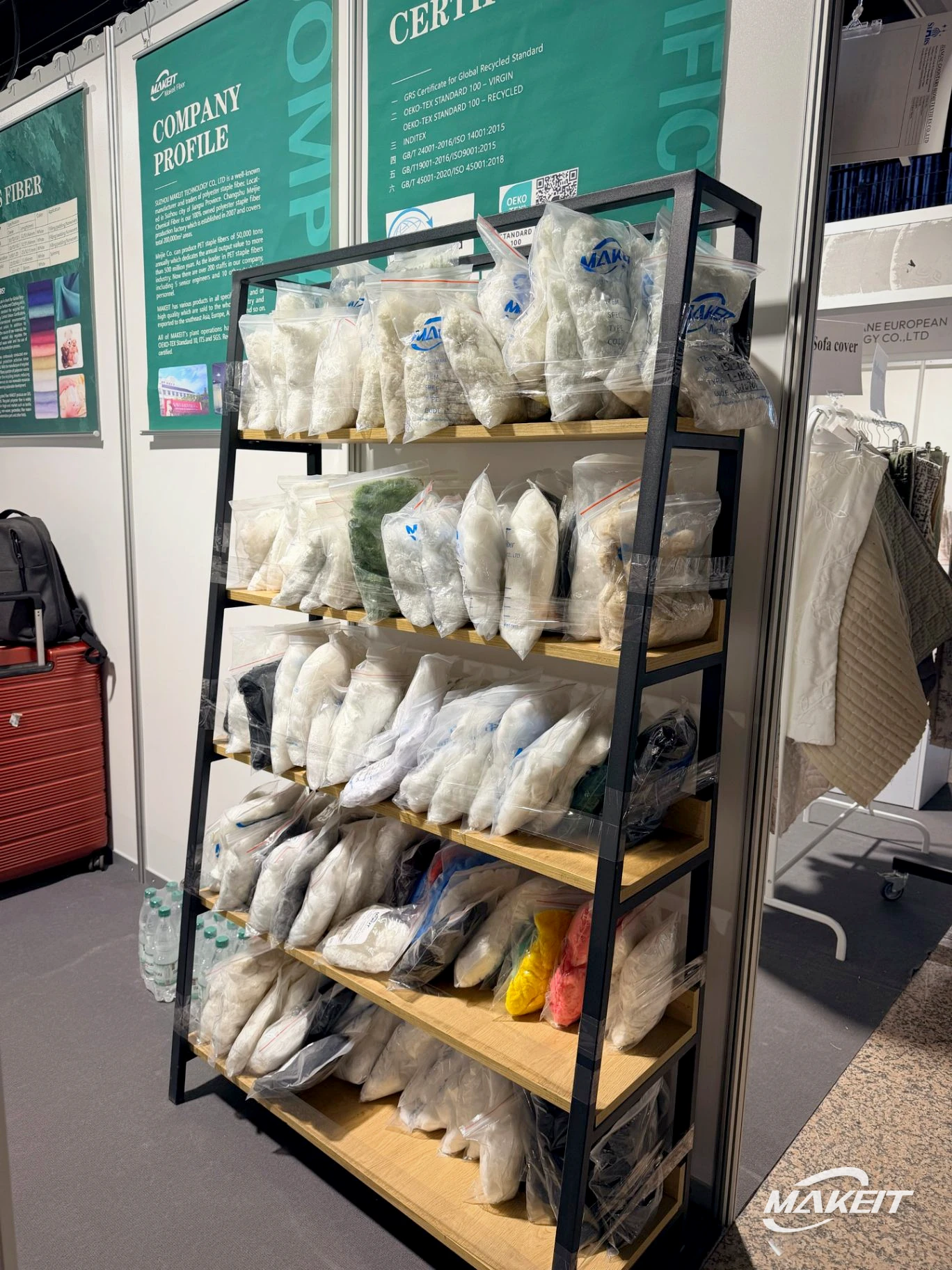
For buyers in filling and bedding applications, the practical question was rarely “which fiber is best” and more often “which denier and which cut length fits our opening and carding line.” That is the same logic we use in our hollow conjugated fiber page and low melt fiber page.
Recycled fiber and GRS documentation
Recycled polyester staple fiber was represented on the stand through our GRS-related materials, and it was the topic that generated the most document requests. Buyers from European markets asked to see the current scope certificate and to confirm which products and processing activities were covered.
Our position at the booth was direct: for a GRS-related order, the buyer and supplier should agree on the applicable transaction documentation before the order is placed, and the scope certificate should be checked against the specific product. The same guidance is written on our GRS recycled polyester staple fiber page.
Certification documents on the wall
One thing we deliberately put at eye level was the certification board. The documents there were not generic claims — they carried certificate numbers and dates that buyers could check.
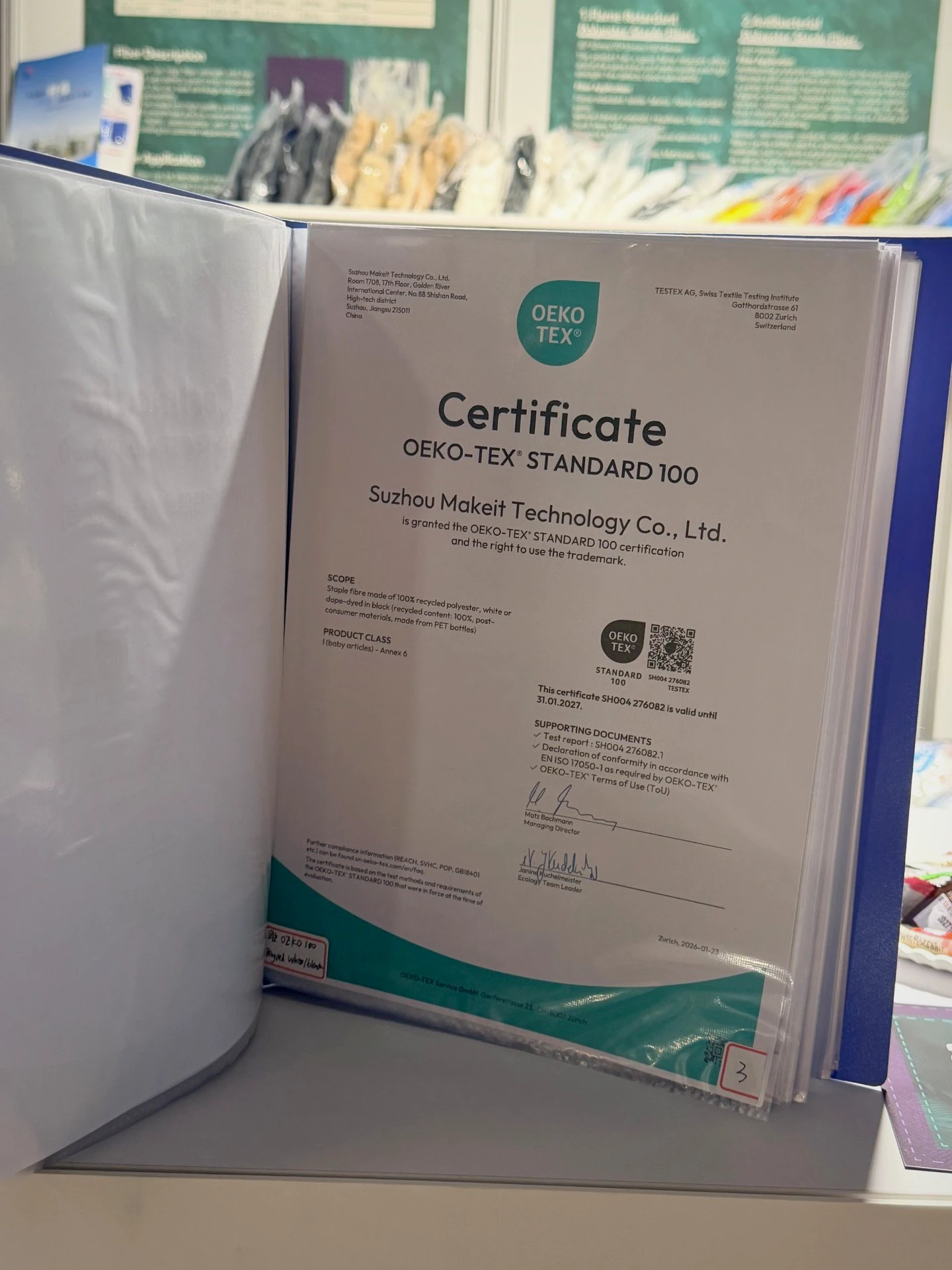
The OEKO-TEX STANDARD 100 certificate on display was issued to Suzhou Makeit Technology Co., Ltd. with certificate number SH004 276082, valid until 31 January 2027, under Product Class I (baby articles). The listed scope covered fibers and yarns made of 100% polyester, polyester-viscose, polyacrylic and polyamide, including material made from PET bottles.
We also showed GRS-related materials and third-party test documents from SGS and Intertek. The reason is simple: European and other export buyers increasingly ask for the certificate number, the issuing body and the validity date, not just a logo on a brochure. Having the documents visible at the booth turned several general conversations into specific ones.
Questions we heard at the booth
Across three days, the same practical questions came up repeatedly. These are the ones worth answering in writing for buyers who could not attend.
Which fiber should we choose for spinning? Start with the yarn count and spinning system, then confirm denier, cut length and tenacity. For our standard textile fiber, the listed grades were 1.2D and 1.4D at 38 mm or 51 mm.
Can you supply recycled fiber with certification documentation? Yes. Discuss the grade and destination market first, then confirm the scope certificate and the transaction documents required for the order.
What does “functional” mean on your fiber board? It refers to grades developed for flame-retardant or antibacterial requirements. The final performance has to be verified on the finished textile using the agreed test method.
Do you support custom specifications? Many grades can be adjusted. Send the end use, current specification and target performance, and we will confirm what is workable before sampling.
Who is behind the MAKEIT brand? MAKEIT Fiber is the polyester staple fiber brand of Suzhou Makeit Technology Co., Ltd. Manufacturing is supported by Changshu Meijie Chemical Fiber Co., Ltd., a wholly owned polyester staple fiber production factory.
Why we keep exhibiting face to face
A fiber sample in a bag tells you what the material looks like. It does not tell you how it runs on your line. Most of the useful conversations at Booth B50D started when a buyer put a sample in our hands and described their machine, their blend and the problem they were trying to solve.
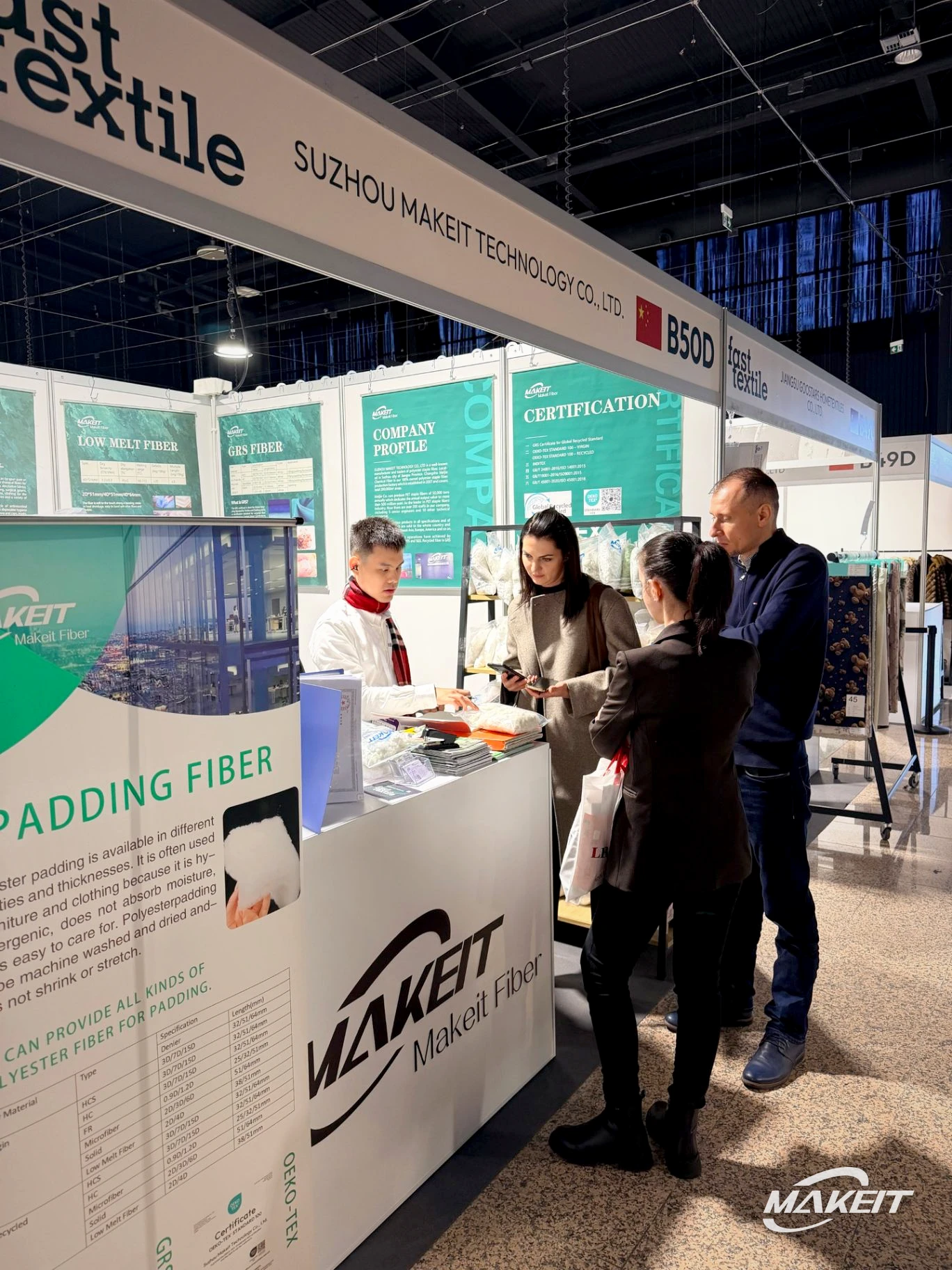
We would rather have that conversation early. It is faster than exchanging specification sheets by email, and it gives both sides something concrete to test. For buyers who missed the show, the same discussion can start with a message and a sample request.
Continue the conversation after Fast Textile 2026
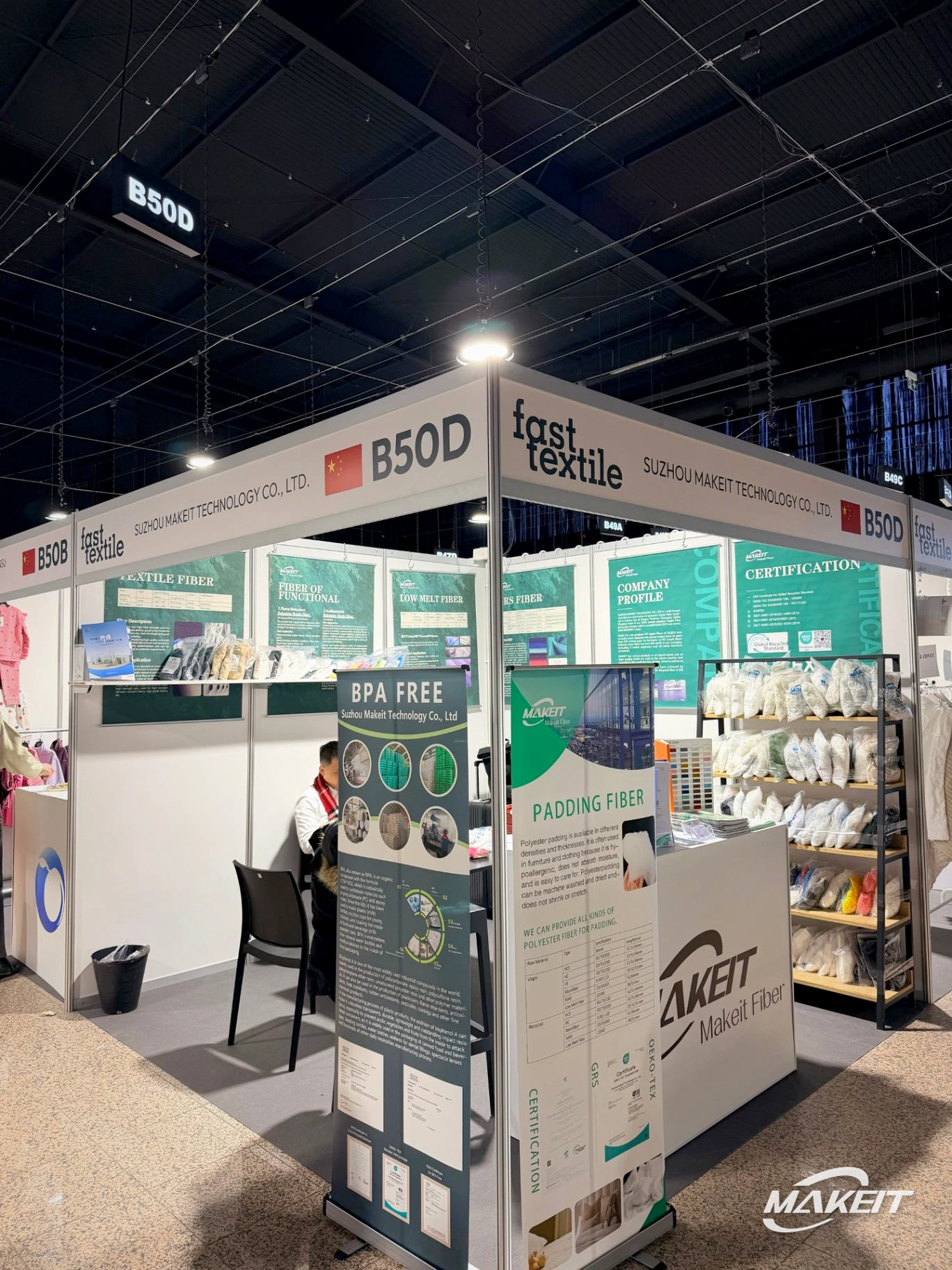
Thank you to everyone who visited Booth B50D and shared their requirements with us, and to the organizers of Fast Textile 2026 and Tekstyline 2026 for hosting the event.
If you are sourcing recycled, textile, filling or functional polyester staple fiber, tell us your end use, target specification and estimated volume. We will confirm the available grades, sample arrangements and the documentation needed for your market.
Discuss Your Fiber Requirements →